
Reviewed · COMMUNISM & PRL HISTORY TOURS
Krakow: Communism City Sightseeing Tour Nowa Huta E Golf Car
Communism-era Krakow feels surprisingly human. This Nowa Huta golf cart tour threads together wide socialist avenues, landmark squares, and everyday places, so the district feels less like a museum and more like a lived-in plan. I especially love the easy golf-cart pace, which makes it simple to see a lot in about 4 hours.
I also like how the stops balance symbolism with real-life functions, from the Monument to Solidarity to the hospital area and then out toward Zalew Nowohucki. One possible drawback: this is not a slow, story-by-story walk through one building, so if you want long indoor time at every site, some stops are more of a look-and-learn photo break.
In This Review
- Key highlights to look for on this Nowa Huta golf cart circuit
- Nowa Huta, seen the practical way (by golf cart)
- Starting at plac Centralny Imienia Ronalda Reagana: the big idea begins
- Monument to Solidarność: a small memorial with heavy meaning
- Szpital Specjalistyczny im. Stefana Żeromskiego: life still happens
- Klasztorna Street and Bulwarowa Street: older routes, softer edges
- Solidarity Avenue (formerly Lenin Avenue): one street, decades of change
- Nowe Centrum Administracyjne and the Palace of the Doges interiors
- Zalew Nowohucki: the green heart after the monumental blocks
- Łaźnia Nowa Theatre: culture in the working-class district
- Stefan Żeromski Street and Rose Avenue: the district’s axes and rhythms
- Teatr Ludowy and the Our Lady Queen of Poland Church: culture and spirituality
- Price and logistics: is $65.62 worth it for 4 hours?
- Who should book this Nowa Huta communism city tour?
- Should you book the Nowa Huta golf cart tour?
- FAQ
- How long is the Nowa Huta golf cart sightseeing tour?
- What is the price per person for this Krakow experience?
- Where does the tour start and where does it end?
- Do I get a mobile ticket?
- How large is the group on this tour?
- What are some of the main stops on the itinerary?
- Is there free cancellation?
- Is the meeting point near public transportation?
Key highlights to look for on this Nowa Huta golf cart circuit
- A 4-hour Nowa Huta route designed for wide streets so you can cover more ground without tiring out early
- Central Square and early planning points that show where the whole district idea began
- The Monument to Solidarity and Solidarity Avenue to connect political messaging with local identity
- Administrative Center interiors, the Palace of the Doges for that dramatic “wow, this is official” feeling
- Green and cultural stops after the concrete like Zalew Nowohucki and Łaźnia Nowa Theatre
- Multiple viewpoints on faith and culture including Teatr Ludowy and the Our Lady Queen of Poland Church
Nowa Huta, seen the practical way (by golf cart)
Nowa Huta is the kind of place where the city planning matters as much as the buildings. You get wide avenues, big squares, and a strong sense that everything was designed to project an idea of power and order. That makes it a perfect match for a golf cart tour, because you can actually move across the district without turning it into a marathon.
The tour is set up for an easy half-day feel, and you’re not left guessing what to do next. A small group size, with a maximum of 30 people, helps keep things orderly while still letting you enjoy the scenery. You’ll also get a mobile ticket, so you can keep everything simple on your phone.
Price-wise, it’s about $65.62 per person for a 4-hour experience. That sounds like a decision point, so here’s how I think about value: you’re paying for transportation inside a district that is built for spacing and scale, plus guided interpretation that connects street layouts to everyday life.
More Nowa Huta blocks and PRL relics:
- Krakow: Nowa Huta Guided Tour in Vintage Car
★ 4.9 · 277 reviews - Legendary Private Nowa Huta Communism Tour with Crazy Guides
★ 5.0 · 262 reviews - Nowa Huta: Steelworks Administration Buildings/Shelters Tour
★ 4.8 · 260 reviews
Starting at plac Centralny Imienia Ronalda Reagana: the big idea begins
The tour kicks off at plac Centralny Imienia Ronalda Reagana, Central Square in Nowa Huta. Even if you only pause briefly, this is a powerful starting point because it anchors the whole geometry of the district. It’s not just a place to stand and look around, it’s where the planning logic becomes visible.
From this square, you’re set up to notice how Nowa Huta works: tram tracks, major streets, and the feeling of a district that was shaped to function like a system. That matters for what you’ll learn later, especially when you reach the more administrative and symbolic sites.
This first stop also helps you reset your expectations. Central Square is more about orientation than emotion, but it gives you the reference points that make the rest of the route click.
Monument to Solidarność: a small memorial with heavy meaning
Next up is the Pomnik Solidarności, with the phrase Bądź wierny, idź associated with it. The description of this monument emphasizes how it can feel modest at first glance, almost easy to miss. Then it lands emotionally, because it’s tied to identity and lived experience in Nowa Huta.
I like this stop because it prevents the tour from becoming purely architectural sightseeing. You’re reminded that socialist city design wasn’t only about buildings, it was also about shaping people’s daily rhythms and messaging. And here, the message turns into something residents carried forward.
If you’re the type who likes to read details closely, take a slow second. Even if you only get a few minutes, this is the kind of stop where looking matters more than speed.
Szpital Specjalistyczny im. Stefana Żeromskiego: life still happens
You’ll also pass the area around Szpital Specjalistyczny im. Stefana Żeromskiego SP ZOZ in Krakowie. Instead of focusing only on the monumental, this stop points you toward a quieter kind of significance, where the district’s everyday needs show through.
There’s something grounding about seeing a setting that has less overt grand-staircase energy and more real-world utility. It helps balance the message-driven spaces you’ll see elsewhere.
You’re meant to notice contrast too, the idea that not every building in a planned district communicates the same way. That’s a big part of understanding Nowa Huta as it actually is.
Still tacked up around Krakow


Klasztorna Street and Bulwarowa Street: older routes, softer edges
The tour includes Klasztorna Street, described as one of the oldest and most symbolic arteries in this part of Kraków. When a planned district grows around older streets, you can feel the layers of time. Even with limited time, this is a stop that helps you connect past routes to the newer socialist layout.
Then you shift to Bulwarowa Street, where urban geometry gives way to nature and there’s a break from the heavier concrete feel. Bulwarowa is essentially your permission to breathe and reset your eyes.
If you’re photographing, these are useful transitions. You’ll go from hard lines to more open atmosphere, which helps your brain process what you’re seeing rather than just collecting views.
Solidarity Avenue (formerly Lenin Avenue): one street, decades of change
One of the most important symbolic threads in the tour is Solidarity Avenue, formerly known as Lenin Avenue. This is where you can feel how politics changes the names, but the street still carries the weight of what happened on it.
That renaming detail matters because it’s a real reminder that the city’s meaning can shift without changing the underlying built environment. You’ll walk through that contradiction, and it’s one of the reasons this route feels more thoughtful than a simple photo loop.
As a practical tip, treat this part of the tour like your “story spine.” If you pay attention here, the later stops about culture and administration won’t feel random. They’ll feel like chapters in the same narrative.
Nowe Centrum Administracyjne and the Palace of the Doges interiors
The tour then heads to Nowe Centrum Administracyjne, connected with the Coworking Kraków offices and conference spaces, and the highlight linked to the Palace of the Doges. This is a key moment because it shifts from streets and monuments into monumental interiors.
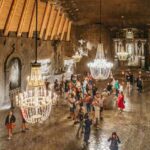
The Palace of the Doges is described as having monumental interiors and an atmosphere that brings the era to life. When you’re in spaces designed for power, you instantly understand why architecture was part of propaganda. Big rooms, formal layouts, and a sense of official rhythm are not accidental.
You should plan for a longer stop here compared with the street breaks. It’s listed as 1 hour 30 minutes, which gives you real time to look around and absorb what you’re seeing instead of rushing past doorways.
This is also the best place to slow down and focus on details like how the interior space is organized. Even if you don’t read every label, the room-to-room feeling tells a story about control, formality, and public life during the communist era.
Zalew Nowohucki: the green heart after the monumental blocks
After the administrative intensity, the tour heads toward Zalew Nowohucki, Nowohucki Lagoon. This stop is described as the green heart of Nowa Huta, a place where the district shows another side away from the rigid lines of socialist-realist architecture.
I like this kind of contrast because it stops your brain from becoming numb. After seeing so much planning and messaging, it’s refreshing to experience open water and trees as part of the district’s identity.
If your interest is photography or just taking a breather, this is where you can do it. Even a short pause here is useful because it resets your senses for the next cultural and spiritual stops.
Łaźnia Nowa Theatre: culture in the working-class district
Next you’ll encounter Łaźnia Nowa Theatre. The description notes it opened in 1998 on the site of a former bathhouse. That is an important detail, because it shows how a district built for workers continues to evolve, not just freeze in time.
Bathhouses and communal spaces are part of daily life history, and the theatre replacing that site gives you a living continuity. It’s not just a building now, it’s an example of how people repurpose city infrastructure after political change.
This stop also helps you understand that Nowa Huta is not only about the communist period. It’s also about what came after, and how residents re-wired their cultural life.
Stefan Żeromski Street and Rose Avenue: the district’s axes and rhythms
The tour includes Stefan Żeromski Street, established during development in the 1950s, and Rose Avenue, described as a short street with a strong sense of an era. Together, these stops reinforce how Nowa Huta’s streets work like a plan.
Stefan Żeromski Street helps you visualize the working-class arteries that supported everyday movement. Rose Avenue, with its symmetrical facades and massive cornice style details, adds visual rhythm to the story. It’s the kind of street where you might notice repeating patterns and think about how planning created familiarity.
If you’re a fan of urban design, this is where you can have fun with observation. Look at how the street frames buildings, how the facades align, and how the district communicates order through repetition.
Teatr Ludowy and the Our Lady Queen of Poland Church: culture and spirituality
You’ll also stop at Teatr Ludowy, the Ludowy Theatre, located near Theatre Square. This is described as a cultural heart of Nowa Huta for decades, which is a good clue that you’re seeing more than just another theatre building.
Then there’s the Our Lady Queen of Poland Church, described as monumental yet organic, raw yet full of spirituality. The nickname or phrase used for it includes Ark of the Lord. Even if you don’t have time for a long interior look, the church’s presence among concrete housing estates is the point.
I find these two stops useful because they show two different ways people build meaning. Theatre supports community life through performance and gathering. A church supports meaning through faith and ritual. Seeing both gives you a fuller picture of what communal space became after the period of communist messaging.
Price and logistics: is $65.62 worth it for 4 hours?
At $65.62 per person for around 4 hours, you’re paying for a lot of guided interpretation in a district that can otherwise be time-consuming to navigate. The tour uses a golf cart, which is the practical tool that makes the itinerary work without turning it into a long walking day.
One practical upside is that the tour is designed for a small group, max 30, which usually means you can ask questions and not feel totally rushed. The mobile ticket is also simple, and the activity notes it’s near public transportation, which helps if you plan your Krakow day around trams or buses.
Timing matters too. The tour is commonly booked about 21 days in advance, so if you’re traveling in busy periods, I’d suggest booking earlier rather than waiting for the last minute.
Who should book this Nowa Huta communism city tour?
This tour fits best if you want Krakow beyond the postcard squares and you’re interested in how urban planning reflects political power. It’s also a good choice if you prefer a guided format where the architecture and street names connect into an understandable story.
I’d especially recommend it if you like a mix of:
- Architecture and design that you can interpret, not just admire
- Symbolic sites like Solidarity Avenue and the Monument to Solidarity
- A bit of nature and cultural life after the heavy planning
If you only want old-town medieval vibes, you might feel out of place here. This is intentionally about communist-era design and the district’s evolution, so you’ll get the most satisfaction if you’re in the mood for that kind of context.
Should you book the Nowa Huta golf cart tour?
Yes, if you want an efficient, guided way to understand Nowa Huta without spending your whole day commuting or trying to piece together meaning alone. The strongest reason to book is the combination of broad coverage and guided context, especially the stop at the Palace of the Doges interiors where you get real time to look and absorb.
If you’re budget-sensitive, compare it to other Krakow tours you’re considering. But in this case, the golf cart makes the price feel more reasonable, because it’s tied to seeing a large, spread-out district.
Go in with a mindset of observation, street geometry, and contrast. When you do, Nowa Huta stops feeling like a political label and starts feeling like a real city that still shapes daily life.
FAQ
How long is the Nowa Huta golf cart sightseeing tour?
The tour lasts approximately 4 hours.
What is the price per person for this Krakow experience?
The price is $65.62 per person.
Where does the tour start and where does it end?
The tour starts at Kiss&Ride Zyblikiewicza Mikołaja Zyblikiewicza 2, 31-029 Kraków, Poland, and it ends back at the same meeting point.
Do I get a mobile ticket?
Yes, the tour includes a mobile ticket.
How large is the group on this tour?
The maximum group size is 30 travelers.
What are some of the main stops on the itinerary?
You can expect stops around Central Square in Nowa Huta, the Monument to Solidarity, the administrative center linked with the Palace of the Doges, Zalew Nowohucki, Łaźnia Nowa Theatre, Teatr Ludowy, and the Our Lady Queen of Poland Church, plus several streets that connect the district’s key areas.
Is there free cancellation?
Yes, you can cancel for free up to 24 hours in advance of the experience for a full refund.
Is the meeting point near public transportation?
Yes, the meeting point is noted as being near public transportation. The activity also says most travelers can participate.
Freshly posted from Krakow
- Krakow: Audio-Guided City Experience by Golf Cart★ 5.0 · 1 review
- Krakow: Zakopane and Thermal Springs Tour with Hotel Pickup★ 5.0 · 1 review
- Half-day In the footsteps of John Paul II Tour from Krakow★ 5.0 · 1 review
- Krakow: Wawel & Salt Mine Experience with Lunch★ 5.0 · 1 review
- Tour to Wadowice: Hometown of Pope Saint John Paul II★ 5.0 · 1 review
- Krakow: Outdoor Paintball with Hotel Transfers★ 5.0 · 1 review
- Krakow: Nowa Huta Communist District Walking Tour★ 5.0 · 1 review
Communism & PRL History Tours, compared.
Legendary Private Nowa Huta Communism Tour with Crazy Guides
Read our review →
Nowa Huta: Steelworks Administration Buildings/Shelters Tour
Read our review →
Private Tour: Warsaw’s Communist History by Retro Fiat
Read our review →Private Nowa Huta Adventure Tour in Communist Cars
Read our review →
Browse the lists this tour appears in