
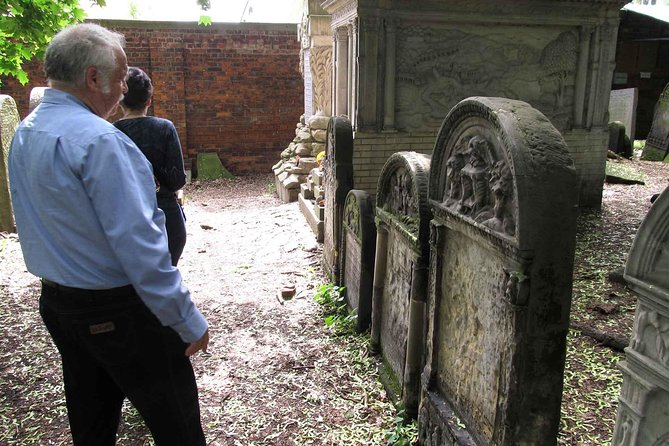
Reviewed · JEWISH HISTORY & HERITAGE TOURS
Warsaw Jewish Ghetto: private tour by retro car with hotel pickup
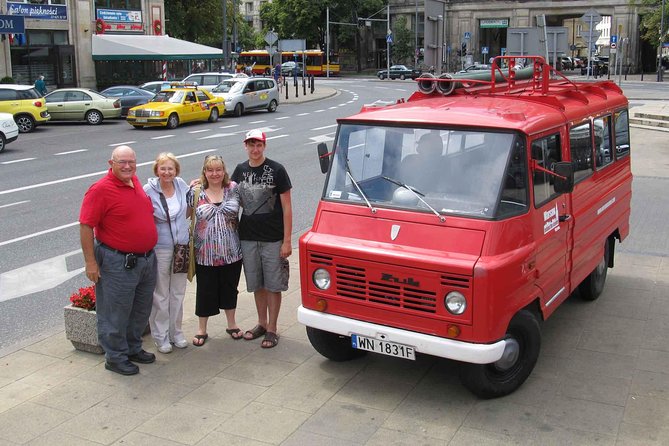
A tour like this hits hard, and fast. You ride in a retro Communist-era minibus between key wartime spots, then do short walks while your guide connects the dots from the ghetto boundary to the uprising and deportations. If you want a focused way to see what remains in modern Warsaw, this route is built for it.
I like that the stops are specific and physical, not vague. You’ll see places like Umschlagplatz and the Mila 18 memorial site, plus surviving street remnants such as Próżna Street and fragments of the ghetto wall. One thing to consider: this is a heavy topic in a limited 3-hour window, and the narration can feel intense, especially on a cold day when you may want more breathing room.
In This Review
- Key highlights worth your time
- Warsaw Jewish Ghetto tour with retro minibus: what the format gets right
- Price and value: what $168.58 buys you in real terms
- Stop-by-stop: how the itinerary tells the story of the ghetto in Warsaw
- 1) Monument to Janusz Korczak: the human beginning
- 2) Grzybowski Square: layers of 20th-century Warsaw
- 3) Próżna Street: the surviving tenement reminder
- 4) Fragment of Ghetto Wall: where history hides between buildings
- 5) Kamienica przy Waliców 14: the last visible ghost feel
- 6) Chłodna Street: the wooden bridge over tram traffic
- 7) Muranów: post-war neighborhood built on rubble
- 8) Monument to Ghetto Heroes: the uprising remembered
- 9) POLIN Museum grounds: optional entry, useful context
- 10) Memorial at Mila 18: a bunker story you feel in your chest
- 11) Umschlagplatz: deportations and the end of Jewish life in Warsaw
- The guide factor: why this tour can feel excellent, or at least unsettled
- Who this tour suits best (and who should think twice)
- Practical tips so your 3 hours work for you
- Should you book this Warsaw Jewish Ghetto private tour?
- FAQ
- How long is the Warsaw Jewish Ghetto private tour by retro car?
- What time does the tour start?
- Is hotel pickup included?
- Is the tour private or shared?
- What language is the tour?
- Are there entrance fees for the sites on the route?
- What are the car and comfort details for the retro minibus?
- Is the tour suitable for children?
- Is cancellation free?
Key highlights worth your time
- Retro minibus, direct pickup: you start close to your hotel or apartment, then move efficiently between sites
- Umschlagplatz and Mila 18: two of the most solemn, concrete places tied to deportations and the 1943 uprising
- Surviving Warsaw street remnants: Próżna Street still shows pre-war tenement life, and wall fragments are built into the city fabric
- Uprising and resistance story beats: from the ghetto boundary and wooden bridge to the monument to ghetto heroes
- Outside POLIN Museum grounds: you get the context before deciding whether to add entry tickets
Warsaw Jewish Ghetto tour with retro minibus: what the format gets right
This is a classic get-there-and-see-it tour, designed for people who want accuracy without spending their whole day figuring out transit. The retro Communist-era minibus matters because it keeps you moving, while the walking segments keep things from feeling like a bus window slideshow.
The hotel pickup is also genuinely useful. You can be collected from lodging within 3 km of the city center, and if your place is farther or awkward to reach by car, the operator will point you to the closest practical meeting spot. One small but important detail: transfer time counts inside the 3 hours, so if you are staying at the edges of that 3 km zone, you might want to compare meeting near the center versus being picked up right at the door.
Group size is small in practice. Each minibus holds up to 8 passengers, and the tour is private, meaning it is only your group, not a big mixed crowd. That changes the feel: your guide can slow down for questions, and you are less likely to be rushed past a stop that hits you emotionally.
Finally, the vehicle setup is part of the reality check. Some minibuses are not equipped with air conditioning, and some do not have seat belts, which is permitted for historic vehicles. Heating is included for winter. If you are sensitive to cold, dress in layers. The route includes outside stops where you will be standing and listening.
Further Jewish history and heritage itineraries:
- Warsaw: POLIN Museum of the History of Polish Jews Ticket
★ 4.7 · 1,142 reviews - Warsaw: Warsaw Ghetto Private Walking Tour with Hotel Pickup
★ 4.9 · 369 reviews - Warsaw: Jewish History Guided Walking Tour in English
★ 4.7 · 324 reviews
Price and value: what $168.58 buys you in real terms
At $168.58 per person for about 3 hours, the headline cost is not low. But you are paying for the whole package: a professional English speaking local guide, transportation by retro minibus, and hotel or apartment pickup and drop-off within 3 km.
Here’s how the value usually shows up on the ground:
- You avoid planning friction. You do not need to stitch together multiple neighborhoods, tickets, and timing on your own.
- Many stops are free at the point of entry. The tour includes sites where admission tickets are listed as free, so your main extra spending is optional add-ons, not mandatory fees.
- Your guide does the connecting work. The route ties street-level remnants to larger events like the Warsaw Ghetto Uprising and the deportation process.
Where it can feel less like a bargain is the emotional intensity. You are in a dense route with multiple memorials and historical sites packed into a half-day. If you prefer a slower pace, or if you know you get overwhelmed easily, you might want to plan a calmer rest of day afterward.
Also, because the tour duration is fixed and transfer time is included, it is worth thinking about your meeting logistics before you choose pickup. This is one of those tours where small timing choices change how you feel at the end.
Stop-by-stop: how the itinerary tells the story of the ghetto in Warsaw
This route moves in a logical order, starting with context, then moving through surviving fragments and memorial points, and ending at the deportation site. The best way to use it is to treat each stop as a piece of a larger map, not just a photo opportunity.
1) Monument to Janusz Korczak: the human beginning
Your tour starts at the Monument to Janusz Korczak, with your guide giving the background for Jewish Warsaw and the creation of the Jewish Ghetto during World War II.
Korczak is remembered as a Polish-Jewish educator and author who ran a Warsaw orphanage. He had an opportunity to escape but chose not to leave the children in his care. He was deported with them to Treblinka.
Why this stop matters: it frames the story as people first, not only dates and places. It also sets the emotional tone early, so you are ready for the darker sites that follow.
Practical note: expect a short introduction and then movement on. If you arrive cold or rushed, try to settle in right away, because the whole tour keeps a steady rhythm.
More melex loops around the old town:



2) Grzybowski Square: layers of 20th-century Warsaw
Next is Grzybowski Square, once part of Jewish Warsaw and today a reminder of the city’s dramatic 20th-century history.
This is the type of place where your guide helps you notice continuity and breakpoints. You learn how the area went through two world wars, two totalitarian systems, and the transformation of modern Europe. Nearby streets still preserve traces of pre-war Jewish life.
Why it’s valuable: it prevents the common mistake of treating the ghetto as a sealed box. Instead, you see how wartime events grew out of a real living city.
Time is short here, so if you want extra photo time, you’ll need to be quick or ask your guide what is most worth capturing.
3) Próżna Street: the surviving tenement reminder
On Próżna Street, you visit a rare survival: it is described as the only street in Warsaw where pre-war Jewish tenement houses still stand.
Today it remains a physical reminder of Jewish Warsaw. It also becomes a focal point during the annual Singer’s Warsaw Jewish Culture Festival.
This stop hits differently because it is not a monument you have to imagine. You are looking at a street structure that outlasted the destruction and rebuilding.
The drawback: with only about 10 minutes, you should be ready to absorb more than you photograph. The value is in understanding why the survival is so rare.
4) Fragment of Ghetto Wall: where history hides between buildings
The tour then moves to a fragment of the ghetto wall, marking the former boundary of the ghetto. Some sections are hidden between buildings, and your guide takes you to one of the accessible locations.
This is one of the most visually powerful stops because walls are hard to argue with. Even if you know the story intellectually, a preserved boundary fragment makes the concept of separation feel immediate.
This is also a good place to focus on your guide’s explanation of how the ghetto was sealed off from the rest of the city, not just on the stone or brick itself.
5) Kamienica przy Waliców 14: the last visible ghost feel
At Waliców Street, you see the ruined tenement house sometimes described as the last visible ghost of the ghetto. A fragment of the ghetto wall is also preserved there.
In practice, this stop combines two things: architectural damage and a preserved boundary line. It is a stark reminder that destruction was not only mass violence, it also rewrote the city’s physical map.
Because the tour is already dense, keep your expectations realistic. This is not a long museum-style viewing. You’re getting the meaning and the visual anchor in about 15 minutes.
6) Chłodna Street: the wooden bridge over tram traffic
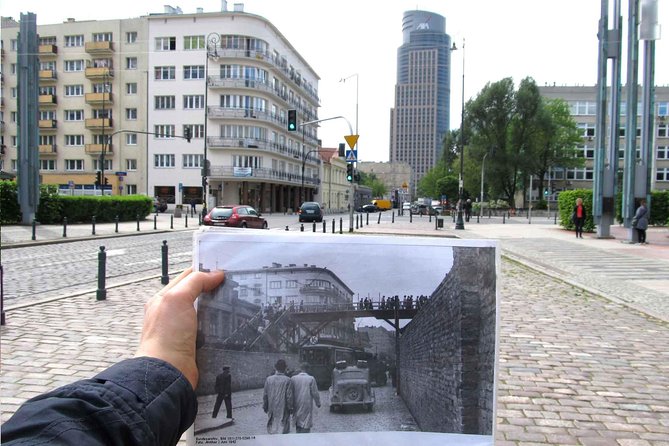
At Chłodna Street, you learn about a wooden bridge built in 1941 to connect the two separated parts of the ghetto.
Your guide explains how the bridge rose above street traffic, allowing trams and German vehicles to pass underneath. Archival photographs help show what made it unusual.
This stop is a great example of how the tour tries to make the ghetto story concrete. Instead of only speaking about borders, it shows a border workaround built inside wartime constraints.
Drawback to consider: because it relies on archival photos and explanation, your ability to hear matters. If the air is noisy or you struggle to follow narration in cold weather, it can help to position yourself where you can clearly see and listen.
7) Muranów: post-war neighborhood built on rubble
Then you move to Muranów, a post-war residential district built directly on the rubble of the destroyed ghetto.
From street level it can look like a typical neighborhood, but your guide points out that the ground has layers of wartime history revealed through explanation and context.
This is where the tour shifts from “what happened here” to “what survived here.” You learn to read modern Warsaw like a layered document.
The main consideration: it can be tempting to mentally fast-forward because it looks ordinary. Let your guide do the work of slowing you down again.
8) Monument to Ghetto Heroes: the uprising remembered
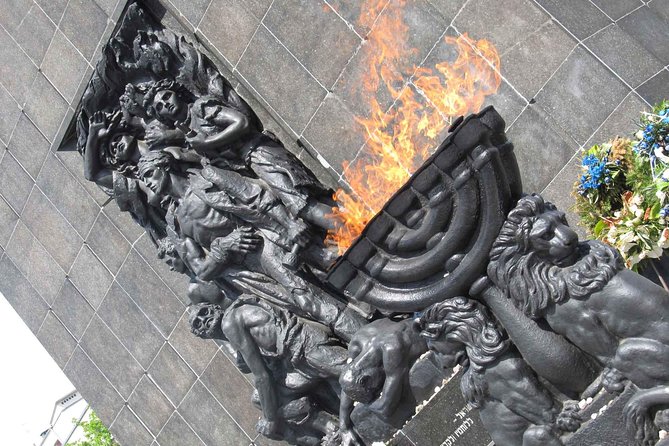
At Pomnik Bohaterów Getta (Monument to the Ghetto Heroes), you learn about the 1943 Warsaw Ghetto Uprising. The monument is located near the site of the first armed clashes.
This stop also connects wartime memory to post-war commemoration and reconciliation through events held over the last several decades.
If you want an ending that is not just tragedy, this is a good place for it. Resistance and remembrance are part of the story, not an afterthought.
9) POLIN Museum grounds: optional entry, useful context
Next is the POLIN Museum of the History of Polish Jews, with a stop outside the building on former ghetto grounds. The museum name refers to a legend connected with Jewish settlement in Poland.
Entrance is optional and not included in the tour price.
Why stopping outside helps: you get the significance of the site without committing right then to an indoor ticket. If you are curious, you can add it later. If you are museumed-out, you can keep your day moving.
The short stop also means you should not expect detailed museum-level interpretation here. The tour uses it as a signpost.
10) Memorial at Mila 18: a bunker story you feel in your chest
At Mila 18, you learn about a bunker used by Jewish resistance fighters during the 1943 uprising.
When German Nazi forces discovered it, many people hiding inside chose death rather than capture. Their remains are buried beneath the site.
This is one of the most emotionally direct points on the route. It is not only a history lesson. It is a reminder of the choices people faced when survival options collapsed.
Time is listed as about 10 minutes. That can feel short for such a heavy subject, but the guide’s explanation helps you understand why this site is a memorial, not a landmark for casual photos.
11) Umschlagplatz: deportations and the end of Jewish life in Warsaw
The tour concludes at Umschlagplatz, the former deportation point where Jews were transported to Treblinka. Today, the memorial at Stawki Street marks this final chapter of Jewish life in wartime Warsaw.
This ending makes sense because it draws together everything you saw earlier: the boundary, the surviving remnants, the uprising, the underground resistance, and then the deportation mechanism.
If you remember just one idea from the tour, make it this: the ghetto was not only confinement. It was a system that led to deportation.
The guide factor: why this tour can feel excellent, or at least unsettled
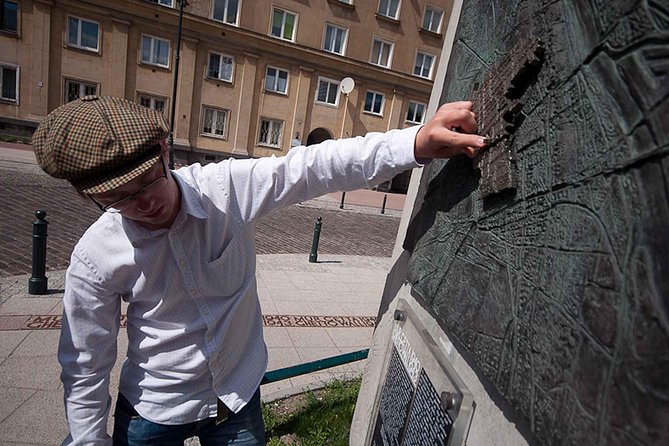
In the reviews I looked at, the consistent praise was about the guides. People highlight a caring, friendly approach and a strong command of Jewish Warsaw and its history. They also mention picture references from the past, which can make the scenes feel less abstract.
At the same time, one notable concern came up about how wartime events and Polish suffering were presented alongside Jewish suffering. That specific reviewer felt the narrative leaned in a way that could be interpreted as minimizing Jewish tragedy, tied to claims about collaboration and resentment.
Important for you: the response from the guide in that case emphasized that the guide aims to present accurate context, and that he covers multiple aspects of occupation, resistance, and both heroism and betrayal. He also made clear he rejects antisemitism or hate speech.
So here’s the practical takeaway: if you are very sensitive to how the Holocaust and Polish wartime roles are framed, consider sending a quick message before your tour. Ask how your guide handles sensitive comparisons and whether they keep the focus on Nazi responsibility and Jewish victims. You are not being difficult. You are doing due diligence for a topic where framing really matters.
Who this tour suits best (and who should think twice)
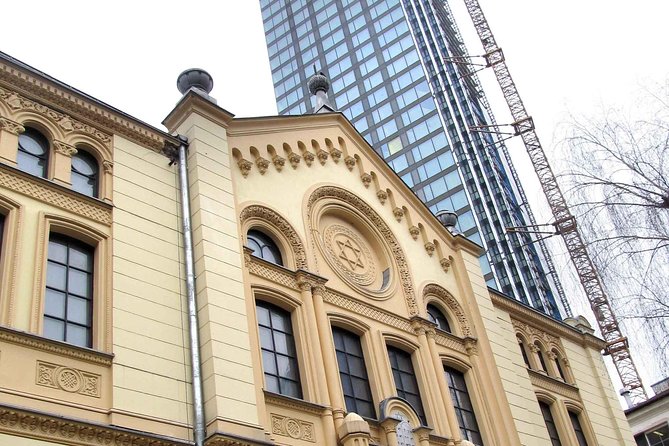
This is a strong match if you want:
- a private format with a dedicated English-speaking guide
- a route that includes both memorials and surviving street remnants
- a short walking itinerary with transit between stops, rather than a long day of self-guided research
- a half-day overview that sets you up for optional follow-ups, like adding entry at POLIN later
It may be less ideal if:
- you want a lighter, purely architectural walk
- you prefer museums with indoor pacing rather than multiple outside memorial points
- you struggle with intense subjects in a tight time window
For families: the tour allows adults and children over 150 cm, and seat boosters are mandatory under Polish law for kids under 150 cm. If you are traveling with younger children, check availability in advance.
Practical tips so your 3 hours work for you
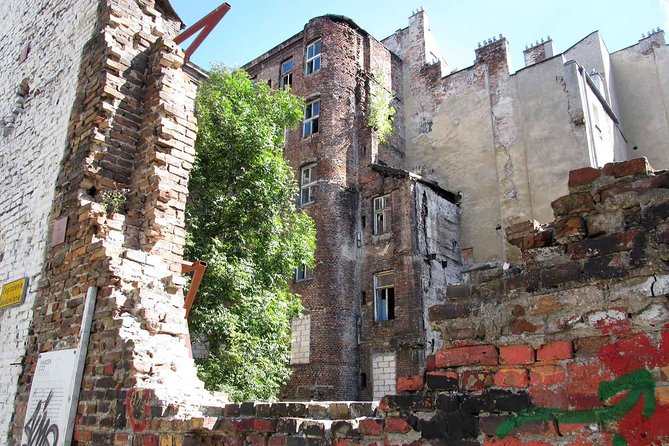
This is the kind of tour where small prep improves everything.
- Wear comfortable footwear. You will do short walks at each stop.
- Dress for cold weather. Vintage minibuses may not have air conditioning, but they do have heating for winter, and you will still spend time outside.
- Plan your photos fast. The meaning is in the guide talk, and the time is tight.
- If you have mobility issues, discuss with the operator in advance. The data says most travelers can participate, but the route includes walking segments.
Also, take note of the starting time. The listed start is 10:00 am, so you’ll want to be ready to go early enough that you are not rushing.
Should you book this Warsaw Jewish Ghetto private tour?
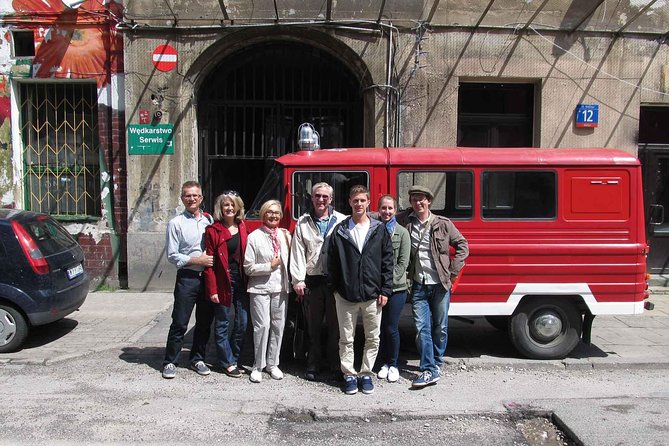
Yes, you should book it if you want a structured, local-guided experience that connects the surviving remnants of the Warsaw Ghetto to the uprising and deportation story, without you having to plan transport or sequencing. The value is strongest when you factor in hotel pickup, a dedicated English-speaking guide, and a route packed with meaningful stops that are mostly free to access.
I would think twice and ask questions before booking if framing of sensitive wartime topics is a major concern for you. One review raised that issue, and the guide’s reply indicates how contested narratives can feel on the ground. A quick pre-tour message can help you confirm what kind of tone and emphasis your guide uses.
If you do book, treat this like a serious appointment, not a casual attraction. Give yourself a calmer rest of the day afterward, and let the places do their work.
FAQ
How long is the Warsaw Jewish Ghetto private tour by retro car?
The tour is about 3 hours.
What time does the tour start?
The listed start time is 10:00 am.
Is hotel pickup included?
Yes. Pickup and drop-off are included for hotels and apartments within a 3 km radius of the city center.
Is the tour private or shared?
It is private. Only your group participates.
What language is the tour?
The tour is offered in English.
Are there entrance fees for the sites on the route?
Most stops are free. Entrance to the POLIN Museum is optional and not included. Entrance fees to synagogue and cemetery are also not included, and those visits are optional.
What are the car and comfort details for the retro minibus?
The vintage minibuses are not equipped with air conditioning (some do not have seat belts, which is permitted for historic vehicles). Vehicles have heating for winter.
Is the tour suitable for children?
Adults and children over 150 cm can book. For children under 150 cm, seat boosters are mandatory under Polish law, so you should contact the operator to check availability.
Is cancellation free?
Free cancellation is available up to 24 hours in advance for a full refund.
Freshly posted from Warsaw
- Krakow Small Group Tour from Warsaw with Lunch, Schindler’s Factory included★ 5.0 · 7 reviews
- Warsaw Private Transfer from Warsaw Chopin Airport (WAW) to City centre★ 4.0 · 7 reviews
- 3-hour tour at Warsaw Uprising 1944 Museum /inc. Pick-up/★ 4.9 · 7 reviews
- Wolfs Lair – Hitlers hideout★ 4.5 · 7 reviews
- Warsaw: Evening History and Pubs Tour by Retro Minibus★ 5.0 · 7 reviews
- Warsaw: Private Vodka Tasting Night with Snacks and Pickup★ 5.0 · 7 reviews
- Warsaw Old Town with Royal Castle + Royal Route: SMALL GROUP /inc. Pick-up/★ 5.0 · 7 reviews
Jewish History & Heritage Tours, compared.
Bike Tour of Old Town, Jewish Quarter and the Ghetto
Read our review →
POLIN Museum of the History of Polish Jews Ticket
Read our review →
Kazimierz, Schindler’s Factory & Ghetto Guided Tour
Read our review →
Full Bike Tour – the Old Town, Jewish Qtr & the Ghetto NEW BIKES
Read our review →
Warsaw Ghetto Private Walking Tour with Hotel Pickup
Read our review →Browse the lists this tour appears in