
Reviewed · JEWISH HISTORY & HERITAGE TOURS
Krakow Old Town & Kazimierz Highlights Tour by Electric Car
Old Town hits different when you ride. This electric car highlights tour is built for saving energy while you cover a lot of ground, from Kraków’s biggest medieval square to Wawel Hill. You also get audio commentary that helps you connect the buildings you see to the people and events behind them.
I love the pace, because you’re not stuck zigzagging between landmarks all day. You also get a clear sense of the city’s Jewish quarter, including context about Krakow and how Jewish and Polish communities were treated during World War II, which adds meaning beyond photos. One possible drawback is that the route packs many stops into a short time, so you’ll need to decide in advance what you want to request for entry.
In This Review
- Key Takeaways Before You Go
- Electric Car Touring in Krakow, How It Saves Your Energy
- Rynek Główny and the Cloth Hall, Krakow’s Medieval Center
- What to watch for here
- St. Mary’s Basilica and Stare Miasto, Gothic Detail Without the Detour
- A small practical tip
- Wawel Royal Castle and Wawel Cathedral, Poland’s Power Hill
- Don’t miss this detail
- Planty Park, Franciscan Church Stained Glass, and Key Church Stops
- How to choose entry requests
- St. Florian’s Gate, Fortifications, and the Dragon That Refuses to Be Subtle
- Photo logic that works
- Kazimierz and Jewish Quarter Stops, Including Synagogues and Square Life
- Two ways to enjoy Kazimierz more
- River Views at Father Bernatek Footbridge and the Old Town Walking Threads
- The “slow look” stops that help you remember Krakow
- Wawel Dragon, Historic Squares, and Smaller Cultural Landmarks
- A simple strategy
- How Much Time You’ll Get in Each Place, and What to Request
- Value and Price, What $115.97 Gets You in Real Terms
- Who Should Book This Electric Car Highlights Tour?
- Should You Book It?
- FAQ
- Where does the tour start?
- How long is the tour?
- Is there pickup?
- Does the tour include audio commentary?
- Is Wawel entrance included?
- Are admissions free for the stops?
- Is the tour suitable for most travelers?
Key Takeaways Before You Go
- Electric car comfort for a fast highlights loop without long walks between areas
- Audio narration in your selected language, with time estimates at key stops
- Wawel focus plus cathedral highlights, often the hardest area to fit neatly on your own
- Kazimierz coverage with synagogue and Jewish-quarter stops, plus WWII context in the story
- Many sights are free from the outside, with optional entries for specific buildings
Electric Car Touring in Krakow, How It Saves Your Energy
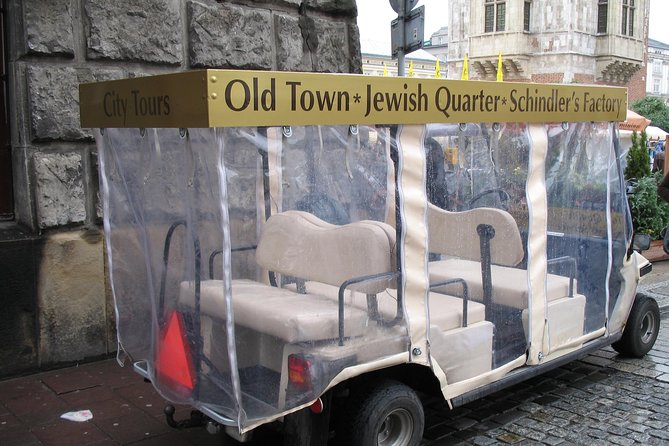
Krakow can be a walking city, especially in the Old Town where streets funnel you into crowds and you keep second-guessing routes. This tour fixes that problem by using a shared or private electric car to move you between neighborhoods, including Old Town, Kazimierz, and Podgorze. You still see plenty, but you arrive at each place with your legs intact.
The duration is listed as about 2 hours, and the included “sightseeing tour” time is 1.5 hours. In practice, that means you should expect a tight loop where you look, listen, and only sometimes go inside. If you’re the type who loves stopping for one long photo or lingering in a chapel, you may want to pick a couple of entry requests and let the rest stay as look-and-learn.
Group size is capped for the shared option because the electric car has 8 seats. Larger groups get split into separate cars, so you still get a proper tour flow and not a huge crowd piling up in one vehicle. If you prefer quieter, more flexible pacing, the private option keeps transfers in your own electric car for the full tour.
You also get a mobile ticket and you’ll receive confirmation at booking. The operator asks you to check your email the day before for important updates, which is worth doing if you want everything to run smoothly.
More Golf Cart Tours in Krakow
- Krakow: City Sightseeing Tour by Electric Golf Cart
★ 4.5 · 3,264 reviews - Krakow: City Sightseeing Tour Eco Electric Buggy Golf Cart
★ 4.7 · 3,143 reviews - Krakow: Extended City Sightseeing Tour – Eco Buggy Golf Cart
★ 4.7 · 794 reviews
Rynek Główny and the Cloth Hall, Krakow’s Medieval Center
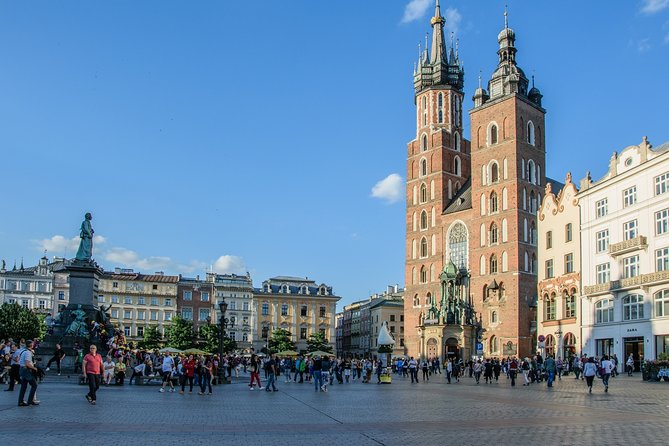
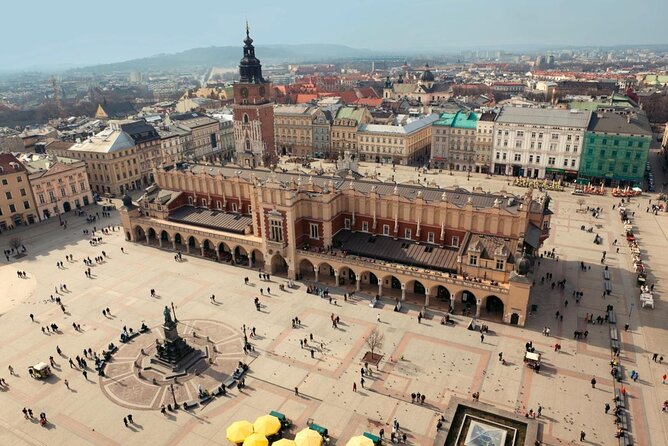
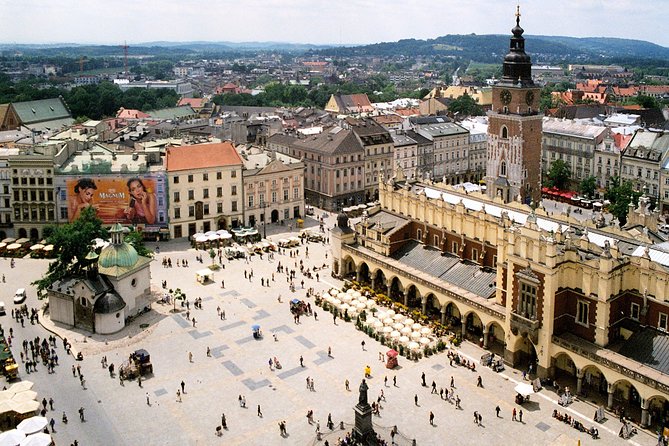
Your loop starts at Kraków Barbican, then you roll straight into Rynek Główny Central Square, Krakow’s massive medieval heart. The square is described as about 10 acres, and it’s known as the largest medieval square of its kind in Europe. This is the place where your guide can quickly give you orientation: where you are, how the city grew, and what the big buildings around you are trying to say.
Rynek Główny is dominated by the 16th-century Renaissance Cloth Hall, a building that also gets called the world’s oldest shopping mall. That’s not just a fun fact. It helps you understand why this area still feels like a “center,” because it was designed to funnel trade and people here for centuries, not just today’s tourists.
Admission at these early stops is listed as free, which matters because it keeps the tour from turning into a ticket-hunting mission. You’re meant to absorb the space first, then move on.
What to watch for here
Don’t rush your first square stop. You’ll get more out of the later landmarks if you spend a few minutes here figuring out the geometry of Krakow’s core. Also, if you spot the Cloth Hall’s internal stalls and small shops, it’s a quick way to see how the square stays alive beyond monuments.
St. Mary’s Basilica and Stare Miasto, Gothic Detail Without the Detour
Next comes St. Mary’s Basilica, one of the city’s most famous churches. You get about 15 minutes, and the structure’s standout features are its two towers of different heights. The interior is described as surprisingly richly decorated, which is exactly why this stop works well on a highlights tour.
From there, you head into Stare Miasto, the merchants’ town with 14th-century fortifications. It’s known as home to one of Europe’s largest market squares, plus historical houses, palaces, and churches with impressive interiors. Admission is again listed as free, so you can focus on experiencing the area rather than paying for every doorway.
A nice part of this section is that you start connecting neighborhoods to their functions. Rynek Główny feels civic and commercial. Stare Miasto feels like the older merchant city layer, where the streets and building facades reflect how wealth and power moved through time.
Further Jewish history and heritage itineraries:
A small practical tip
If you want photos, plan for the fact that the Old Town gets busy. You’ll get short windows at the most iconic pieces, so be ready to shoot and move rather than doing a slow walk-through.
Wawel Royal Castle and Wawel Cathedral, Poland’s Power Hill
Wawel is the big-ticket stop, and this tour treats it that way. You’ll see Wawel Royal Castle, described as the royal residence and the place where Poland’s rulers governed for five centuries. It’s positioned as a symbol of the independent Polish state, so you’re not just looking at architecture. You’re seeing the idea of leadership and national identity concentrated in one hilltop complex.
The listing notes that entrance is possible on request, and it says admission tickets are free. You should read that as: you may be able to go in, but your access depends on whether your group requests it and the operator’s ability to arrange it. If Wawel is your top priority, this is one of the best times to ask.
Then you move to Wawel Cathedral for about 20 minutes. This is a national shrine with major religious art, including the giant Zygmunt bell of 1520, described as one of the world’s largest. It’s also noted as the burial place of many Polish kings and their families. Again, entrance is listed as possible for the free parts of the cathedral during opening hours.
This part is valuable because it gives you context quickly. If you try to DIY Wawel, it’s easy to get stuck in the logistics, lines, and route planning. Here, the tour sequence brings you from square level into the symbolic center of Polish history without you thinking too hard.
Don’t miss this detail
Wawel is physical elevation, so even your outside viewpoints can feel like a reset. When you’re finished, you’ll likely see the river and Old Town layout differently, because you’ve gained the “high point” perspective.
Planty Park, Franciscan Church Stained Glass, and Key Church Stops
Between the big monuments, the tour includes breathing space and side streets that many visitors skip. Planty Park circles around the Old Town, and you’ll get it as a scenic walkway break. Since it’s listed with free admission, it’s an easy mental reset between heavier stops.
Then you visit Bazylika Franciszkanów Sw. Franciszka z Asyżu, with vibrant interior decoration and Stanisław Wyspiański’s stained glass window called God the Father. This is one of those stops where the value is in the artwork. If you care about design and symbolism, you’ll likely enjoy it more than you expected.
Next is Church of St. Peter and St. Paul, which is listed as a beautiful cathedral with organ concerts. The tour time here is about 15 minutes, and entrance is marked as possible on request. Even if you don’t request entry, the quick stop helps break up the route and keeps the day from feeling like one long monument checklist.
You also pass by other church moments, including Church of St. Bernard of Siena, described as unusual and breathtaking inside, with light colors, murals, and sculptures. That’s another stop that’s designed for you to see details up close. Plan to spend your attention where you’ll actually get something special, not just another photo from the street.
How to choose entry requests
Because entry requests are mentioned several times, you’ll want to use a simple rule: request entry for places where interior art is the whole point, like stained glass or major decoration. For quick churches where the outside view is enough, you can skip and keep momentum.
St. Florian’s Gate, Fortifications, and the Dragon That Refuses to Be Subtle
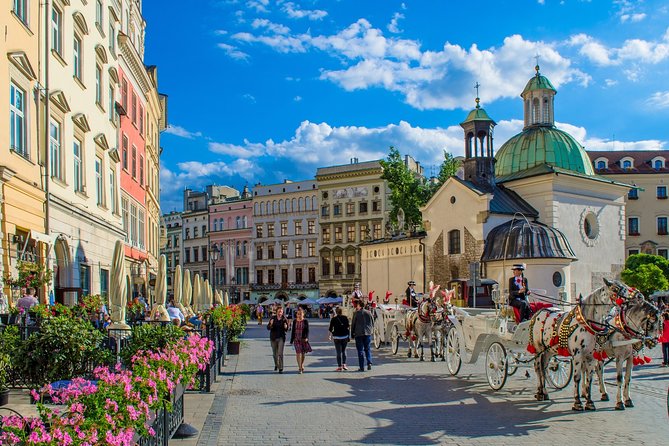
Krakow’s Old Town is protected by layers of defensive architecture, and the tour makes sure you see at least one of the key remnants. You’ll stop at St. Florian’s Gate, a 14th-century gate with four towers. It’s described as the remnants of city fortifications, many of which were destroyed at the start of the 19th century. Seeing it gives you a sense of the Old Town as a walled system, not just a pretty walking zone.
In the same broader area, you’ll also get a chance to see the monument of the Wawel Dragon. The description is exactly what it sounds like: a dragon sculpture with fire-breathing effect, and it says you can see it on request. This is a classic “Krakow is playful too” moment, which is helpful because the day also includes serious memorial and cathedral stops.
Then you hit another visual landmark: Museum of Krakow Town Hall Tower, built of stone and brick at the end of the 13th century and standing 70 meters tall, with a lean caused by wind in 1703. Even if you don’t go inside, the tower’s mention of a measurable wind effect gives you a story you can picture.
You’ll also pass by Pomnik Grunwaldzki honoring the Battle of Grunwald, which is noted as one of Krakow’s finest monuments, and it’s possible to see on request. This works as a pause point, because monuments let you step back and get the broader “Poland across centuries” view.
Photo logic that works
For the fortification gate, shoot from a place where you can see towers and street alignment. For the dragon, be ready to decide quickly whether you want to wait for the firing moment, since it’s listed as request-based.
Kazimierz and Jewish Quarter Stops, Including Synagogues and Square Life
This is the part that most strongly adds meaning beyond monuments. The tour explicitly highlights Kazimierz, the former Jewish district, and it uses the electric car to help you see more in less time. You’ll spend about 30 minutes in this area, and the narrative ties the streets to their history, including context about WWII treatment of Jewish and Polish communities.
Kazimierz includes several synagogue and church related stops. One is described as a Reformed Temple, a synagogue in the Jewish Quarter. Another described stop is a synagogue built in the mid-17th century in Judaic-Baroque style, with entry possible on request. These details matter because synagogue architecture in Kazimierz isn’t just decorative. It signals community identity, eras, and artistic influences.
You’ll also visit Plac Wolnica, described as a quieter square with lots of bars and restaurants, plus good tenement houses. That mix is what makes the area feel real. It’s not preserved as a museum only. It’s lived in, and the tour timing helps you connect history to modern street life.
The tour also includes stops connected to Jagiellonian University, including Collegium Iuridicum. It’s described as one of the oldest parts of the university, with interesting sculptures and great style buildings, with about 15 minutes there. This might feel like a left turn from Jewish Quarter sights, but it helps show how Krakow layered education, faith, and civic life over the same centuries.
Two ways to enjoy Kazimierz more
1) Listen for the story beats. The WWII context is mentioned in the only provided review, and it changes how you read the streets.
2) Keep your expectations realistic. Some synagogue entries are request-based, so you’ll want flexibility.
River Views at Father Bernatek Footbridge and the Old Town Walking Threads
Not all highlights are grand castles. Some are small moments that stick. The tour includes Father Bernatek Footbridge, where people attach padlocks. It’s also described as a good place for a nice view on the Vistula River. This is a great “exhale” stop because it shifts your attention from stone and towers to moving water and wider city angles.
Back on the walkable sides, you’ll see Ulica Florianska, described as photogenic and one amazing street to walk down. You’ll also stop along Ulica Grodzka, one of Krakow’s oldest streets, and it’s part of the Royal Way route kings and dignitaries took to reach Wawel Castle. When you connect that street to processions, it stops being only a photo corridor and becomes a narrative path.
The tour also includes Royal Way (Droga Krolewska) itself, described as a historic walking trail through the heart of Krakow used for royal processions and funerals. This matters because it ties movement through the city to power and ceremony, which is exactly what you’re learning from Wawel.
You’ll also have time at Ulica Florianska and then pass by other sights connected to art and culture, including Juliusz Słowacki Theatre, a baroque-style theater built in 1892 that continues to host regular performances of plays and operas, with entry possible on request.
The “slow look” stops that help you remember Krakow
These are the short square pauses: Maly Rynek, a small colorful market square, and Szczepanski Square, with benches and a place to sit. Even the quick Matejko Square stop helps because it’s close to Old Town and has monuments plus nice architecture. Your brain needs those small pauses, or the day turns into blur.
Wawel Dragon, Historic Squares, and Smaller Cultural Landmarks
The tour doesn’t only repeat the biggest names. It tosses in several distinct landmarks that add texture.
You’ll see Adam Mickiewicz Monument, with the listing noting it’s a bronze statue of the romantic poet. Then there’s Statue of John Paul II, described as a tribute to the pope’s legacy in Krakow. These memorial pieces may not be the main reason to visit, but they work well for quick context as you travel between main hubs.
You’ll also pass by Pomnik Grunwaldzki. In many cities, war monuments feel detached. Here, tying it into your earlier Wawel story helps you understand the way Krakow uses physical markers to keep national memory visible.
On the Old Town edge, you’ll also see Jagiellonian University architecture and Szczepanski Square style open space. And there are additional church stops outside the headline basilicas. One church stop is described as smaller but peaceful behind St Mary’s Cathedral. Another is said to be not crowded so you can experience a spiritual atmosphere. The tour also includes a church from 1223 described as Gothic and ornate, with entrance possible on request.
Finally, there’s St. Adalbert, described as a beautiful little church with a domed ceiling, and entrance possible on request. If you like interiors more than facades, you can treat these as your “choose-your-own-church” moments depending on how your energy holds up.
A simple strategy
If the line to enter looks uncertain, skip it. Keep the energy for places that are explicitly described as especially decorated, like stained glass, murals, or domed interiors.
How Much Time You’ll Get in Each Place, and What to Request
This tour’s structure is short stops mixed with drive-by glimpses and a few “look longer” moments. Some stops include set time windows like 15 minutes for St. Mary’s Basilica, St. Peter and St. Paul, St. Bernard of Siena, St. Florian’s Gate, and others. Wawel Cathedral is noted at 20 minutes.
A lot of entries are marked as possible on request, including Wawel Royal Castle, parts of the cathedral, Franciscan basilica, St. Peter and St. Paul, several synagogues, and multiple churches. That means you should go into the tour with your own shortlist.
Pick your request priorities:
- If you want the big “must” experience, request Wawel Royal Castle and plan to use your cathedral time well.
- If you care about art inside churches, choose one or two: the Franciscan stained glass stop is a strong contender.
- If you want the most meaning from Kazimierz, request synagogue entry where possible, since these are specifically called out.
Also remember: you’re in a moving loop. Even with the electric car, you will still need to transition quickly between stops.
Value and Price, What $115.97 Gets You in Real Terms
At $115.97 per person, this isn’t the cheapest way to see Krakow. But it’s also not just a ride around town. The value comes from combining three things you’d otherwise have to manage yourself: transport by electric car, audio narration in your language, and a tight route that covers Old Town plus Kazimierz.
The tour includes transfers by electric car with pickup from Old Town or Kazimierz. If you stay outside those areas, the tour departs from Bracka Street 15, which matters for your total convenience cost. In other words, where you’re staying can either make this feel like a smooth door-to-door plan or a more “meet me there” situation.
Since many listed admissions are free, you also avoid the feeling that your highlights day turns into paying for every stop. Still, optional entries like Wawel castle and some interiors are request-based and may depend on opening hours, so keep a flexible mindset.
If you’re short on time, this tour is a strong “high-impact” option. If you have several days and you love slow wandering, you might not need this level of structure.
Who Should Book This Electric Car Highlights Tour?
This tour fits best if:
- You want two neighborhoods plus Wawel covered without planning a complex route.
- You prefer to sit back between areas and still get story context through audio.
- You’d like a structured way to experience Kazimierz, including WWII context tied to Jewish history and Krakow’s communities.
You might skip it if:
- You want long museum time or deep interior visits across many buildings.
- You dislike quick photo stops and prefer one area for hours at a time.
Also, if you’re thinking about the group option, remember the vehicle seating is 8, and the tour is still planned to run as a group experience. For couples or small groups who want maximum control, the private option may feel more comfortable.
Should You Book It?
If you’re time-tight and you want the biggest Krakow hits plus meaningful Kazimierz context, I’d book this. The electric car reduces the city-stress factor, the audio narration gives you a clearer story thread, and Wawel plus Old Town land you in the right places fast.
Choose this when your goal is smart coverage, not slow exploration. If that sounds like you, this tour is a practical way to see Krakow without wearing out your feet before your evenings.
FAQ
Where does the tour start?
The tour starts at Kraków Barbican, Basztowa, 30-547 Kraków, Poland.
How long is the tour?
It’s listed as about 2 hours. The included sightseeing tour time is 1.5 hours, so expect a tight schedule in that range.
Is there pickup?
Pickup is available by electric car only for accommodations located in Krakow’s Old Town or Kazimierz. If you are outside those areas, the tour departs from Bracka Street 15, 31-005 Krakow.
Does the tour include audio commentary?
Yes. You get audio guide commentary in the language selected when booking, and audio guides are available in 26 languages.
Is Wawel entrance included?
The tour notes that entrance to Wawel Royal Castle is possible on request. For Wawel Cathedral, free parts of the cathedral are available during opening hours.
Are admissions free for the stops?
The tour notes free admission tickets for many sights. For optional interiors, access may depend on opening hours and whether you request entry.
Is the tour suitable for most travelers?
The listing says most travelers can participate. Service animals are allowed, and the meeting point is near public transportation.
Melex Loops
- Krakow: Electric Car Sightseeing Tour
★ 4.4 · 450 reviews - Krakow: Jewish Quarter and Ghetto Electric Golf Cart Tour
★ 4.6 · 348 reviews - Krakow Grand City Tour by golf cart – All 3 districts
★ 5.0 · 311 reviews - Krakow: City Sightseeing Tour Eco Electric Buggy Golf Cart
★ 4.5 · 311 reviews
Freshly posted from Krakow
- Krakow: Audio-Guided City Experience by Golf Cart★ 5.0 · 1 review
- Krakow: Zakopane and Thermal Springs Tour with Hotel Pickup★ 5.0 · 1 review
- Half-day In the footsteps of John Paul II Tour from Krakow★ 5.0 · 1 review
- Krakow: Wawel & Salt Mine Experience with Lunch★ 5.0 · 1 review
- Tour to Wadowice: Hometown of Pope Saint John Paul II★ 5.0 · 1 review
- Krakow: Outdoor Paintball with Hotel Transfers★ 5.0 · 1 review
- Krakow: Nowa Huta Communist District Walking Tour★ 5.0 · 1 review
Jewish History & Heritage Tours, compared.
Bike Tour of Old Town, Jewish Quarter and the Ghetto
Read our review →
POLIN Museum of the History of Polish Jews Ticket
Read our review →
Kazimierz, Schindler’s Factory & Ghetto Guided Tour
Read our review →
Full Bike Tour – the Old Town, Jewish Qtr & the Ghetto NEW BIKES
Read our review →
Warsaw Ghetto Private Walking Tour with Hotel Pickup
Read our review →Browse the lists this tour appears in