
Reviewed · GOLF CART & MELEX TOURS
Krakow: City Sightseeing Tour Eco Electric Buggy Golf Cart
A warm buggy tour is the fast way in. In about 90 minutes, you cover nearly 24 sights with smooth city stops, from Skałka’s hillside church to Podgórze’s ghetto landmarks. Even better, the route is built for people who want a big-picture orientation without doing marathon walking.
I love that it gives lots of stops across Krakow’s key districts, so you can connect places you’d otherwise keep guessing about later. I also love the way the narration is handled in English, with guides like Olivia and Jacob called out for being clear, friendly, and very human in the way they explain what you’re seeing.
One thing to consider is that comfort can depend on how the buggy is loaded. If you’re sensitive to tight seating or you rely on the audio headsets, you may want to speak up early if anything feels off, since a small number of people reported crowding and headset problems.
In This Review
- Key Things That Make This Krakow Buggy Tour Worth It
- Getting Oriented Fast at the Old Town Car Park Pickup
- Eco Electric Buggy Comfort When Krakow Turns Cold
- Skałka, the Church on the Rock, and a Story with Teeth
- Kazimierz Market Life at Plac Wolnica
- Monastery Basilicas and the Big Land Plot Behind the Walls
- The Jewish Quarter Route, One Synagogue at a Time
- Tempel Synagogue: Worship and a Culture Hub
- Kupa Synagogue: A 17th-Century Anchor for Community Events
- Izaak Synagogue: Isaac the Rich and Italian Design
- High Synagogue: Tall Synagogue Means Exactly What It Sounds Like
- Old Synagogue: The Oldest Still Standing
- Wolf Popper Synagogue: The Stork, the Animals, and the New Uses
- Augusta Rubinstein Stop: A Person Linked to Big Names
- Remah Synagogue: Smallest, Named for ReMA, Still Active
- Where the Jewish Quarter’s Past Hides in Street Layouts
- Ghetto Heroes Square and the Eagle Pharmacy Museum
- Schindler’s Enamel Factory and Podgórze Church Views
- Price and Time Value for $28.88 in 1.5 Hours
- Best Time to Go, What to Bring, and Photo Tactics
- Who Should Book This Krakow Eco Electric Buggy Tour
- Should You Book It?
Key Things That Make This Krakow Buggy Tour Worth It
- Eco electric buggy, plus warmth, with blankets and heating mentioned in multiple rides
- Nearly 24 stops in 90 minutes, a practical way to learn the layout of the city
- Kazimierz synagogues and ghetto-era sites, not just the postcard highlights
- English narration and recorded audio support, so you can keep moving while still learning
- A max group size of 50, which usually helps the ride stay organized
- Good guide vibes, with Olivia, Natalie, and Jacob named as examples of strong leadership
Getting Oriented Fast at the Old Town Car Park Pickup
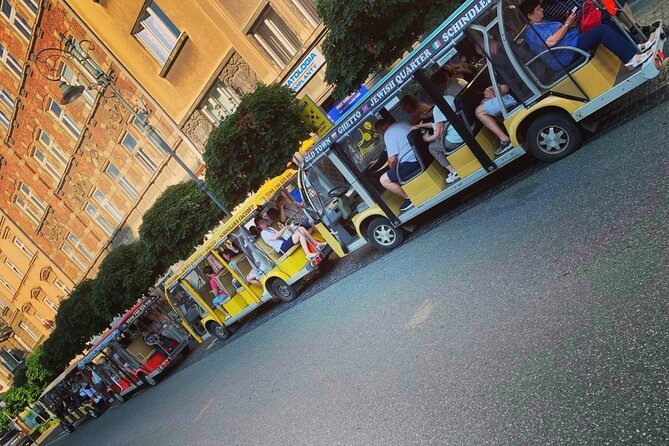
This tour starts at the Parking 24H Kraków old town car park on Mikołaja Zyblikiewicza 2. That’s helpful because it puts you near a walkable, central area, not out on the edge where you’d need extra transit. If you like to plan calmly, this is the kind of meeting point that makes your day feel less chaotic.
Pickup is also offered, which you’ll appreciate if you’re arriving by tram, walking in from the main sights, or just do not want to play navigation games in winter darkness. And yes, this is in Krakow, so even when the weather turns, you won’t be stranded far from a real street scene.
More Golf Cart Tours in Krakow
- Krakow: City Sightseeing Tour by Electric Golf Cart
★ 4.5 · 3,264 reviews - Krakow: City Sightseeing Tour Eco Electric Buggy Golf Cart
★ 4.7 · 3,143 reviews - Krakow: Extended City Sightseeing Tour – Eco Buggy Golf Cart
★ 4.7 · 794 reviews
Eco Electric Buggy Comfort When Krakow Turns Cold
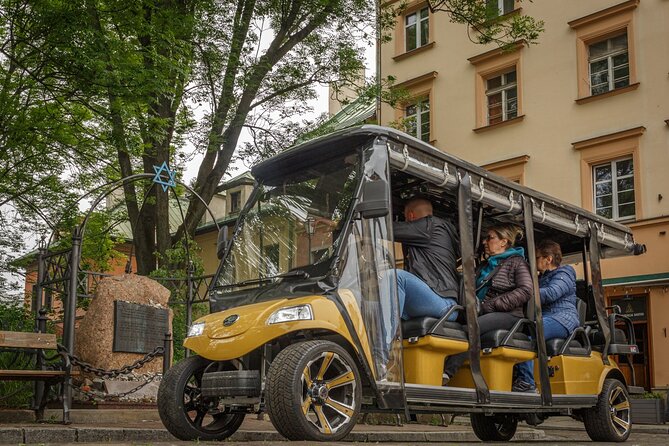
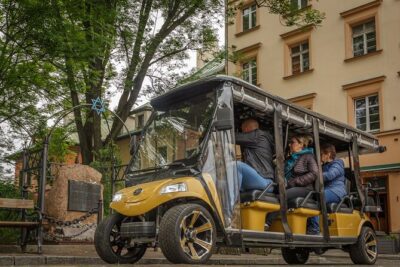
You’re riding an eco electric buggy golf cart, designed for short hops between sights. The big win is simple: your legs get a break while you still see a lot. Multiple people specifically called out how manageable it feels even when it’s freezing outside.
Practical comfort details matter here. Blankets were mentioned, and heating also came up. That turns a “maybe this will be miserable” day into a “fine, let’s go” day. It’s still an open-air style of transport, so if it’s really biting out, bring gloves and a hat anyway.
One heads-up: the ride can be a little bumpy. That’s not unusual when you’re gliding over city streets, but it’s worth knowing if you’re prone to motion discomfort. Also, because it’s a group activity, try to arrive a few minutes early so staff can assign seating smoothly.
Skałka, the Church on the Rock, and a Story with Teeth
Your first meaningful anchor is Church on the Rock (Kosciol na Skalce), the Saint Michael the Archangel and Saint Stanislaus the Bishop and Martyr Basilica. This spot sits atop a small rock outcrop, with a Pauline monastery in the picture. The setting alone makes it feel different from a typical street church.
The story linked to this site is intense and specific. In 1079, Bishop Stanislaus of Szczepanów was slain on this rock by order of Poland’s King Bolesław II the Bold. That political violence triggered upheaval, including the king’s exile and, later on, the bishop’s canonization. It’s the kind of moment that explains why religious sites in Krakow are never only about architecture.
There’s no paid admission ticket mentioned for this stop, so you can focus on the experience rather than budgeting. If you want a quick win, arriving here early in your tour helps, because it sets a tone for the rest of the route.
Kazimierz Market Life at Plac Wolnica
From church terrain to urban commerce, you’ll pass through Plac Wolnica, which was part of Kazimierz’s original market square when the city was founded in 1335. Think of it as a place that once handled trade, with civic functions too, like a town hall and authorities focused on administration and justice.
The name itself is a clue. Plac Wolnica traces back to the Latin Forum liberum, tied to the right to free trade in meat outside stalls. The form of the name you’ll see today dates from the end of the 18th century, when Kazimierz gained the privilege of free trade.
Why this matters for you, beyond history trivia: walking Kazimierz can feel like a maze unless you know what kind of space you’re standing in. Plac Wolnica gives you that mental map fast, so later synagogue stops hit harder, because you understand how neighborhoods organized daily life.
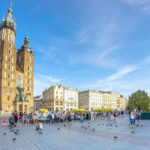
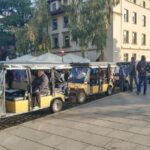
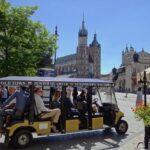
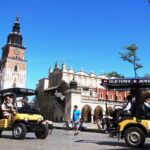
More melex loops around the old town:
Monastery Basilicas and the Big Land Plot Behind the Walls
Another stop centers on a monastery church built in stages from 1340 to around the mid-15th century. The clue is in its layout: it was intended as a monastery church, so it sits on a larger plot than you might expect. There’s also a monastic cemetery next to it, which reinforces that this wasn’t just a church for casual visits.
In 1404, King Władysław II Jagiełło gave this church to the Canons Regular of the Lateran, a congregation he brought from Kłodzko. For you, this means you’re seeing how Krakow’s institutions shifted and expanded over centuries, not in neat modern categories.
The Jewish Quarter Route, One Synagogue at a Time
If you do only one thing in Krakow besides touring Auschwitz, you should consider understanding Kazimierz. And this buggy route is a practical way to do it because it strings together multiple synagogues in a way that helps you compare styles and eras without getting exhausted.
Here’s what you can expect from the synagogue stops, in plain terms:
Tempel Synagogue: Worship and a Culture Hub
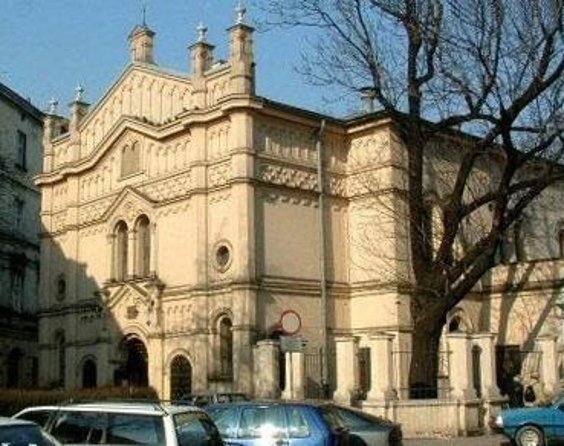
The Tempel Synagogue is more than a place of worship. It’s also described as a center of Jewish culture in Krakow, hosting concerts and meetings, especially during festival times. That makes the building feel alive, not frozen in the past.
When you visit or pass by places like this, it helps to notice the dual purpose. It’s not only sacred space. It also supports community life.
Kupa Synagogue: A 17th-Century Anchor for Community Events
The Kupa Synagogue dates to the 17th century and sits in the former Jewish quarter of Kazimierz. It serves the Krakow Jewish community for religious ceremonies and cultural festivals, including the annual Jewish Culture Festival.
If you’ve ever wondered how a neighborhood stays meaningful across centuries, this is one of the best clues in the city. The building isn’t only a museum. It’s connected to ongoing community rhythm.
Izaak Synagogue: Isaac the Rich and Italian Design
At the Izaak Synagogue, you’re looking at an Orthodox Jewish synagogue from 1644. It’s named for its donor, Izaak Jakubowicz, also known as Isaac the Rich, a banker connected to King Ladislaus IV.
The architect was Francesco Olivierri, an Italian-born designer. That’s a valuable reminder for you: Krakow’s Jewish architecture was influenced by broader European talent, not built in isolation.
High Synagogue: Tall Synagogue Means Exactly What It Sounds Like
The High Synagogue, also known as the Tall Synagogue, is inactive today. It’s a 16th-century Orthodox synagogue, and it’s called Tall because of the building’s height, and possibly also because the prayer hall was upstairs.
Late Renaissance architecture is the style label here. You may not need to identify every detail, but do look at proportions. It’s the kind of building where the overall shape tells you the story, even before you read any plaque.
Old Synagogue: The Oldest Still Standing
The Old Synagogue is described as the oldest synagogue building still standing in Poland, sometimes known in Yiddish as the Alta Shul. It also served as a central hub for Krakow’s Jewish community up through the outbreak of World War II in 1939.
For you, this stop is emotional in a way that doesn’t require theatrics. The age and continuity, followed by rupture, is part of the lesson. If you feel quiet, that’s normal. Just let the silence do some work.
Wolf Popper Synagogue: The Stork, the Animals, and the New Uses
The Wolf Popper Synagogue, also tied to the name Poppera, was founded in the early 17th century by Wolf “The Stork” Popper. There’s a vivid detail about its entrance: openwork doors once showed four animals, including an eagle, a leopard, a lion, and a buck deer. They symbolized traits of a devout man.
Today, it serves new roles: a bookshop and an art gallery in the women’s area upstairs. That mix of old space plus present-day use is exactly why Kazimierz feels real. It’s not only about surviving memory. It’s also about continuing life.
Augusta Rubinstein Stop: A Person Linked to Big Names
One stop is connected to Rubinstein, described as Augusta Rubinstein, one of eight daughters. The details include that philosopher Martin Buber was her cousin. The stop is likely tied to a specific marker or site connected to her, but the key value for you is the human thread: cultural influence isn’t just anonymous.
Use this as a reminder that Jewish life in Krakow produced people who connected to major intellectual circles across Europe.
Remah Synagogue: Smallest, Named for ReMA, Still Active
The Remah Synagogue is the smallest of the historic synagogues in the Kazimierz district. It’s named after Rabbi Moses Isserles, known by the Hebrew acronym ReMA. It’s currently one of two active synagogues in the city, so it’s not only a monument.
As a visitor, I like that contrast. You can see many synagogues with different statuses, and that makes the story feel current instead of locked in time.
Where the Jewish Quarter’s Past Hides in Street Layouts
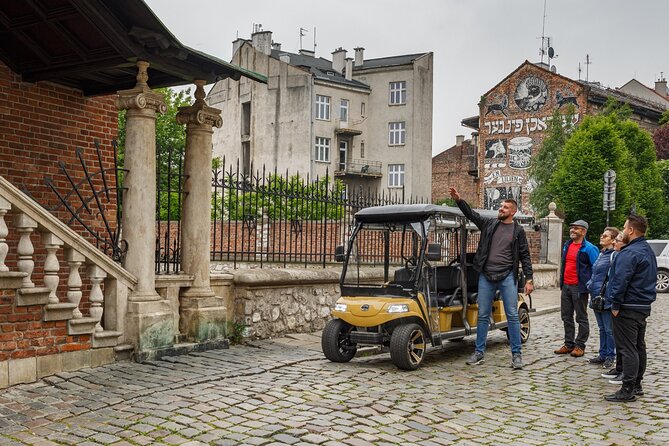
Some of the most interesting Krakow moments are not single buildings. They’re how the street grid tells you what used to exist.
One stop references the Libuszhof, a former complex of streets and buildings that existed until the 19th century. The current shape was established in regulatory projects in 1808 and 1844. On the northern side of the square, along the defensive walls of Kazimierz, are houses that used to belong to a Jewish hospital associated with the Kupa synagogue.
For you, this matters because it teaches you how to read a neighborhood. You start noticing the defensive walls, the way blocks curve, and the evidence that everyday services, not only places of worship, shaped what Kazimierz became.
Ghetto Heroes Square and the Eagle Pharmacy Museum
Switching from Kazimierz to Podgórze gives you a heavier, more direct chapter. At Ghetto Heroes Square, the location once went by other names, including Mały Rynek around 1880 and Plac Zgody from 1917 to 1948. Between 1941 and 1943, this square was inside the Kraków ghetto, functioning as a concentration point before people were transported to concentration camps.
One detail is central here: at number 18 there was the pharmacy called Under the Eagle, run by Tadeusz Pankiewicz. It’s described as the only non-Jewish inhabitant of the ghetto.
Then you connect the dots at the Eagle Pharmacy Museum, at that same address. The proprietor was Jozef Pankiewicz starting in 1910, and his son Tadeusz took over running it in 1933. Before World War II, it was one of four pharmacies in the Podgórze district, serving Polish and Jewish residents. There’s also mention of charity connections like Bikkur Cholim.
In March 1941, when the Germans established the ghetto in Podgórze, the pharmacy was described as the only one within the ghetto borders. Tadeusz Pankiewicz was described as the only Pole with rights to stay in the ghetto.
For me, the value of this section is that it gives you a tangible object lesson. You’re not only hearing about policies. You’re standing at a workplace where survival and ethics intersected.
Schindler’s Enamel Factory and Podgórze Church Views
The route also includes Oskar Schindler’s Enamel Factory, a former metal item factory in Krakow that now hosts two museums. One is the Museum of Contemporary Art on the former workshops. The other is a branch of the Historical Museum, located at ul. Lipowa 4 in the former DEF administrative building, the same factory linked in film imagery.
Why it’s valuable for you even if you are not doing a long museum visit: the tour gives you a grounded context. You see the factory as a real industrial space first, then you connect it to the stories people associate with Schindler.
After that, you’ll pass Old ghetto wall as a stop, and you’ll also reach St. Joseph’s Church in Podgórze, on Podgórski Square on the northern slopes of the Krzemionki foothills.
This combination helps your brain do something useful: it ties the ghetto period into the physical city around it. Buildings and walls are not background. They shape what happened.
Price and Time Value for $28.88 in 1.5 Hours
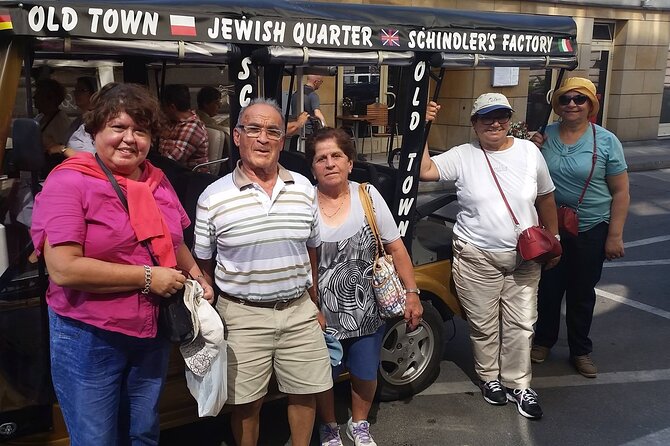
At $28.88 per person for about 1 hour 30 minutes, the value comes from density. This is not one neighborhood and done. It’s Kazimierz synagogues, market squares, Podgórze ghetto landmarks, plus the Schindler factory area, all without forcing you to sprint between far-apart points.
The comfort details you heard about, like blankets and heating, help justify paying for transport when weather is not on your side. And the narration support matters because you’re collecting context while you ride, rather than relying only on your own reading time later.
Still, you need to match expectations to the format. This is built for seeing a lot of stops, not for long museum hours inside every site.
Best Time to Go, What to Bring, and Photo Tactics
Timing changes the whole feel of this kind of tour. Some people found it easier in daylight, because dark hours can make it harder to spot details at street-level stops. If you can choose, go earlier in your trip and in better light.
What to bring:
- Warm layers. Even with heating and blankets, Krakow weather can cut through.
- Good walking shoes for short segments, since getting to the meeting point and moving at stops is still part of the day.
- A charged phone for photos and any quick notes, because you’ll be hopping around many areas.
Photo tactic that works well: take a quick wide shot at each stop, then one closer shot. The wide one helps you remember where everything sits, later.
Who Should Book This Krakow Eco Electric Buggy Tour
This tour is a great fit if you want:
- A fast orientation to Krakow’s main districts
- A guided overview that includes Kazimierz synagogues and Podgórze ghetto memorial sites
- A day plan that protects your energy without skipping the important context
It may be less ideal if:
- You strongly dislike group seating or you are very sensitive to bumpy rides
- You need guaranteed, problem-free audio headsets at every stop, since a small number of people reported headset issues
If you’re going with friends, even better. One person can focus on listening, while the others keep track of photo moments and meeting points.
Should You Book It?
Yes, I think you should book this if your goal is to get your bearings quickly and understand Krakow in a connected way. The combination of Kazimierz synagogue stops, ghetto-era sites, and the Schindler factory area is exactly the kind of route that helps you later make sense of what you chose to spend more time on.
If you’re visiting in winter or you’d rather not walk for hours, this is one of the most practical ways to do it. Just be ready for a group experience, and if you care about comfort or audio, say something early so the ride stays enjoyable.
Freshly posted from Krakow
- ZALIPIE – painted village, unique small group tour from Krakow★ 5.0 · 7 reviews
- “John Paul II Route” PRIVATE -Wadowice, Kalwaria Z.-Łagiewniki★ 5.0 · 7 reviews
- Krakow: Craft Beer Tasting City Walking Tour★ 4.4 · 7 reviews
- Magic of Krakow: Guided Tour of the Old Town★ 5.0 · 7 reviews
- Krakow : Zakopane Tour + Thermal Pools with Hotel Pickup★ 4.8 · 7 reviews
- Krakow in One Day: City Tour by Electric Car★ 5.0 · 7 reviews
- Guided Tour of Plaszow Concentration Camp, Kraków★ 4.8 · 7 reviews
Golf Cart & Melex Tours, compared.
City Sightseeing Tour Eco Electric Buggy Golf Cart
Read our review →
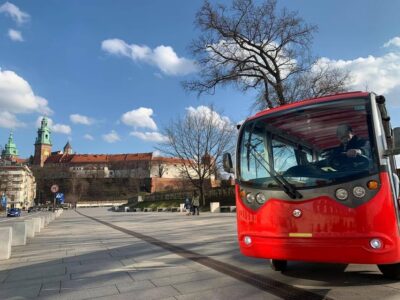
Extended City Sightseeing Tour – Eco Buggy Golf Cart
Read our review →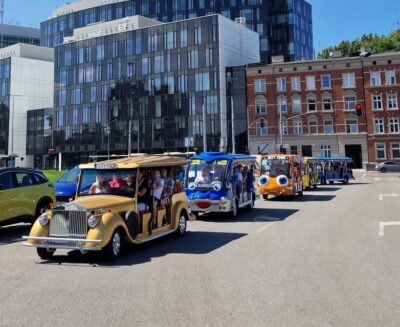
Shared or Private City Tour Sightseeing by Golf Cart
Read our review →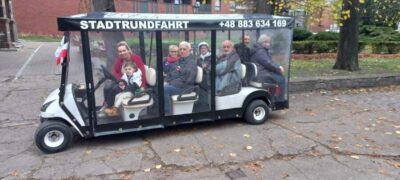
City Tour Live Guided by Golf Cart/Buggy Sightseeing
Read our review →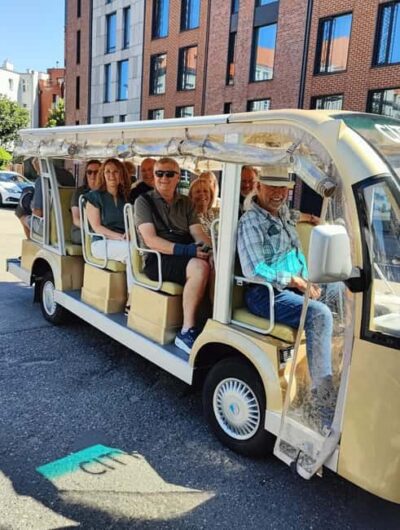
Shared/Private Golf Cart City Tour with Local Guide
Read our review →
Browse the lists this tour appears in