
Reviewed · HISTORICAL TOURS
Warsaw History and Reality Walking Tour
Warsaw makes sense when a guide points at it. This 2.5-hour walk connects the Mermaid statue and the rebuilt city to real details you’d otherwise skip, with story-driven stops along Warsaw’s historic spine. I especially liked the WWII context behind the Mermaid and the upstairs views from the University of Warsaw Library rooftop garden.
A possible drawback is the walking pace. You cover a lot in about 2 hours 30 minutes, and the rooftop garden portion is described as open April to October, so timing can matter for what you see.
In This Review
- Key highlights to expect
- Why this Warsaw history walk feels different than a standard “see it all” route
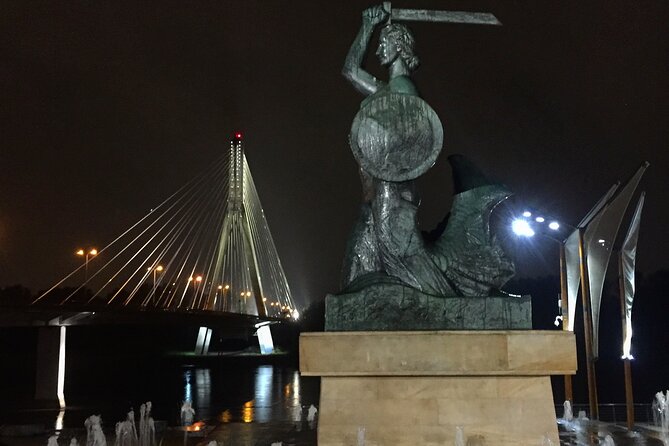
- Starting at the Mermaid statue, and why her story matters
- University of Warsaw Library rooftop garden: the break you’ll appreciate
- The rebuilt workers district: understanding what Old Town cost
- St. Anne’s Church and the Royal Castle square area
- Old Town on cobblestones: reconstructed streets with real emotion behind them
- Krakowskie Przedmiescie: the Royal Route and the Presidential Palace lions
- Plac Marszalka Jozefa Pilsudskiego: the Unknown Soldier and Saxon Garden
- Price and pace: whether $114.39 feels like a good deal
- Logistics that affect your comfort (without the headache)
- Who this tour suits best, and who might want something else
- Should you book this Warsaw History and Reality Walking Tour?
- FAQ
- How long is the Warsaw History and Reality Walking Tour?
- Is the tour offered in English?
- What’s included in the price?
- How many people are in the group?
- Where do you meet and where does the tour end?
- What happens if the weather is poor?
Key highlights to expect
- WWII and symbolism at Pomnik Syreny (Warsaw’s Mermaid), with the real backstory tied to the city’s coat of arms
- University of Warsaw Library rooftop garden and river views, plus a welcome break from street-level sights
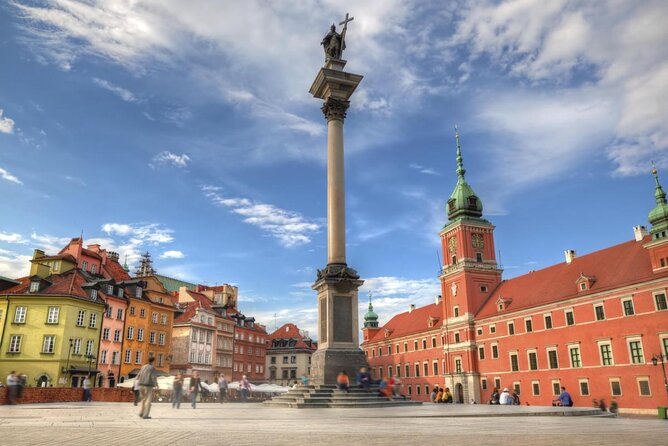
- Old Town’s reconstructed textures at St. Anne’s Church, the Royal Castle area, and the cobblestone lanes
- Krakowskie Przedmiescie’s Royal Route with major landmarks, including the Presidential Palace and its lions
- Plac Marszalka Jozefa Pilsudskiego for the Unknown Soldier memorial and the Saxon Garden afterward
- Small group size (max 10) so you can ask questions and actually keep up with the stories
Why this Warsaw history walk feels different than a standard “see it all” route
This tour works because it doesn’t treat Warsaw as one big museum piece. You move from symbol to street, from rebuilt stone to what it was built for, and from pretty facades to the reasons those facades exist.
I like that the route leans into Warsaw’s layered reality: the city you recognize, plus the city that had to be remade after World War II. In practice, it means you’re not just looking at landmarks. You’re listening for what each place stands for, and you start to notice patterns in the rebuilding and the meaning behind names.
Also, it helps that this is a small group. With a maximum of 10 travelers, the pace stays human, and the guide can tailor the flow when people ask questions or want to pause for photos. If you want a walking tour that feels more like a smart friend showing you around than a lecture on legs, this fits.
More Walking Tours in Warsaw
- Warsaw: Old Town Highlights Walking Tour in English
★ 4.7 · 1,516 reviews - Warsaw: Old Town Guided Walking Tour
★ 4.9 · 599 reviews - Half-Day Polish Food Walking Tour with Guide and Dinner
★ 4.5 · 381 reviews
Starting at the Mermaid statue, and why her story matters
The walk opens at Pomnik Syreny, the Warsaw Mermaid statue. On the surface, it’s a classic photo stop. But the story attached to the Mermaid is the point.
You’ll hear why the Mermaid appears in Warsaw’s coat of arms and who was the model connected to the sculptor. That alone is interesting, because it turns a familiar icon into a specific human story. Then the tour adds a WWII connection tied to the city, so the statue stops being just decorative. It becomes part of Warsaw’s survival and identity.
Timing is short here, about 10 minutes. So I recommend using that first stretch to get your bearings. Look around before you start walking, notice the scale of what’s around you, and let the Mermaid story give you a mental hook for the rest of the route.
One practical note: this is an outdoor starting area, so dress for the weather. The tour is described as requiring good weather.
University of Warsaw Library rooftop garden: the break you’ll appreciate
Stop two is the University of Warsaw Library, with a rooftop garden that is described as open April to October. If your trip falls within that window, you get the best version of this stop: a modern library feel combined with green space designed to respect the shape of the Vistula embankment.
Even when you just treat it as a view stop, it’s a smart move mid-walk. You’ve been on streets and facades, and suddenly you’re looking out over the river and across the city. It’s the kind of pause that keeps the tour from feeling like nonstop sightseeing.
The viewing terrace element is included in the tour. So you’re not scrambling for tickets or guessing if you’re allowed up somewhere. You show up, go in, and enjoy the perspective.
A small caution: if you’re visiting outside April to October, the rooftop garden itself may not be operating. The description highlights the seasonal opening, so check your travel dates if rooftop access matters to you.
The rebuilt workers district: understanding what Old Town cost
Between the rooftop stop and the next major church, you’ll pass through an area described as the first district in Warsaw rebuilt after WWII. The explanation ties it to work connected with rebuilding the Old Town, and the idea was to serve the workers who made that reconstruction possible.
This part matters because it changes how you read Warsaw. Old Town can look like a perfect, polished result from far away. But when you understand that real people rebuilt it in stages, you start to see the city’s effort, not just its output.
You don’t get a long time here in the plan, so use it as a mental reset rather than a full sightseeing stop. Notice what kind of neighborhood shape you’re walking through and think about how urban planning supports rebuilding, housing, and daily life. That’s where the tour title fits: history meets reality.
If you like tours that explain how a city functions, not just how it looks, this segment is one of the most satisfying moments.
More Polish squares crossed on foot:



St. Anne’s Church and the Royal Castle square area
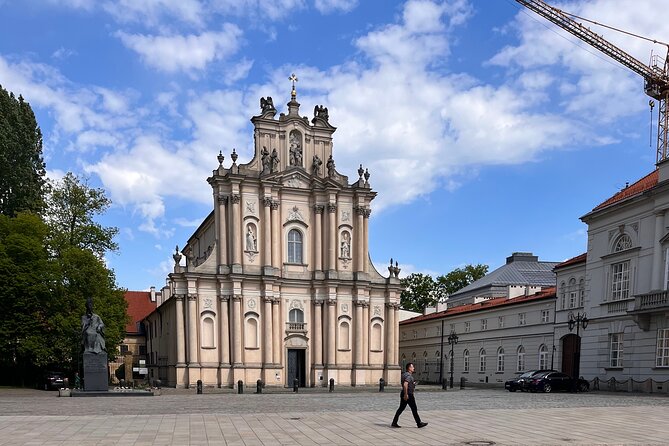
Next up is St. Anne’s Church (Kosciol Swietej Anny). It’s highlighted as one of Warsaw’s most beautiful baroque churches. If you’ve seen baroque elsewhere, you’ll recognize the drama: ornament, curves, and a sense of theater built into the architecture.
But the tour doesn’t keep you staring at the church walls. It also links your walk to the Royal Castle square area and to reconstructed tenement houses of the Old Town. That means you’re seeing how religious architecture, civic space, and residential facades all sit together.
There’s about 15 minutes allocated to this stop. That’s enough to absorb the main exterior feel and understand what makes the baroque style important here, without turning it into a slow church crawl.
If you’re sensitive to crowding, this is still a busy part of any Old Town visit. The good news is your guide’s timing and the route flow helps you avoid feeling stuck. You keep moving, and the explanations give the facades context instead of just decoration.
Old Town on cobblestones: reconstructed streets with real emotion behind them
Then you step into the Old Town. This segment is about 30 minutes and it’s designed to be pure walking. Expect cobblestone Gothic streets and alleyways, with lots of churches and tiered burgher tenement houses.
What makes this more than a scenic stroll is that the tour frames the reconstruction choices. You’re not only admiring the look of the lanes. You’re learning why the streets and buildings were reconstructed to reflect a past atmosphere. That turns the visuals into a story about memory and identity.
You’ll also hear about a favorite place of lovers. It’s the kind of detail that’s easy to miss on your own. In a tour like this, you don’t just see the famous sights. You also get the small local touch points that make the city feel lived-in rather than staged.
If you’re planning footwear, think practicality. Cobblestones are charming, but they’re also unforgiving if your shoes don’t have grip. Bring comfortable shoes you can walk on for the full 2.5 hours.
And yes, this is also where you’re most likely to slow down for photos. The trick is not to let photos eat your time. I find it helps to take a wide shot first, then come back for close details once the guide moves you along.
Krakowskie Przedmiescie: the Royal Route and the Presidential Palace lions
After Old Town, the route shifts to Krakowskie Przedmiescie, described as a 2.5 mile Royal route with major buildings and monuments. This stretch is a nice change of pace because it’s more structured and monumental than the Old Town lanes.
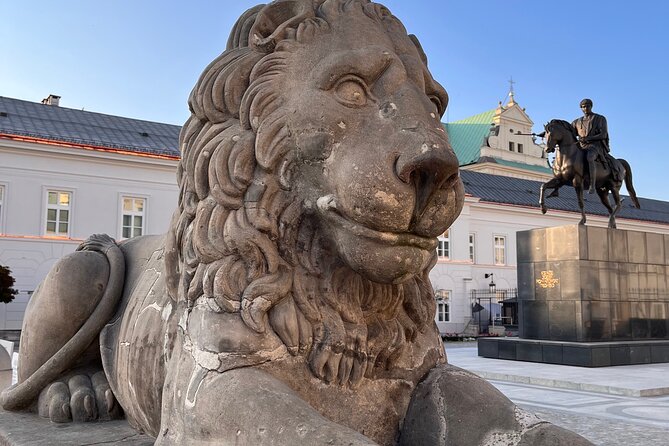
One of the main draws here is the Presidential Palace. It’s described as a beautiful neo-classic building where the Polish president resides. You’ll also hear about the four lions sculpted by Camilio Laudini that guard the palace. Lions at a palace might sound like a small detail, but it becomes a fun anchor for remembering what you’re seeing.
Then the tour adds a music history connection. You’ll hear that Chopin played there publicly for the first time when he was 8 years old. That’s the kind of fact that makes you look up at a building differently. Suddenly it’s not just architecture. It’s a stage where real people lived, performed, and passed through history.
Timing here is about 10 minutes. That’s short, but it’s consistent with a strategy that keeps the tour from bogging down. You get the main markers and the key stories, then you move on.
If you want deeper time inside any palace or museum, you’d need a separate plan. This tour focuses on context while you’re moving, and it does that well.
Plac Marszalka Jozefa Pilsudskiego: the Unknown Soldier and Saxon Garden
The final sightseeing stop is Plac Marszalka Jozefa Pilsudskiego. This parade square is important for Varsovians and a place for meetings, concerts, and events. You also see the memorial of the Unknown Soldier.
This memorial is one of those landmarks that lands differently when a guide gives you the interpretive angle. Without that, it can feel like just another statue. With context, it becomes a way to understand national memory and public space in Warsaw.
Behind the memorial is the Saxon Garden. That’s a small but thoughtful finish. Gardens after intense architecture help your legs cool down and your brain reset.
The time is about 10 minutes for this stop. Again, it’s not trying to be a long park hangout. It’s designed as a closing chapter that ties history to daily life.
Price and pace: whether $114.39 feels like a good deal
The price is $114.39 per person for about 2 hours 30 minutes. You’re getting a lot of walking, a guided English explanation, and an included entrance ticket for a viewing terrace.
What tips the value in your favor is that the itinerary is built around stops where admission is listed as free, while the terrace access is specifically included. So you avoid the classic problem where you think a walking tour covers everything, then you hit paid entries that weren’t mentioned.
You’re also capped at a maximum of 10 travelers, which usually means the guide can actually speak like a human, not like a radio announcer.
One more factor: the tour is described as offered in English with a mobile ticket. That matters in real life because it reduces friction. You don’t want to spend your limited sightseeing time figuring out logistics.
If you’re doing only a single paid history walk in Warsaw, this one is a strong candidate because it threads multiple key areas into one coherent story rather than bouncing randomly.
Logistics that affect your comfort (without the headache)
You’ll start at Pomnik Syreny, the Mermaid statue area, and the tour ends at the Roman Catholic Church of the Visitants on Krakowskie Przedmieście 34, with Google Maps pointing you toward meeting near the Cardinal Stefan Wyszyński statue.
Since it’s near public transportation, you can also use transit for quick connections before and after the tour. The format is best if you already know where you’ll be staying or if you’re planning to explore the city center afterward.
Bring water, plan for sun or wind, and wear shoes that do well on cobblestones. The tour is described as requiring good weather, so have a backup plan for rain.
Also, it’s worth knowing this is a small group, and the guide can adapt. In past tours with Mona, people highlighted how she adjusted the route, answered deep questions, and even offered restaurant recommendations at the end. That kind of attention is not common in the cheapest group tours.
Who this tour suits best, and who might want something else
This is ideal if you:
- Want a guided narrative of Warsaw, not just a list of sights
- Like WWII context tied to icons like the Mermaid statue
- Prefer a small group (max 10) where questions feel normal
- Enjoy walking through Old Town streets and learning how reconstruction shaped what you see
It might not be your best match if you:
- Want very long, slow museum time, since many stops are short by design
- Are traveling with limited mobility, since it’s still a walking route (the tour says most travelers can participate, but the street surfaces include cobbles in Old Town)
- Are visiting outside April to October and rooftop views are your main goal, since the rooftop garden is described as seasonal
Should you book this Warsaw History and Reality Walking Tour?
I’d book it if you want to understand Warsaw beyond the postcard version. The mix of symbol stories (Mermaid and memorial), reconstruction context (post-WWII rebuilding), and practical city navigation (Old Town into Krakowskie Przedmiescie and ending in the central core) makes the time feel efficient.
If you’re the kind of traveler who likes to ask why something exists, or how a city reassembled itself after catastrophe, this tour gives you that. And with Mona_be_your_guide and a small group size, the experience tends to feel personal and flexible, not scripted.
If you only want a quick highlights walk with zero historical framing, then you might prefer a shorter, less story-heavy option. But if you want Warsaw to click in your mind, this one is a solid bet.
FAQ
How long is the Warsaw History and Reality Walking Tour?
It runs for about 2 hours 30 minutes.
Is the tour offered in English?
Yes, the tour is offered in English.
What’s included in the price?
The tour includes an entrance ticket for a viewing terrace.
How many people are in the group?
This experience has a maximum of 10 travelers.
Where do you meet and where does the tour end?
The start is at the Mermaid statue area, and the tour ends at the Roman Catholic Church of the Visitants on Krakowskie Przedmieście 34. Google Maps guidance references the Cardinal Stefan Wyszyński statue near the end.
What happens if the weather is poor?
The experience requires good weather. If it’s canceled due to poor weather, you’ll be offered a different date or a full refund.
Between Rebuilt Squares
- Warsaw: POLIN Museum of the History of Polish Jews Ticket
★ 4.7 · 1,142 reviews - Warsaw: Chopin Concert at Historical Venue in Old Town
★ 4.7 · 445 reviews - Small-Group Historical Guided Tour of Warsaw with pick up/drop off. Public Tour.
★ 4.5 · 343 reviews - Warsaw: Warsaw Historical Group Tour with Pickup & Drop-Off
★ 4.6 · 233 reviews
Freshly posted from Warsaw
- Krakow Small Group Tour from Warsaw with Lunch, Schindler’s Factory included★ 5.0 · 7 reviews
- Warsaw Private Transfer from Warsaw Chopin Airport (WAW) to City centre★ 4.0 · 7 reviews
- Wolfs Lair – Hitlers hideout★ 4.5 · 7 reviews
- 3-hour tour at Warsaw Uprising 1944 Museum /inc. Pick-up/★ 4.9 · 7 reviews
- Warsaw: Evening History and Pubs Tour by Retro Minibus★ 5.0 · 7 reviews
- Warsaw: Private Vodka Tasting Night with Snacks and Pickup★ 5.0 · 7 reviews
- Warsaw Old Town with Royal Castle + Royal Route: SMALL GROUP /inc. Pick-up/★ 5.0 · 7 reviews
Historical Tours, compared.
POLIN Museum of the History of Polish Jews Ticket
Read our review →
Gdańsk City Sights & History Guided Walking Tour in English
Read our review →

Tipsy Polish Food Tour With History, Pierogi & Shots
Read our review →
Browse the lists this tour appears in