
Reviewed · GOLF CART & MELEX TOURS
Gdansk: Hansa Electric Golf Cart City Tour with Local Guide
A one-hour cart ride can teach you a whole city. This Gdansk tour is built around Hanseatic trade stories and riddle-based sightseeing, so you are not just looking at buildings, you are spotting the meanings behind them. I particularly like the comfortable pace of an electric golf cart paired with short guided stops, which makes it easy for families and groups to keep up.
I also love that the route does not end with Old Town postcard stops, it pushes forward to the Gdańsk Shipyard and the history of Solidarity. One consideration: because it is only 1 hour with brief guided glimpses at each stop, if you want to linger for photos or go deep inside any single site, you will feel a bit rushed.
In This Review
- Key highlights to look for
- Riding in style from Pańska 1, and why the cart matters
- Hanseatic trade stories, hidden symbols, and the fun of solving the city
- St. Catherine’s Church and Wielki Młyn, where the tour starts teaching scale
- From the Port to the Fish Market area: grain, amber, and herring in motion
- The Museum of Second World War stop: history layers in a short moment
- Post Office and St. Brygida: city life behind the famous names
- Hala Targowa Kupcow Dominikanskich to St. Nicholas: merchants, markets, and power
- Gdańsk Shipyard and Solidarity: the tour’s emotional endpoint
- Finishing with Granary Island: trade infrastructure you can picture fast
- Price at about $4.89, and whether it is real value
- Should you book this Gdansk electric golf cart tour?
- FAQ
- Where is the tour starting point?
- How long is the Hansa electric golf cart city tour in Gdansk?
- Do you get a live guide?
- Is an audio guide included?
- Which major places are included on the route?
- Is the tour wheelchair accessible?
- What is included in the tour price?
- Can I cancel and get a full refund?
Key highlights to look for
- Riddles and secrets that help you notice symbols and meanings as you roll through the city
- Hanseatic trade storytelling, focused on merchants, markets, and port life
- Neptune Fountain and Crane challenges, a fun way to break up the history
- Great Mill, Wielki Młyn, tied to the scale of medieval industry in Gdansk
- Gdansk Shipyard plus Solidarity, where the tour’s message lands
- Audio guide included in German, English, and Polish for added flexibility
Riding in style from Pańska 1, and why the cart matters
The tour starts at Pańska 1, and right away you can feel the difference between a bus or a walking-only route and an electric golf cart. The cart keeps you moving while still letting you pause at key places with a live guide. It is a smart way to cover Old Town and Main Town without turning the day into a marathon.
I like that the experience is designed as active sightseeing, not passive museum time. You are constantly reorienting yourself, hopping between the city’s major points, and hearing how each area connects to trade, power, and everyday life. This also helps if you are traveling with kids or relatives who do not want to spend a whole day walking.
One practical perk: the tour includes “skip the ticket line,” and you also get audio guidance (German, English, Polish). That matters when you want the convenience of a guided route but still prefer to control your attention for a moment.
More Golf Cart Tours in Gdansk
- Gdansk: Shared or Private City Tour Sightseeing by Golf Cart
★ 4.9 · 754 reviews - Gdansk: City Tour Live Guided by Golf Cart/Buggy Sightseeing
★ 4.9 · 715 reviews - Gdansk: Shared/Private Golf Cart City Tour with Local Guide
★ 4.9 · 604 reviews
Hanseatic trade stories, hidden symbols, and the fun of solving the city
Gdansk earns its reputation as a trade gateway because the city was shaped by merchants, ports, and warehouses. What makes this tour work is that it frames the sights around that idea, so you can connect the dots quickly. You will hear about Gdansk as a center of Hanseatic trade, with references to former markets and the townhouses of wealthy merchants.
You also get riddles, secrets, and legends woven into the stops. Instead of “here is a building,” it feels more like “look closely, then listen for what you might have missed.” That is why the tour is especially good for mixed groups. People who like stories stay engaged, and people who like facts can track the historical logic from place to place.
The tour even adds built-in moments where you actively participate. Included are challenges at Neptune Fountain and the Crane. Those brief games or prompts help you remember what you heard, and they make the route feel less like a lecture and more like a guided quest.
St. Catherine’s Church and Wielki Młyn, where the tour starts teaching scale
Your first guided stop is St. Catherine’s Church, Gdańsk. It is a short look, but it is an important opening move. Churches like this usually tell you something about what communities valued, and early on the guide’s story helps you understand why certain spots mattered in the city’s daily rhythm.
Then comes Wielki Młyn, the Great Mill. This is one of the biggest industrial sites in medieval Europe, and the way the tour treats it is key. You are not just walking past an old structure, you are seeing how industry and trade fed each other. Grain had to be processed, and processing meant power, organization, and income. Standing at a place like this gives context to the later port themes, where food shipments and merchant activity drove everything.
A short guided window is both a strength and a limitation. The strength is momentum, you do not get bogged down. The limitation is that you may want more time if a site really grabs you. Still, for a one-hour format, the tour picks high-impact stops that do their job fast.
From the Port to the Fish Market area: grain, amber, and herring in motion
The route then turns toward the port zone and the older commercial heart of the city. This is where Gdansk starts to feel like the trade machine it was built to be. The tour focuses on the Port, the area around the Crane, and the Fish Market area, connecting those places to centuries of commerce.
You will hear about trade in items like grain, amber, and herring. Even if you already know Gdansk was a port city, hearing these specific goods listed makes the history feel concrete. It also helps you read the city differently as you look at waterfront structures, storage areas, and market-linked locations.
The tour also brings you to Stary Zuraw Portowy, the historic port crane. A crane is not just a picturesque prop. In port history, it represents loading power, logistics, and the ability to move goods efficiently. Seeing it with a guide’s explanation is one of the more satisfying “now I get it” moments of the ride.
And don’t ignore the pacing. Because you are in an electric cart, you are able to keep your bearings while still absorbing the geography. This matters in Gdansk, where the Old Town and waterfront details can blend together quickly if you are walking alone without a plan.
More melex loops around the old town:


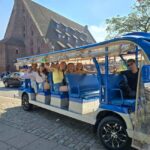
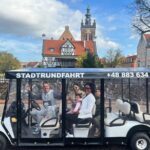
The Museum of Second World War stop: history layers in a short moment
One of the stops is the Museum of Second World War. The tour keeps it brief, with a guided sightseeing moment. That can be frustrating if you wanted a full museum visit, but as part of a one-hour story, it has a useful role.
Here is the angle I like: the tour is not only about merchant glory. It also acknowledges that modern history shaped the city’s identity and choices. When you pair a wartime history stop with later stops tied to courage and breakthrough, you get a clearer picture of why certain sites carry emotional weight for people in Poland.
If you are sensitive to heavy subjects, it is worth knowing that the tour does not linger. This is more of a “context marker” than a long form experience, so you can decide whether you want to come back later for a deeper visit on your own time.
Post Office and St. Brygida: city life behind the famous names
After the museum stop, the route continues to the Post Office, Gdańsk 1 and Parafia pw. Świętej Brygidy. These locations are not the biggest headline names for visitors, but that is exactly why they work well on a short guided cart tour.
Post and communication spots remind you how trade actually runs. Merchants needed reliable messages, paperwork, and coordination, especially in a city built on shipments and schedules. A short guided look here helps translate the tour’s broader theme into something practical.
Then St. Brygida adds a different layer. Religious sites often function as community anchors, and in a city with deep merchant roots, they also connect to how people lived, gathered, and interpreted the world around them. Even with only a few minutes, a guide can make you notice patterns, like what types of buildings get placed near commercial centers and why.
This section of the tour is a good reminder that sightseeing is not only about grand monuments. It is about understanding how daily functions supported the big story.
Hala Targowa Kupcow Dominikanskich to St. Nicholas: merchants, markets, and power
Next you get Hala Targowa Kupcow Dominikanskich, the market hall connected to Dominican merchants. In Hanseatic trade cities, markets are more than places to buy things. They are where relationships get made, information gets traded, and wealth concentrates. The guide’s story helps you view the market as a living system, not just a photo stop.
Then the tour includes Basilica of Saint Nicholas, Gdańsk, Royal Chapel, Gdańsk, and St. Mary’s Church, Gdańsk. I like that this trio of stops gives you a sense of how religious and civic identity overlapped with merchant status. You start to see why wealthy traders often invested in impressive spaces and why certain churches matter to city memory.
One practical benefit of this structure is that it breaks the tour into “business, then meaning.” After port and market talk, the churches help you process the emotional side of the city. You are learning the why behind the architecture and the messages people built into their surroundings.
If you are the type who likes to “collect” impressions quickly, this section works well. If you want detailed interiors, remember the tour time is short at every stop by design.
Gdańsk Shipyard and Solidarity: the tour’s emotional endpoint
The big finish is the Gdańsk Shipyard, tied to the history of Solidarity. The tour frames this as a stage of breakthrough and courage, and that tone shift is part of what makes the ride memorable.
Shipyard history changes how you see the city. Earlier you focused on merchants, goods, and logistics. At the shipyard, the story becomes about people, determination, and social change. The guide’s connection between place and history is the moment where a lot of visitors feel the tour “click.”
This is also a useful way to end a one-hour program. Instead of ending at another landmark that looks like the others, the shipyard gives you a strong final note. You leave with a clearer sense of what Gdańsk stood for, not just what it traded.
If your schedule includes more time in the city later, consider using this as your compass. The shipyard stop often signals which historical theme you want to follow next on your own.
Finishing with Granary Island: trade infrastructure you can picture fast
Near the end, you visit Granary Island and continue with the port-connected story through Stary Zuraw Portowy. Grain has already shown up in the tour themes, so granaries make the story visual. You can almost picture the workflow, ships arriving, goods being handled, and storage keeping trade steady between shipments.
Granary Island is also a nice “wrap-up space.” By the time you reach it, you are primed to interpret what you see. That is a real advantage of doing this in a guided sequence. You do not reach the waterfront and wonder what you are looking at, you arrive with context.
And because it is an electric cart tour, you are not forced to choose between seeing the port area and saving your legs. It is a practical match for short vacations, rainy days, or anyone who wants history without the strain.
Price at about $4.89, and whether it is real value
At around $4.89 per person, this tour is priced like a budget-friendly overview. For a one-hour experience with a live guide, riddles, multiple guided sightseeing moments, plus a shipyard visit, the value proposition is strong.
Here is how I judge it as a traveler: does the tour save you time and effort while still giving you meaningful context? Yes. The route hits key areas across Old Town and Main Town and ties them together with a consistent theme. You also get an audio guide in multiple languages, which adds flexibility if you miss a sentence or want to revisit the story later.
The trade-off is obvious. Because everything is tightly scheduled, you do not get long pauses or deep museum time. If you already know you want detailed interiors at places like churches or museums, you might treat this as the first layer, then plan follow-up visits.
But for first-time visitors or anyone with limited time, the price and format make a lot of sense.
Should you book this Gdansk electric golf cart tour?
I think you should book if you want a one-hour way to understand Gdansk through trade, markets, port life, and the shipyard story. It is especially suitable for families and groups because the pacing is active but not overly demanding, and the riddles keep attention from drifting.
You might skip it if you want a slow, deep, fully self-guided experience where you spend 30 to 60 minutes at one site. This tour moves quickly on purpose, and the value is in seeing the connections, not in lingering.
My best advice: use this tour to get your bearings and to choose what you want to see next. The shipyard and Solidarity link gives you an anchor theme, and the Hanseatic trade stops show you why Gdansk developed the way it did.
FAQ
Where is the tour starting point?
The tour starts at Pańska 1.
How long is the Hansa electric golf cart city tour in Gdansk?
The duration is 1 hour.
Do you get a live guide?
Yes, there is a live tour guide available in Polish, English, and German.
Is an audio guide included?
Yes. Audio guides are included in German, English, and Polish.
Which major places are included on the route?
The tour includes stops such as St. Catherine’s Church, Wielki Młyn, the Gdańsk Shipyard, the Museum of Second World War, the Post Office Gdańsk 1, St. Mary’s Church, Stary Zuraw Portowy, and Granary Island, among others.
Is the tour wheelchair accessible?
Yes, it is listed as wheelchair accessible.
What is included in the tour price?
Included are the golf cart journey through Old Town and Main Town, riddles, secrets, and legends of Gdańsk, challenges at Neptune Fountain and the Crane, and a visit to Gdańsk Shipyard.
Can I cancel and get a full refund?
Free cancellation is available up to 24 hours in advance for a full refund.
Freshly posted from Gdansk
- 1-Day Private Tour Stutthof Concentration Camp and Malbork Castle★ 5.0 · 1 review
- Oliwa Cathedral in Gdansk & Trip to Park – 2h private trip by luxury car★ 5.0 · 1 review
- Private Bartending Workshop in Gdańsk★ 5.0 · 1 review
- A Two Hour Walking Tour in Old Town Gdansk★ 5.0 · 1 review
- Gdańsk Private Romantic Sunset Cruise★ 5.0 · 1 review
- Sopot: Old Town Highlights Private Walking Tour★ 5.0 · 1 review
- Surprise Walk of Gdansk with a Local★ 5.0 · 1 review
Golf Cart & Melex Tours, compared.
City Sightseeing Tour Eco Electric Buggy Golf Cart
Read our review →
Extended City Sightseeing Tour – Eco Buggy Golf Cart
Read our review →
Shared or Private City Tour Sightseeing by Golf Cart
Read our review →
City Tour Live Guided by Golf Cart/Buggy Sightseeing
Read our review →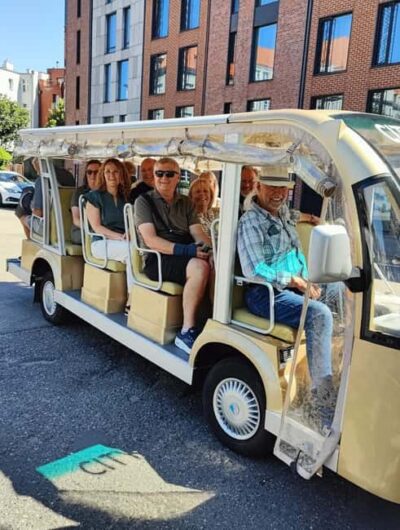
Shared/Private Golf Cart City Tour with Local Guide
Read our review →
Browse the lists this tour appears in