Reviewed · WARSAW TOURS & ACTIVITIES
Warsaw Off the Beaten Path & Local Pastry
Warsaw has a quieter side. In two hours, you’ll walk through communist-era planning and end with a local pastry moment, plus a string of free, story-rich stops. What makes it special is the mix: power buildings, park edges, pre-war apartment blocks, and places with a real today feel.
What I like most is Łukasz’s excellent English and the way he adjusts the walk to your interests so you’re not just hearing dates. Second, I like how the route is built for value, lots of ticket-free stops in a tight loop, so your money goes to interpretation, not entry lines. One drawback to note: it’s a walking tour with short stops, so if you want long indoor time, you’ll need another plan after.
In This Review
- Key highlights you’ll feel right away
- A small-group route through Warsaw’s lesser-seen corners
- Łukasz’s English, architecture eye, and hands-on tailoring
- Stop 1: Nowy Świat 6/12, a communist power base you can spot fast
- Stop 2: Elizeum Park along the Warsaw Escarpment
- Stop 3: Pniewski House and the 1930s modernist statement
- Stop 4: Jazdów, the wooden-house colony with a very today feel
- Stop 5: Park Ujazdowski, a 19th-century garden-style pause
- Stop 6: Ujazdów Avenue, elegant 19th-century residences of the elite
- Stop 7: Mokotowska Street, pre-war apartments that survived
- Stop 8: Plac Konstytucji and Socialist Realism at street level
- Stop 9: Politechnika, the Faculty of Architecture at Warsaw University of Technology
- Stop 10: Wilcza, the local pastry stop for a quick sweet reset
- Stop 11: Hostel Witt, Roman Polanski’s The Pianist filming connection
- Stop 12: Hala Koszyki, the historical food market finish
- Price and timing: what $41.40 really buys you
- Who should book this Warsaw pastry-and-architecture walk
- Should you book this Warsaw off-the-map tour?
- FAQ
- How long is the Warsaw Off the Beaten Path and Local Pastry tour?
- Is the tour offered in English?
- What is the maximum group size?
- Do I get a mobile ticket?
- Where does the tour start and end?
- Are the stops ticket-free?
- Is free cancellation available?
Key highlights you’ll feel right away
- Small group (max 10), which keeps questions and conversation realistic
- English tour with a guide who gives practical suggestions beyond the street corners
- Architecture-forward route from 1930s modernism to Socialist Realism blocks
- Free admission at each listed stop, so your cost is mostly for guiding and time
- Pastry stop at Wilcza plus an ending at Hala Koszyki for food lovers
A small-group route through Warsaw’s lesser-seen corners
This is one of those tours where the city starts to make sense fast. You’re not stuck in the big-ticket sights loop, and you’re not wandering randomly either, because the walk ties together different eras of Warsaw along the way.
The pace is built for an efficient two hours. You’ll cover a lot of ground on foot, with about ten minutes at each stop, which is perfect if you want context without a half-day commitment. It also helps that the group is limited to ten people, so the guide can actually talk to you, not just perform at you.
The best use of this kind of tour is as a “get your bearings” tool. Afterward, you’ll know where to return on your own, and which streets to treat like an outdoor museum.
Still tacked up around Warsaw
- Warsaw: Chopin Concert in the Old Town
★ 4.8 · 2,287 reviews - Warsaw: Traditional Galar Cruise on The Vistula River
★ 4.6 · 1,640 reviews - Warsaw: Old Town Highlights Walking Tour in English
★ 4.7 · 1,516 reviews
Łukasz’s English, architecture eye, and hands-on tailoring
A big part of why this works is the guide, Łukasz. His English is described as excellent, and that matters because architecture and city planning get clearer when you can ask direct questions and follow the explanations.
I also like that he doesn’t run the same script for everyone. One theme from recent experiences is that he engages with you, including where you’re coming from, and he can shift the focus based on what you care about. If you’re into architecture and photography, this tour is especially compatible with that mindset, because he tends to point out what to look for and how buildings communicate power, taste, and survival.
And yes, he tends to share tips for the rest of your stay. Even a few local suggestions can save you time and prevent the usual “walk until you find something” frustration.
Stop 1: Nowy Świat 6/12, a communist power base you can spot fast
You start at the Charles de Gaulle statue on Nowy Świat, and the first stop is Nowy Świat 6/12. It’s identified as the former headquarters of the communists, which immediately sets the tone for how this walk will connect politics to streets and buildings.
What to pay attention to here is not only the structure, but the idea of location. In many cities, the political center tells you where authority wanted to be visible, and Warsaw is no exception. Even with only a short visit, you’ll come away with a clearer sense of why certain areas carried more weight than others.
Possible drawback: this is a “notice-and-understand” stop more than a deep-entry visit. If you’re hoping for guided interior access, you may be a bit limited by the exterior-focused timing.
Stop 2: Elizeum Park along the Warsaw Escarpment
Next you head to Elizeum Park. It sits along the Warsaw Escarpment, described as an exceptional natural site along which the city evolved over centuries. That line matters, because it turns a park into more than a green break. It becomes part of the city’s timeline.
For your walk, the escarpment is a useful mental model. You start seeing Warsaw as a mix of built form and terrain, with neighborhoods shaped by where the ground rises and falls. Even if you’re not a geology person, you’ll likely feel how this kind of setting influences views and street layout.
The only consideration is time. Ten minutes goes quickly, so treat it like a chance to reset your eyes, not to plan a full park detour.
Beneath the newer pins on the Warsaw board:

Stop 3: Pniewski House and the 1930s modernist statement
Pniewski House is next, and it’s noted as one of the important modernist buildings from the 1930s. This is where the tour stops being only about ideology and becomes more about style, design choices, and the idea of progress before the later devastation.
Modernism can feel abstract until you see how it’s used to communicate something. Look for the clean lines and the practical logic of form, then connect that to what came after. Warsaw’s 20th-century story is full of breakpoints, and this house is one of the earlier signals.
Because the stop is brief, you’ll get clarity more than details. Still, it’s a great primer if you later want to read a little more on interwar architecture.
Stop 4: Jazdów, the wooden-house colony with a very today feel
Jazdów is a colony of wooden houses, and it’s described as a place hosting local activities like lectures, concerts, urban gardening, and yoga classes. That combination is important. It shows you how Warsaw repurposes space and keeps culture moving in smaller venues.
What I like about this stop is the contrast. You’ve just been thinking in terms of political blocks and 1930s architecture, and then you’re in a more human-scaled environment. The wooden-house idea also gives you a different lens on survival and adaptation, especially in a city where so much has been rebuilt.
Possible drawback: activities change. You might not see a specific lecture or concert on the day you go, but the setting itself still communicates the neighborhood’s role as a creative hub.
Stop 5: Park Ujazdowski, a 19th-century garden-style pause
Park Ujazdowski is a beautiful 19th-century garden-style park. This is a calmer chapter in the walk, and it’s useful because it gives your brain a break between architectural “signals.”
You can use this stop for simple observation. Notice how the park structures the edges of the city, where paths tend to pull people through, and how the greenery softens the street grid. If you’re the type who likes photography, you’ll likely find frames here that don’t feel like the usual tourist angles.
Consideration: it’s short. Treat it as a palate cleanser and a place to breathe, not a full park outing.
Stop 6: Ujazdów Avenue, elegant 19th-century residences of the elite
Then you move to Ujazdów Avenue, described as an elegant 19th-century venue with former residences of Warsaw elite. This is one of those areas where architecture and social ranking are written into the streetscape.
As you walk, think about the word former. It reminds you that these buildings were made for people with power and taste in mind, and now they reflect that earlier worldview in their proportions and presence. It’s also an easy place to compare what you saw at the communist-era start to what you’re seeing here.
Short stop note: you may only catch the exterior feel. Still, the route works because the guide helps you connect what you see to the bigger pattern.
Stop 7: Mokotowska Street, pre-war apartments that survived
Mokotowska Street is next, and it’s described as lined with elegant pre-war apartment buildings that survived World War II. That wording is a reminder to look carefully at what remains, because surviving buildings are physical evidence of continuity where you might expect total loss.
This is a great stop if you like everyday architecture. Apartments are where most people live, and seeing them as part of the city’s endurance story makes Warsaw feel more real than monuments alone.
Possible drawback: if you want a lot of time to study building details, ten minutes may feel tight. The win here is understanding the big picture quickly, then returning later on your own if something catches your eye.
Stop 8: Plac Konstytucji and Socialist Realism at street level
Plac Konstytucji is described as a significant communist-era housing estate representing Socialist Realism, with Socialist Realism treated as a mandatory style in the 1950s. This is the most ideologically explicit stop on the walk.
What to watch for is how architecture can enforce an aesthetic. Socialist Realism is not just decoration, it’s a message, and on a housing estate that message affects daily life, from how people moved through public areas to how the buildings signaled the state.
Short stop warning: you won’t have time for a full, document-level explanation at this point. But you will leave with clearer language for what you’re looking at, which makes further self-exploration easier.
Stop 9: Politechnika, the Faculty of Architecture at Warsaw University of Technology
Next comes Politechnika, specifically the Faculty of Architecture of the Warsaw University of Technology. This stop connects the street-level walk to the education side of architecture, and it helps you see the city as a living classroom.
Even in a brief stop, it helps to ask yourself a simple question: who studies the choices that shape a place? When you know there’s a local architecture faculty nearby, you start noticing how Warsaw treats design, planning, and reconstruction as part of its ongoing identity.
Possible consideration: this is more of a “see the institution and get the context” moment than a visitor center stop. If you’re hoping for an indoor tour, the data here doesn’t promise one.
Stop 10: Wilcza, the local pastry stop for a quick sweet reset
Then you reach Wilcza, the local pastry stop. This is where the tour shifts from architecture talk to taste, and it’s exactly the kind of break that keeps a walking tour from feeling heavy.
You’ll have time to buy something sweet and snack like a local. Since the specifics of which pastry aren’t spelled out here, don’t assume you’ll get a named item. Go with what’s available that day, and consider asking what people recommend.
Possible drawback: the stop is short. If you want a full café sit-down, plan that after the tour ends. During the tour, the goal is a quick, satisfying local bite.
Stop 11: Hostel Witt, Roman Polanski’s The Pianist filming connection
Hostel Witt is a very interesting stop because it’s described as a house where Roman Polanski filmed his famous The Pianist movie. Even if film is not your main interest, this connection changes how you see a building.
What I like about film-linked stops is that they turn abstract history into something visual. You start imagining how a location would look on camera, and you also notice how a place can carry multiple layers of meaning over time.
Short stop reality: you may not have time for a full deep dive on the production details. But as a perspective shift, it works.
Stop 12: Hala Koszyki, the historical food market finish
Finally, the tour ends at Hala Koszyki, a very popular local spot housed in a historical food market building constructed over 100 years ago. Finishing here is smart because the experience naturally ends with food, not a final question mark.
This is also where you can expand your meal without overplanning. If you want to try something Polish, you can browse at your pace and choose what looks best. If you want something lighter after a couple of hours of walking, you can do that too.
Practical note: because it’s a popular venue, it can get crowded. Give yourself a little extra patience at the end and keep your expectations simple, enjoy the atmosphere and the options.
Price and timing: what $41.40 really buys you
At $41.40 per person, you’re paying for a guided walk that strings together 12 meaningful stops in about two hours. Each stop is listed as admission ticket free, which is key. Your money is for the guide’s storytelling and navigation, not for expensive entries.
Value-wise, you’re also getting several advantages at once: English language instruction, a small group cap of ten, and a route that mixes architecture, public space, and local food. That combination is hard to replicate on your own unless you already know the city well.
Timing: the tour starts at 1:00 pm and runs long enough to reset your afternoon. It’s a solid choice if you arrive earlier in the day, or if you want to reduce jet lag by getting your body moving and your bearings set without committing to a full-day plan.
Who should book this Warsaw pastry-and-architecture walk
This tour fits best if you:
- like architecture and city design, and you want explanations that help you see patterns
- want a small-group walk rather than a big bus crowd
- enjoy local food stops, even if it’s just a quick pastry moment
- want a route that includes communist-era planning, pre-war survivals, and Socialist Realism in a single loop
If you only want major monuments and museum ticket time, this may feel a bit too street-level and outdoor. The upside is that you get more variety in less time, and you can follow up later based on what you liked.
Should you book this Warsaw off-the-map tour?
I’d book it if you want a smart, efficient way to understand Warsaw beyond the obvious highlights, with an architecture-minded guide and a real local food ending. The biggest reasons to say yes are the small group size, English-friendly guidance, and the fact that the stops are ticket-free, so your cost goes to interpretation.
I’d think twice if you need lots of indoor access or long sits at each location. This is built for walking, brief stops, and quick context. Done right, that style leaves you curious, not exhausted.
FAQ
How long is the Warsaw Off the Beaten Path and Local Pastry tour?
It runs for about 2 hours.
Is the tour offered in English?
Yes, the tour is offered in English.
What is the maximum group size?
The tour has a maximum of 10 travelers.
Do I get a mobile ticket?
Yes, it includes a mobile ticket.
Where does the tour start and end?
The tour starts at the Charles de Gaulle statue, Nowy Świat 12, and it ends at Hala Koszyki, Koszykowa 63.
Are the stops ticket-free?
The listed stops show admission ticket free.
Is free cancellation available?
Yes. You can cancel up to 24 hours in advance for a full refund.
Freshly posted from Warsaw
- Warsaw Uprising and WWII Old Town Walking Tour with Museum★ 5.0 · 1 review
- EVERYDAY Warsaw Traditional Food Tour with Old Town Sightseeing★ 5.0 · 1 review
- Warsaw to Auschwitz and Krakow Old Town Full-Day Trip by Car★ 5.0 · 1 review
- A Day in Warsaw: Private Full-Day Highlights Tour★ 5.0 · 1 review
- Pub Crawl with Shots, Discounts, Games & VIP Entry★ 5.0 · 1 review
- POLIN Museum of the History of Polish Jews : PRIVATE TOUR /inc. Pick-up/★ 5.0 · 1 review
- Full-Day Kazimierz Dolny Private Tour from Warsaw with Guide★ 5.0 · 1 review
Warsaw Tours & Activities, compared.
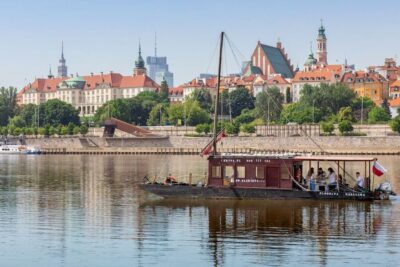
Traditional Galar Cruise on The Vistula River
Read our review →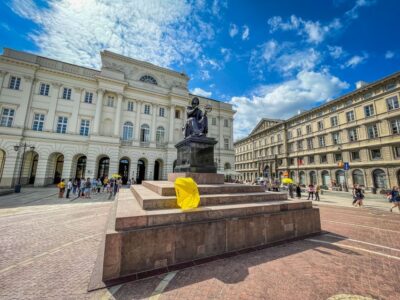
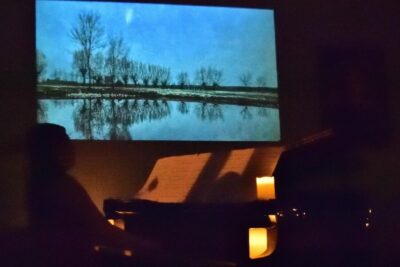
Warsaw Concert: Chopin – Painted by Candlelights with Wine
Read our review →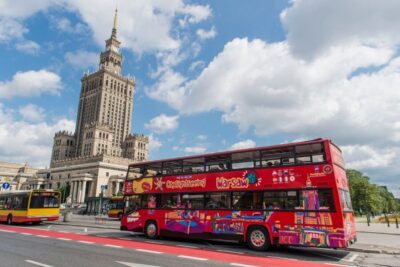

Highline Warsaw Entry With 360° Views & Rooftop Bar
Read our review →
POLIN Museum of the History of Polish Jews Ticket
Read our review →