
Reviewed · CITY TOURS
Warsaw City Tour – PRIVATE (4h)
Warsaw in four hours, with real context.
This private half-day gives you a guided thread through Poland’s capital, from UNESCO-listed Old Town to the calm of Lazienki Park, with a local explaining how the city was rebuilt after brutal destruction. I like that the stops are not random, they connect: royal power, civic life, wartime memory, then modern Warsaw’s science and skyline.
Two things I especially like. I love the way the guide turns key monuments into a story you can actually follow, including why certain symbols were moved or reconstructed. I also like the practical flow, hotel pickup and drop-off, plus transport between the core areas so you spend less time figuring out buses and more time seeing what matters.
One consideration: the day mixes walking and car travel, and in car-restricted zones you may do more on foot than you expect. If it is hot, rainy, or anyone in your group needs extra comfort time, plan for a slightly slower pace and tell the guide right away so the route can be adjusted.
In This Review
- Key highlights at a glance
- King Sigismund’s Column to Old Town, where symbols get a second life
- Royal Castle and St. John’s Cathedral, royal power meets national identity
- Rynek Starego Miasta and the Barbican, the heart of Old Town
- Warsaw Uprising Monument and the Tomb of the Unknown Soldier, remembering without theatrics
- Miodowa Street and Theatre Square, the Royal Route in miniature
- Royal Route to Tomb, then the science and parks that soften the day
- The 1950s skyscraper and the 2012 stadium era, modern Warsaw in one block
- Copernicus Science Centre, hands-on Warsaw if you have extra energy
- Price and vehicle reality for a $195.18 private half-day
- Who should book this private Warsaw city tour
- FAQ
- How long is the Warsaw City Tour – PRIVATE?
- Is the tour private or shared?
- Does the tour include hotel pickup and drop-off?
- Is the guide available in English?
- What does the tour price include?
- Are admission tickets included?
- Is the tour ticket mobile?
- Where will the guide meet me?
- What is the best time of day to plan this?
- What if I need to walk less?
- Should you book this private 4-hour Warsaw tour?
Key highlights at a glance
- Hotel pickup and drop-off reduce friction and make a 4-hour tour feel truly half-day
- Old Town and Royal Castle reconstruction explained as a living postwar story, not just sightseeing
- Memorial stops with meaning, including the Warsaw Uprising Monument and the Tomb of the Unknown Soldier
- Lazienki Park breaks up the schedule with space to breathe near the Chopin-related concerts
- Modern Warsaw options built in, from the Copernicus Science Centre to the 1950s skyscraper and the 2012 stadium area
King Sigismund’s Column to Old Town, where symbols get a second life
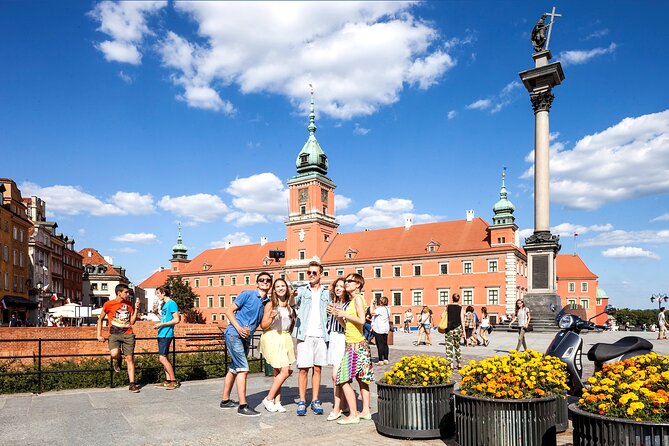
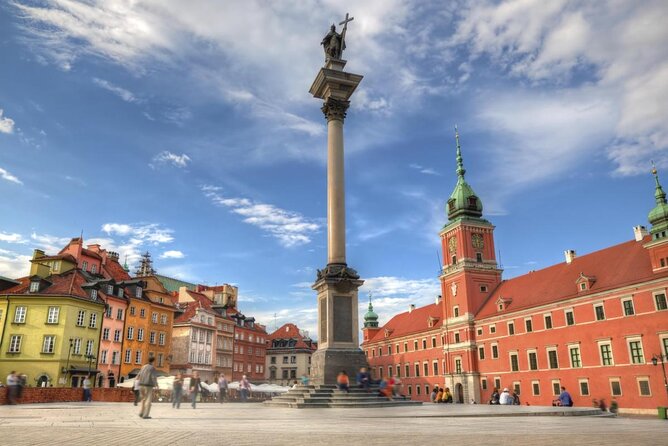
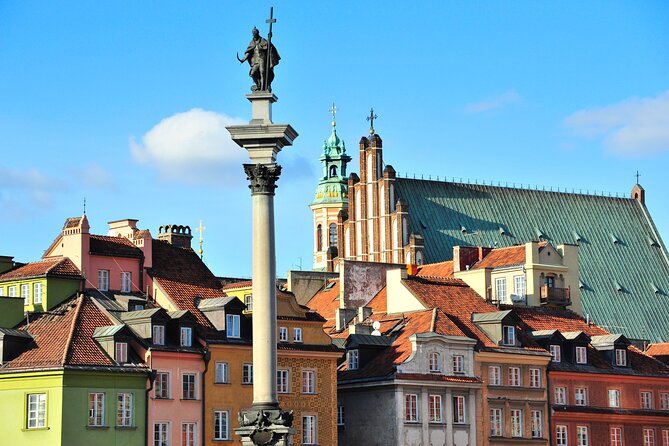
You start at King Sigismund’s Column, one of Warsaw’s best-known landmarks. It is the oldest public memorial in Warsaw, but it has not always stood where you see it today, it was moved when major street axes changed and later during the development of the WZ route. Then came World War II, when German troops brought it down in 1944, followed by reconstruction finished in 1949.
This is a smart opener because it teaches you how Warsaw works: history here was repeatedly broken, then carefully rebuilt. Spend a few minutes looking at it as a symbol of continuity, even when the city’s layout and political realities kept shifting.
From there you move into Old Town, the UNESCO World Heritage Site. The area grew quickly because the city was founded at a trading-friendly spot on a river tied to routes between the Baltic Sea and the Black Sea. Over centuries, wooden structures and older defenses gave way to masonry tenements and stone walls, then 1944 brought near-total destruction of the district, with around 90 percent razed.
Old Town feels like the city’s greatest act of reconstruction, and your guide can help you read the place in layers. You see what was rebuilt, you learn what disappeared, and you understand why it earned UNESCO status as a faithful restoration of an historic urban core.
Practical note: this is usually where you will walk a bit, so comfortable shoes matter. Also, even when the sights are free outside, take your time, because the story is in the details.
Still tacked up around Warsaw
- Warsaw: Chopin Concert in the Old Town
★ 4.8 · 2,287 reviews - Warsaw: Traditional Galar Cruise on The Vistula River
★ 4.6 · 1,640 reviews - Warsaw: Old Town Highlights Walking Tour in English
★ 4.7 · 1,516 reviews
Royal Castle and St. John’s Cathedral, royal power meets national identity
Next comes the Royal Castle, and the guide’s explanation is where this stop becomes more than a photo. The castle gained royal-residence status in the 16th century when Masovia joined the Crown, and it was destroyed and rebuilt multiple times across major historical upheavals. In World War II it was bombed early, later nearly destroyed by fire, and then in 1944 it was blown up in retaliation for the Warsaw Uprising.
This is also where you learn about what was saved. Some priceless works of art had been moved out in time, later hidden, so not everything was lost. The reconstruction decision came much later, in 1971, funded largely by community support, and the site opened to visitors in 1984. Like Old Town, the rebuilt castle was later recognized as a successful, faithful reconstruction worth protecting.
Then you step to the Archcathedral Basilica of St. John the Baptist, one of Warsaw’s oldest churches. If you time it right, there is special music here: every Sunday at 4 PM from July to September, concerts happen as part of the International Organ Music Festival. The church also ties to national milestones, including the Constitution of May 3 oath, described as the first of its kind in Europe.
If you like monuments with hidden depth, the crypt is the bonus. It holds tombs of many historical figures, and the Chapel-Mausoleum of the Primate of the Millennium is singled out as especially interesting.
The value of this pairing is simple: you get royal history and national identity in one pocket-sized circuit. You will also appreciate why Warsaw’s rebuild is not only about buildings, it is about memory and identity.
Rynek Starego Miasta and the Barbican, the heart of Old Town
Rynek Starego Miasta, the Old Town Marketplace, is where the vibe turns from solemn to lively. The square sits inside a ring of tenement buildings that host restaurants, cafes, clubs, plus galleries and museums. It is also home to Warsaw’s Mermaid statue, a central city symbol.
Your guide may also point out how the marketplace reflects enlightenment-era activism. The square was divided into four sections named after activists Kołłątaj, Dekert, Barss, and Zakrzewski. It is the kind of detail that helps you see the square as civic space, not just a pretty stop.
Then you move to the Warsaw Barbican, the defensive structure that used to protect the city’s walls. Built in 1548 as part of the broader fortifications, it looks built for resilience, and your guide’s explanations often lean into that contrast. Today, people use the Barbican area for art and music, with exhibitions running from May to October inside.
If you want to use this stop wisely, look at the nearby photos and the historical models your guide may reference. Seeing the old lines and towers next to the Old Town layout helps you imagine what the fortress system looked like before wartime destruction and reconstruction reshaped everything.
This is also a good place for a short pause. Your legs get a break, and it gives you a mental reset before the next heavier memory-focused stops.
Warsaw Uprising Monument and the Tomb of the Unknown Soldier, remembering without theatrics
After the Old Town core, you head toward the city’s most intense commemorative landmarks. The Warsaw Uprising Monument depicts insurgents during battle, and the context matters. The Warsaw Uprising ended in defeat, and the death toll was staggering, with 200,000 Poles reported killed, making it one of the bloodiest and most painful moments in modern Polish history.
A private guide helps here because you do not just stand in front of a statue, you understand why it was made and what it represents. The monument can land hard, so I like having enough time to process instead of rushing through.
You then visit the Tomb of the Unknown Soldier, which shifts the scale from one event to a broader national vow. This symbolic tomb commemorates the millions of soldiers who sacrificed themselves for Poland’s freedom. The tomb holds ashes of a defender of Lvov and soil from World War I battlefields, and it contains urns from every battlefield where Polish troops fell in the last century.
And yes, there is an eternal flame. A military honour guard watches it, and the guard changes daily at noon.
This combination works well in a half-day tour because it gives you two lenses. One is specific and dramatic, the Warsaw Uprising. The other is collective, the unknown soldier idea as a country-wide memory.
Beneath the newer pins on the Warsaw board:


Miodowa Street and Theatre Square, the Royal Route in miniature
Next you get a change of pace through Miodowa Street, a narrow, lively street with older, luxurious residences. It is the kind of place where a guide can point out what you might otherwise miss. For example, number 24 used to host Collegium Nobilium, described as the first school for the young of the ruling elite, and it now houses the Academy of Theatre.
Number 17 is linked to the Primate of Poland through the Palace of the Warsaw Archbishops, erected in the 18th century. Number 16 is described as Warsaw’s only Eastern Catholic Church, and nearby buildings connect to national institutions like the Ministry of Health.
You can also walk to the Monument of Warsaw’s Heroes, commonly called the Monument of Nike. Even if you do not spend long there, it is a nice modern marker inside a street that still feels historic.
Then you reach Theatre Square, where buildings tell you what civic life looked like before and after World War II. The Late Baroque Blank Palace borders the area, and behind it sits Jabłonowski Palace, which functioned as city hall before the war. Wartime destruction led to rebuilding in the 1990s, and the facade and clock tower are the parts that remain from the original design.
A practical tip here: the gate under the tower is worth a look because it leads to foundations laid in the 19th century. After that, the Grand Theatre is the big stage presence, described as a huge Classicist building for the National Opera and National Theatre. If you are lucky enough to attend a performance, the interiors are known for cut glass chandandeliers, a spacious foyer, and floor tiling, but even outside, the scale gives you a feel for Warsaw’s cultural ambitions.
The square ends at the Petrykus Tenement House from 1821, a cluster of restaurants and clubs that locals seem to keep using.
Royal Route to Tomb, then the science and parks that soften the day
One highlight of this tour is the broad Royal Route idea, a former grand street axis stretching from Zamkowy Square to Trzech Krzyży Square. Your guide may point out several must-sees along the way, including St. Anne’s Church and a view from its tower, plus the Polonia House linked to Maria Skłodowska-Curie’s time at the former Museum of Industry and Trade.
You also get a look at the Radziwiłł Palace, the current residence of the President of Poland, and stops along the university campus with Kazimierzowski Palace. Czapski Palace connects to the Academy of Fine Arts, and Nowy Świat Street adds shops and restaurants as the Royal Route continues.
If you want a city tour that actually feels like a journey, this segment helps. It is not only monuments, it is the shape of Warsaw’s important streets and institutions.
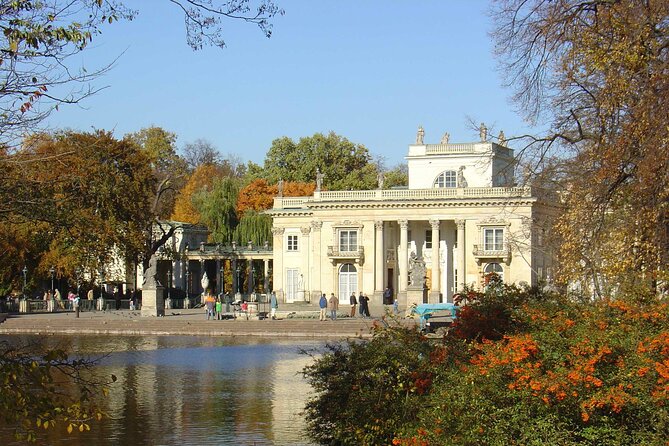
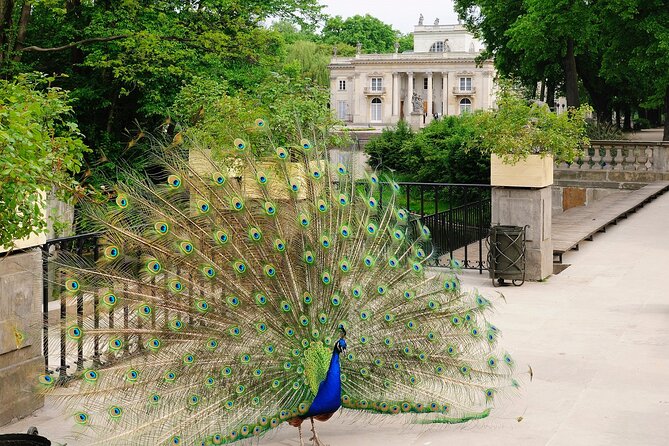
After that, the day moves toward Lazienki Park, the Royal Łazienki Park complex. It is described as one of the most beautiful palace and garden complexes in Europe, with historical monuments and a park set inside a former forest. It is also a museum-like space that hosts cultural and scientific events, so it feels active without feeling hectic.
One detail worth planning around if you are there in summer is the tradition of free piano concerts. For 50 years, summer weekend piano concerts have been held next to the famous monument of F. Chopin, drawing both tourists and local classical music lovers.
This is where the tour becomes enjoyable on a human level. You get history, then you get shade, paths, and a slower pace.
The 1950s skyscraper and the 2012 stadium era, modern Warsaw in one block
Before or after Lazienki, your route typically includes Warsaw’s modern landmarks. You will see the 1952 to 1955 Palace built as a gift from the Soviet people, and its scale is hard to ignore. It is the tallest building in the country, with an observation deck on the 30th floor and views over Warsaw. Inside, it has many rooms and uses, including offices, institutions, and facilities like a post office, cinema, museums, libraries, theatres, a café, and clubs.
Then the tour takes you to the modern and largest stadium linked to the European Football Championship in 2012. The description also ties it to the historic Tenth Anniversary Stadium, which for years hosted major sporting events and large propaganda rallies, including the Peace Race and Polish football finals.
This mix is useful. Older Warsaw tells you what was lost and rebuilt. These newer landmarks show you how Warsaw reshaped itself into a modern city with big events and big infrastructure.
If you love views, the observation deck is the part that can justify the stop. If you are more museum-minded, you may prefer using that time to shift toward science and parks.
Copernicus Science Centre, hands-on Warsaw if you have extra energy
The final modern stop is the Copernicus Science Centre. It opened in November 2010 and is described as one of the most modern science centers in Europe. Its goal is to spark curiosity and support independent learning through hundreds of interactive attractions.
You will find things like an earthquake simulator and a magic carpet, and there is also a roof garden with observation decks for panoramas. Nearby, there is an art gallery, a climbing wall, and a park with art exhibits.
Admission is not included for this stop, so you will want to decide in advance if hands-on science is worth the extra cost for your group. If you are traveling with kids, it is a strong fit, and if you are traveling as adults, it can still be a fun way to end a history-heavy day.
Even if you skip the inside part, the roof views could be the mental reward for surviving a long list of major landmarks.
Price and vehicle reality for a $195.18 private half-day
At $195.18 per person for about 4 hours, you are paying for several things: a professional local guide, private transport, and hotel pickup and drop-off. That last part sounds small until you try it in Warsaw, where car access can be restricted in central zones and you do not want to spend your short time hunting for buses.
The plan includes an air-conditioned vehicle for the non-Old-Town sections, but car rules can affect how much driving you get. If your route crosses UNESCO-listed areas and pedestrian-heavy streets, you should expect some on-foot walking. In practice, I suggest you treat this as a guided city walk with transport between major clusters, not a drive-by tour.
Value is best when you care about context. If you just want to see photos of famous buildings, self-guided walking might be cheaper. If you want the why behind the reconstructions, the symbolism, and the way the city remembers, this private format is where the money goes.
Also, the tour offers group discounts and a mobile ticket. If you can travel with others and split the total cost, it can make this itinerary much easier to justify.
Who should book this private Warsaw city tour
Book it if you want a structured half-day that mixes the big names with the meaning behind them. It is especially good for first-timers who want UNESCO Old Town, royal sites, wartime memory, and one real pause in nature at Lazienki.
It is a good fit for couples too, because the route is private and the guide can adjust pace. If you have anyone in your group who needs slower walking, tell the guide early, since the day includes walking segments and car access may vary by zone.
Skip it if your entire idea of a city tour is staying in a vehicle. This is not that. It is a guided route built around walking through Warsaw’s most important historic spaces.
FAQ
How long is the Warsaw City Tour – PRIVATE?
It is approximately 4 hours.
Is the tour private or shared?
It is a private tour, so only your group participates.
Does the tour include hotel pickup and drop-off?
Yes. The guide provides hotel pickup and drop-off.
Is the guide available in English?
English is offered.
What does the tour price include?
It includes private transportation, an air-conditioned vehicle, a professional local guide, and hotel pickup and drop-off.
Are admission tickets included?
Entry or admission fees are not included, and some optional admissions may require payment. Admission for the Copernicus Science Centre is not included.
Is the tour ticket mobile?
Yes, it includes a mobile ticket.
Where will the guide meet me?
The guide waits for you in the hotel lobby with your name.
What is the best time of day to plan this?
The tour runs about 4 hours, so it is a good choice for a morning or afternoon slot when you want a concentrated overview.
What if I need to walk less?
The itinerary includes walking and transport between areas. You should discuss walking needs with the guide so the pace and route can be adjusted.
Should you book this private 4-hour Warsaw tour?
If you are here for a short stay and you want a guided “connect-the-dots” route, this is a strong option. You get hotel pickup, a private guide, UNESCO Old Town, the Royal Castle reconstruction story, wartime memorials, Lazienki Park downtime, plus a modern finale at Copernicus Science Centre if you want it.
Just go in with the right expectation: you will walk some. If you like history with context and you value not wasting time on logistics, this half-day can be a very efficient way to get Warsaw’s key chapters into one coherent arc.
Freshly posted from Warsaw
- Krakow Small Group Tour from Warsaw with Lunch, Schindler’s Factory included★ 5.0 · 7 reviews
- Warsaw Private Transfer from Warsaw Chopin Airport (WAW) to City centre★ 4.0 · 7 reviews
- 3-hour tour at Warsaw Uprising 1944 Museum /inc. Pick-up/★ 4.9 · 7 reviews
- Wolfs Lair – Hitlers hideout★ 4.5 · 7 reviews
- Warsaw: Evening History and Pubs Tour by Retro Minibus★ 5.0 · 7 reviews
- Warsaw: Private Vodka Tasting Night with Snacks and Pickup★ 5.0 · 7 reviews
- Warsaw Old Town with Royal Castle + Royal Route: SMALL GROUP /inc. Pick-up/★ 5.0 · 7 reviews
City Tours, compared.
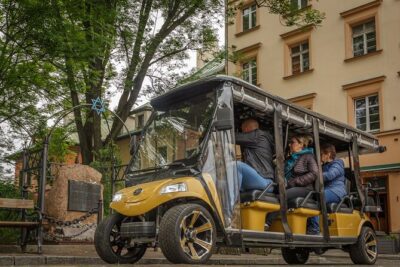
City Sightseeing Tour Eco Electric Buggy Golf Cart
Read our review →
Gdańsk City Sights & History Guided Walking Tour in English
Read our review →
Extended City Sightseeing Tour – Eco Buggy Golf Cart
Read our review →
Shared or Private City Tour Sightseeing by Golf Cart
Read our review →Browse the lists this tour appears in