
Reviewed · WARSAW TOURS & ACTIVITIES
Private 4h Tour in Warsaw Old Town
Warsaw hits you hardest when you see how it was rebuilt. This private 4-hour walk links the best-known Old Town sights with the stories that shaped them.
I love how the tour keeps moving, so you get a real sense of the Royal axis and how sites connect street to street. I also like the human side of the explanations, including the before-and-after war perspective that guides use to make the changes feel real, not abstract.
One consideration: it is a lot of ground in one session, so if you prefer long museum stops or slow photo breaks, you might want to pace yourself or plan extra time on your own afterward.
In This Review
- Key highlights you will feel right away
- Price and what makes this tour a smart buy
- Getting oriented at plac Zamkowy, Sigismund’s Column, and the Royal route logic
- Stop 1: King Sigismund’s Column, a symbol with a moving history
- Stop 2: Old Town, from trade crossroads to UNESCO reconstruction
- Stop 3: Royal Castle Gardens, reconstruction as a community project
- Stop 4: Archcathedral Basilica of St. John the Baptist and the organ-music tradition
- Stop 5: Rynek Starego Miasta, Warsaw Mermaid and the enlightenment names
- Stop 6: Warsaw Barbican, defenses you can still walk
- Stop 7: Warsaw Uprising Monument and Krasiński Palace park break
- Stop 8: Ulica Miodowa, elite schools, an Eastern Catholic church, and the heart connection
- Stop 9: Plac Teatralny, facades, foundations, and the big opera stage
- Stop 10: Tomb of the Unknown Soldier and the daily noon ritual
- Stop 11: Royal Route finish at Krakowskie Przedmieście, from Copernicus to the highlights
- The guides make the difference, especially with tough history
- Who this tour fits best, and who might want something else
- Should you book this private 4-hour Warsaw Old Town tour?
- FAQ
- How long is the private tour in Warsaw?
- What is the price per person?
- Is the tour offered in English?
- Is the tour only for my group?
- Where does the tour start and end?
- Are there admission tickets to pay at the stops?
- Do I need a printed ticket?
- What is the cancellation policy?
Key highlights you will feel right away
- A private, English-language guide who can tailor how fast you move and where you pause
- Old Town plus Royal Route in one sweep, so Warsaw’s main story arc stays clear
- WWII and Warsaw Uprising context at multiple stops, not just one memorial
- Free admission listed for every featured stop, so your time buys more value
- Food and snack ideas from the guide that fit the areas you’re actually walking through
- A strong final finish near Krakowskie Przedmieście, where you can keep exploring independently
Price and what makes this tour a smart buy
At $111.75 per person for a 4-hour private outing, the price feels fair because you are paying for guidance plus a tight route full of major landmarks. The big value angle here is that the stops are generally listed as free admission, which means you are not losing time or budget to ticket lines or paid entries.
You also get the practical perks that make a walking tour easier: a mobile ticket, a professional local guide, and a schedule that tends to be booked well in advance (on average, about 58 days). And because it is private, you do not have to work around strangers deciding they want an extra 20 minutes at one corner.
Still tacked up around Warsaw
- Warsaw: Chopin Concert in the Old Town
★ 4.8 · 2,287 reviews - Warsaw: Traditional Galar Cruise on The Vistula River
★ 4.6 · 1,640 reviews - Warsaw: Old Town Highlights Walking Tour in English
★ 4.7 · 1,516 reviews
Getting oriented at plac Zamkowy, Sigismund’s Column, and the Royal route logic
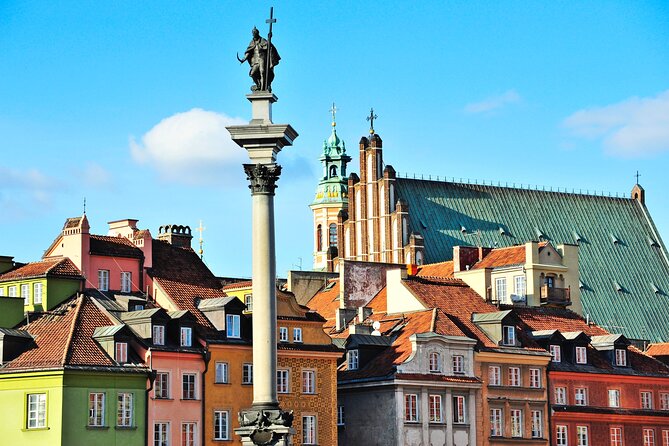
The tour starts at King Sigismund’s Column area, at plac Zamkowy (start point is Sigismund’s Column, 00-001 Warszawa). The route is designed like a guided stroll along the city’s most important connections, ending at the Royal Route on Krakowskie Przedmieście (near the Nicolas Copernicus Monument, where the guide leaves you to continue on your own).
What I like about this layout is that Warsaw’s landmarks start to make sense as a chain. You are not hopping randomly from one far-away spot to another. Instead, you keep walking through the city’s layers: trade and city growth, destruction and reconstruction, and then the ceremonial power spaces that still matter.
Stop 1: King Sigismund’s Column, a symbol with a moving history
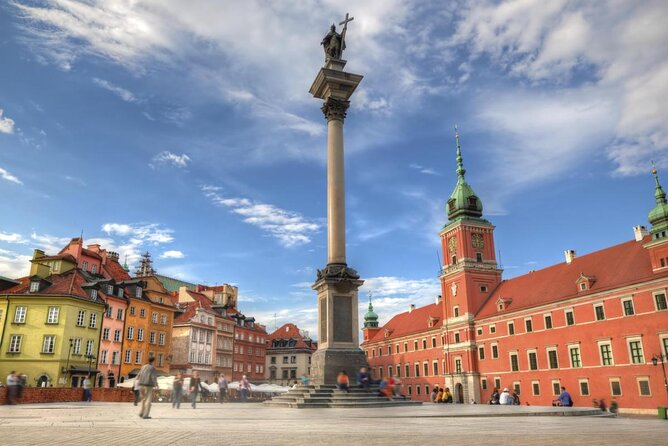
The first stop is Kolumna Zygmunta (about 10 minutes). This is one of Warsaw’s oldest public memorials, but it is not where it originally stood. The column was moved when the axis of Krakowskie Przedmieście Street changed in the 19th century, and again after World War II during the development of the WZ route.
The wartime detail is the emotional hook: on September 2, 1944, German troops brought it down. Reconstruction was completed in 1949. The tour also points out that older column pieces are exhibited near the King’s Castle walls as seen from the WZ route direction.
Why this matters for you: it teaches you to watch for “the story behind the stone.” In Warsaw, locations shift and monuments get rebuilt. That will be a theme throughout the walk.
Practical consideration: this is a quick stop. If you like to linger, do it briefly here, then return on your own later with more time.
Stop 2: Old Town, from trade crossroads to UNESCO reconstruction
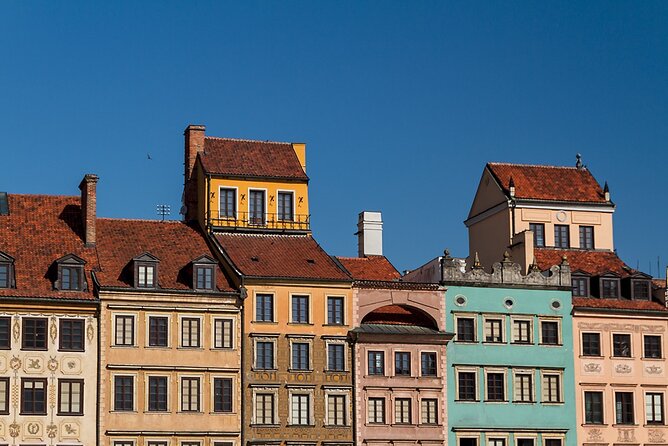
Next is Old Town (about 45 minutes). Old Town started at a river spot that favored trade, right on a main route between the Baltic Sea and the Black Sea. Wealthy tradesmen and craftsmen helped it grow fast.
The tour frames the architectural shift too. Early structures were wooden and later replaced by masonry tenement houses. Earthen ramparts became stone walls. A town hall was built in 1429, and the parish church you see today is the Cathedral of St. John.
Then comes the hard part: in 1944, about 90 percent of the Old Town area was destroyed. Reconstruction took many years and ended with Old Town earning a place on UNESCO’s World Heritage List.
What you will likely enjoy: walking the streets with the timeline in mind. The guide’s job is to connect “this corner looks new-ish” with “that newness is actually reconstruction.” If you want to understand why Warsaw feels both historic and stubbornly repaired, this is where it clicks.
Possible drawback: 45 minutes is solid, but if you want to add extra browsing inside churches or museums nearby, you will need to budget that on your own after the tour ends.
Beneath the newer pins on the Warsaw board:


Stop 3: Royal Castle Gardens, reconstruction as a community project
The walk continues to Warsaw Royal Castle Gardens (about 15 minutes). The Royal Castle gained royal-residence status in the 16th century when Masovia joined the Crown. It was destroyed multiple times through the Deluge and other conflicts, and later repeatedly rebuilt.
World War II is the turning point. The castle was bombed early and almost completely destroyed by fire. Some priceless artworks were removed in time, but the remaining works were plundered. In 1944, the castle was blown up in retaliation for the Warsaw Uprising.
Then the tour brings you forward in time: the decision to reconstruct the castle came much later, in 1971. Work was funded largely through community generosity. The site opened to visitors in 1984 and was later included on the UNESCO World Heritage List as an example of successful faithful reconstruction.
Why this stop is powerful for you: it is not only about tragedy. It also shows how rebuilding became a civic identity.
Practical consideration: gardens are a calmer beat in a walking route. If weather is bad, you might want to wear something comfortable for open-air walking rather than planning on a long sheltered break.
Stop 4: Archcathedral Basilica of St. John the Baptist and the organ-music tradition
Stop four is the Archcathedral Basilica of St. John the Baptist, also known as St. John’s Cathedral (about 15 minutes). This is one of Warsaw’s oldest churches. The guide notes a specific seasonal tradition: on Sundays at 4 PM from July to September, concerts happen here as part of the International Organ Music Festival.
Historically, St. John’s has hosted big moments, including the Constitution of May 3 oath, described as the first of its kind in Europe. Under the cathedral, the crypt holds tombs of many historical figures, including the Chapel-Mausoleum of the Primate of the Millennium.
How to use this stop well: if you happen to be there during the concert season, plan around timing and consider booking tickets for a performance on a different day too. If not, the value is still in the guided explanation of how one church can hold both political history and sacred art.
Stop 5: Rynek Starego Miasta, Warsaw Mermaid and the enlightenment names
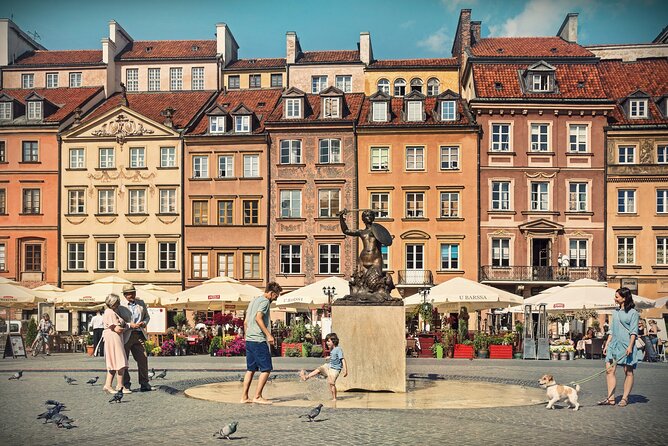
Your next pause is Rynek Starego Miasta (Old Town Marketplace), about 15 minutes. The square is surrounded by tenement buildings tied to restaurants, cafes, clubs, galleries, and museums. In the center, the Warsaw Mermaid statue is a major visual anchor.
The tour also points out a detail that helps you read the square like a map: the marketplace sections are recognized by four enlightenment activists, Kołłątaj, Dekert, Barss, and Zakrzewski.
Why you will like this: it is one of the easiest places to understand Warsaw’s balance between symbolism and everyday city life. It is not only monuments. It is where people actually hang out.
Practical consideration: because it is a social hub, it can be busier. Keep your eyes on your guide for the story beats, then enjoy your own time after.
Stop 6: Warsaw Barbican, defenses you can still walk
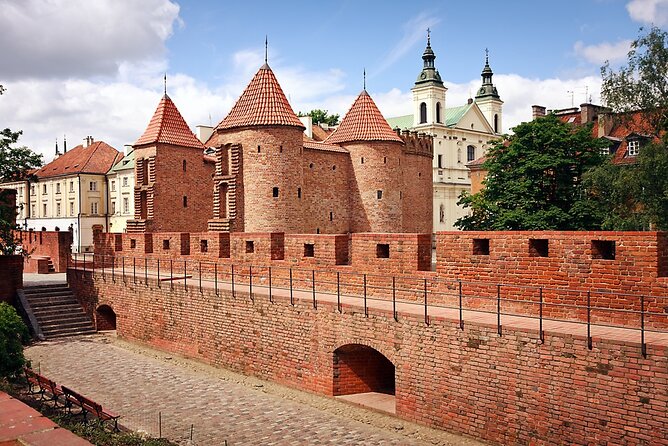
Next up is the Warsaw Barbican (Barbakan Warszawski), about 15 minutes. Built in 1548, it used to be part of the city’s defensive walls. The tour gives you the bigger picture: it was constructed as part of roughly 4,000 feet of defensive ramparts.
Today, it attracts artists and musicians, and it is a great place to slow down visually while walking around Old Town. From May to October, there is an exhibition inside the Barbican that uses historical photos and models of defensive lines and towers that no longer exist. The point is not just viewing. The guide encourages you to compare old plans with Old Town’s current shape so you can imagine what the area could have looked like without war destruction.
Why it is a must: it makes defenses feel human, not theoretical.
Possible drawback: the stop is short. If you catch it when the exhibition is running, you may want extra time nearby after the tour.
Stop 7: Warsaw Uprising Monument and Krasiński Palace park break
Stop seven is the Warsaw Uprising Monument (about 10 minutes). It depicts groups of insurgents during battle. The story is heavy: the uprising ended in defeat, and about 200,000 Poles died. The tour keeps this sober, but it also frames the memory as part of why Warsaw carries resilience.
The route continues past Krasiński Palace (Palace of the Republic), which the guide describes as a Baroque masterpiece originally tied to Jan Krasiński, Prefect of Warsaw. Today, it hosts special collections for the National Library. The palace is known for reliefs inspired by antique works, and the park behind it is a good spot for a short relaxation moment.
A nearby detail adds modern context: a green building next to the palace and across the street is the recently built seat of the Supreme Court.
How to use this segment: if you want a breather between emotional memorial sites and more everyday streets, this palace park area helps.
Stop 8: Ulica Miodowa, elite schools, an Eastern Catholic church, and the heart connection
Stop eight is Ulica Miodowa, about 20 minutes. This narrow street feels like a “walk back in time” corridor, lined with older luxurious residences.
The guide points out a key education legacy: number 24 once hosted the Collegium Nobilium, described as the first school for the young of the ruling elite. Today, it houses the Academy of Theatre.
At number 17, you get the residence of the Primate of Poland, the Palace of Warsaw’s Archbishops from the 18th century. Number 16 is Warsaw’s only Eastern Catholic church, and Pac Palace, housing the Ministry of Health, sits next to the Primate’s residence.
The tour also suggests peeking at the Church of the Capuchins, where the right side of the altar features the heart of Jan III Sobieski, the founder.
Further along, you can see the Monument of Warsaw’s Heroes, commonly called the Monument of Nike.
Why this stop works: it turns history into architecture and street-level clues you can still observe.
Practical consideration: the street is narrow, so movement can be slower. Wear shoes that handle tight sidewalks.
Stop 9: Plac Teatralny, facades, foundations, and the big opera stage
Stop nine is Plac Teatralny (Theatre Square), about 15 minutes. The square is bordered by the Late Baroque Blank Palace, with Jabłonowski Palace behind it. The tour explains how war reshaped what you see today.
Jabłonowski Palace used to function as city hall before World War II. It was razed during the war and rebuilt in the 1990s, but only the façade and clock tower remain from the original design. The guide encourages you to walk through the gate under the tower to see the foundations laid in the 19th century.
Then there is the Grand Theatre, a huge Classicist building facing Jabłonowski Palace. It is the seat of the National Opera and the National Theatre. The guide highlights that the opera stage is one of the largest in Europe, and the interiors can be seen if you attend a performance, including cut glass chandeliers, a spacious foyer with columns, and impressive floor tiling.
The square ends with Petrykus Tenement House, built in 1821, housing restaurants and clubs that are valued by Warsaw locals.
Why you will enjoy this section: it shows Warsaw as a living cultural city, not only a memorial city.
Possible drawback: if you are not interested in opera or theatre, the stop can feel more about architecture. Still, the war-rebuilt foundations are worth your attention.
Stop 10: Tomb of the Unknown Soldier and the daily noon ritual
Stop ten is the Tomb of the Unknown Soldier, about 10 minutes. This symbolic tomb commemorates millions of soldiers who sacrificed their lives fighting for Poland’s freedom. The tour notes the contents: ashes of a defender of Lvov and an urn with soil from World War I battlefields. Today, it contains urns from every battlefield where Polish troops fell in the last century.
There is an eternal flame maintained next to the tomb, and a military honour guard watches over it. The guard changes daily at noon.
If you can plan around it: timing matters. Even without catching the change, the emotional weight is clear. If you do catch the noon ritual, it becomes a memorable focal point in your walk.
Practical consideration: this is a short stop by design. If you want longer reflection or better photo timing, add time before or after the tour.
Stop 11: Royal Route finish at Krakowskie Przedmieście, from Copernicus to the highlights
The tour finishes on the Royal Route, with about 30 minutes covering key stretches. The former Royal Route runs from Zamkowy Square to Trzech Krzyży Square. Your guide highlights must-sees along the way, even if you do not stop at all of them in depth.
Included sights on the route include St. Anne’s Church (and views from the church tower), Polonia House, once the Museum of Industry and Trade where Maria Skłodowska-Curie worked, and Radziwiłł Palace, which is the current residence of the President of Poland. You also get mention of the Warsaw University campus with Kazimierzowski Palace, Czapski Palace of the Academy of Fine Arts, and the elegant shops and restaurants on Nowy Świat Street, an extension of Krakowskie Przedmieście Street.
Your guide will leave you at Nicolas Copernicus Monument on Krakowskie Przedmieście so you can keep exploring on your own.
Why this finish is useful: it gives you a clear next step. If you want to extend the walk, you already know what you are looking at.
The guides make the difference, especially with tough history
Across the experience, the strongest praise connects to the guides themselves. I would treat that as a real decision factor.
Guides like Maria (and also Mariola, Carolina, Cesar, depending on the booking) bring the route to life with clear explanations and an emotional understanding of how Warsaw changed. One consistent theme in the feedback is the way guides talk through the city’s transformation and use before-and-after war photos to show what was lost and what survived.
Another big plus is personalization. Some guides share practical food or snack recommendations tied to the areas you are actually walking through. And if you book with a guide who speaks French well, that can be a big comfort upgrade too, since language fluency changes how much you catch and retain.
Who this tour fits best, and who might want something else
This is a great fit if you want:
- A structured overview of Old Town and the Royal Route without planning every turn
- A walking pace that still includes meaningful stops at major monuments
- WWII and Warsaw Uprising context woven into multiple sites, not dumped in one lecture
- A private setting where you can ask questions without feeling rushed
You might look for a different style if you:
- Prefer long museum time over street walking
- Want to focus only on churches or only on architecture
- Plan to spend lots of time sitting down at cafes, because the route is intentionally packed
Should you bring kids? Possibly, if they can handle memorials and monuments for the length of the walk. Most stops are outdoors or quick interior windows, but the history is serious.
Should you book this private 4-hour Warsaw Old Town tour?
Yes, if you want a high-value, no-nonsense way to understand Warsaw’s story in one afternoon. The combination of Old Town, the Royal Castle area, the Uprising memorials, and the Tomb of the Unknown Soldier gives you both the postcard landmarks and the emotional history that explains why the city looks the way it does today.
I would especially book it if you care about context and you like walking with a guide who can connect details across stops. The best outcome is when you use the tour as your framework, then spend your remaining time wandering those same streets with much sharper instincts.
FAQ
How long is the private tour in Warsaw?
It lasts about 4 hours.
What is the price per person?
The price is $111.75 per person.
Is the tour offered in English?
Yes, it is offered in English.
Is the tour only for my group?
Yes. This is a private tour/activity, so only your group participates.
Where does the tour start and end?
It starts at Sigismund’s Column on plac Zamkowy (00-001 Warszawa) and ends on the Royal Route on Krakowskie Przedmieście (00-079 Warszawa). The guide leaves you at the Nicolas Copernicus Monument on Krakowskie Przedmieście.
Are there admission tickets to pay at the stops?
Admission is listed as free for the featured stops in the tour.
Do I need a printed ticket?
You get a mobile ticket.
What is the cancellation policy?
Free cancellation is available up to 24 hours in advance for a full refund. If you cancel less than 24 hours before the start time, you will not receive a refund.
Freshly posted from Warsaw
- Krakow Small Group Tour from Warsaw with Lunch, Schindler’s Factory included★ 5.0 · 7 reviews
- Warsaw Private Transfer from Warsaw Chopin Airport (WAW) to City centre★ 4.0 · 7 reviews
- Wolfs Lair – Hitlers hideout★ 4.5 · 7 reviews
- 3-hour tour at Warsaw Uprising 1944 Museum /inc. Pick-up/★ 4.9 · 7 reviews
- Warsaw: Evening History and Pubs Tour by Retro Minibus★ 5.0 · 7 reviews
- Warsaw: Private Vodka Tasting Night with Snacks and Pickup★ 5.0 · 7 reviews
- Warsaw Old Town with Royal Castle + Royal Route: SMALL GROUP /inc. Pick-up/★ 5.0 · 7 reviews
Warsaw Tours & Activities, compared.
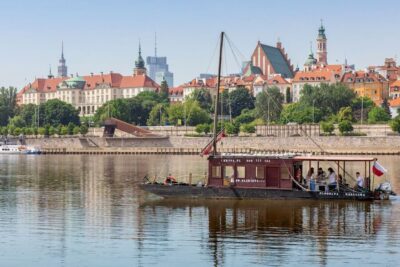
Traditional Galar Cruise on The Vistula River
Read our review →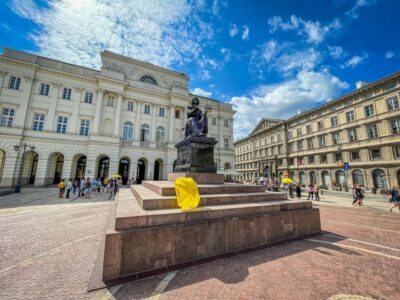
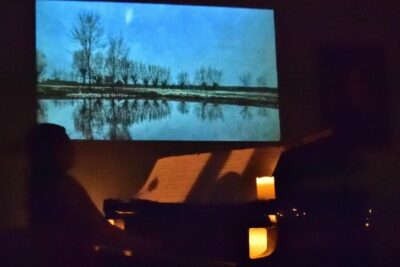
Warsaw Concert: Chopin – Painted by Candlelights with Wine
Read our review →

Highline Warsaw Entry With 360° Views & Rooftop Bar
Read our review →
POLIN Museum of the History of Polish Jews Ticket
Read our review →
Browse the lists this tour appears in