
Reviewed · WARSAW TOURS & ACTIVITIES
Discover the Dark Side of Warsaw in Praga District by Retro Bus
Warsaw has another face, in Praga. On this retro-bus ride, you get a street-level look at one of Warsaw’s most complicated districts, mixing dark WWII stories with real places that now feel trendy. Praga is the point, and the route is packed with stops you usually do not see on the standard center-only sightseeing loop.
I like that this tour pairs hands-on value with easy walking. You get a cup of hot chocolate at the famous 19th-century E.Wedel factory, plus short, well-timed stops for viewpoints and landmark areas that explain why this neighborhood changed so dramatically over time. Another big plus is the way the guide connects small details, like murals on Brzeska and Stalowa, with bigger themes like WWII damage and the long shadow of Communism still visible in rebuilding.
One thing to plan for: the group can be large, and that can affect how long you linger at each stop. If you are sensitive to loud crowds or you like a slow pace, go in with patience and good expectations for a 2.5-hour, moving itinerary, not a private stroll.
In This Review
- Key things to love on this Praga retro-bus tour
- Starting at Palace of Culture and Science, then heading into Praga
- The Vistula crossing and quick hits you will remember later
- E.Wedel chocolate factory: the best value stop on the route
- Basilica of the Sacred Heart of Jesus: a quick visual pause
- Koneser Vodka Factory: industry that shaped the district
- Brzeska and Stalowa murals, Różycki’s Bazaar, and the forgery underworld
- Praga Polnoc and the Praga Bermuda Triangle: courtyards and pre-war architecture
- A street used for The Pianist and other pop-culture wayfinding
- New Praga and the inner courtyard house feel
- Retro bus comfort, timing, and group size reality
- Price and value: what $42.34 buys you in practice
- Should you book the Retro Bus Dark Side of Warsaw tour?
- FAQ
- Where does the tour start and end?
- How long is the tour?
- What time does the tour begin?
- Is the tour offered in English?
- What is included in the price?
- Are there any stop admissions you need to pay?
- Does the tour include food or drinks?
- Will the tour run in bad weather?
- How big are the groups?
- Can I cancel and get a refund?
Key things to love on this Praga retro-bus tour
- E.Wedel hot chocolate served right at a working stop, not just a photo op
- WWII and film-location storytelling, including areas used for The Pianist
- Praga Polnoc as your core focus, with a full hour to take in the district feel
- Street art and exterior views, including murals on Brzeska and Stalowa
- Courtyards and pre-war buildings, especially around New Praga
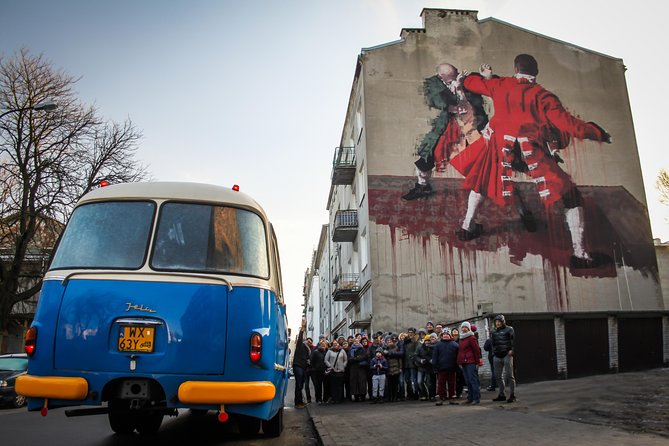
- Retro 1980s-style coach rides, which makes the whole experience feel like a time machine
Starting at Palace of Culture and Science, then heading into Praga
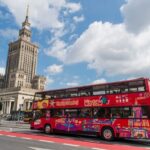
Most tours start with the obvious. This one starts with a Warsaw landmark that sets the mood fast. You meet at the Palace of Culture and Science, near the Tourist Information Office. It is tied to Soviet-era symbolism, originally gifted by Joseph Stalin, and it is a strong visual reminder that Warsaw has always been shaped by outside forces.
From there, you drive toward the Vistula River, and the guide uses that short “on the move” stretch for a foundation lesson on Praga. Praga is not just another neighborhood. It used to be its own city, and that independence helps explain why the district still feels different from Warsaw’s more famous core. You also get the sense that the tour is not trying to sell you an idealized postcard version of the city.
A practical note: the tour duration is about 2 hours 30 minutes, so you should treat it like a guided sampler. You will get history and visuals, but you still need to accept that most stops are short, meant to keep the story flowing.
Still tacked up around Warsaw
- Warsaw: Chopin Concert in the Old Town
★ 4.8 · 2,287 reviews - Warsaw: Traditional Galar Cruise on The Vistula River
★ 4.6 · 1,640 reviews - Warsaw: Old Town Highlights Walking Tour in English
★ 4.7 · 1,516 reviews
The Vistula crossing and quick hits you will remember later
The route is built around story beats. You get small moments that would be easy to miss on your own, and the guide ties them to the bigger plot.
Along the way, the commentary includes stops and mini-stories tied to Warsaw landmarks you recognize from the broader city map, plus a few “only in Warsaw” facts. For example, there is a mention of a Date Palm Tree in the city center, plus a story about what was hidden in the National Museum basement during WWII. You also pass a football stadium built for UEFA Euro 2012, and you hear why places like Warsaw East railway station and the city’s long buildings matter in how the city functions today.
These are not long museum visits. Think of them as wayfinding for understanding the city, like learning the map language before you start reading the street signs.
E.Wedel chocolate factory: the best value stop on the route
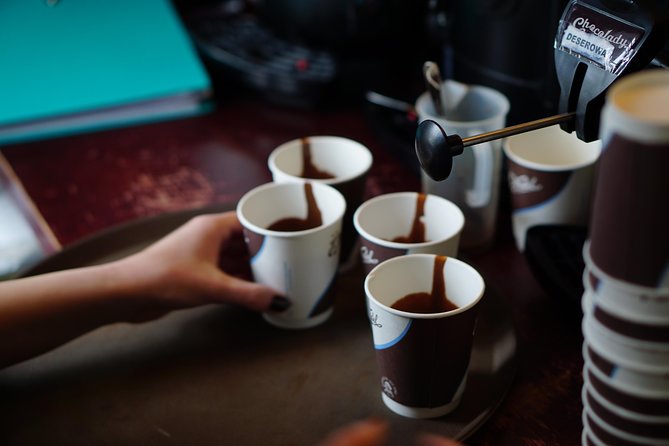
The first proper stop is the 19th-century E.Wedel chocolate factory area. If you want a tour where the “wow” is not only visual, this is it. You are given a cup of hot chocolate, and the time there is designed for both taste and story.
What makes this stop work is the contrast. You begin with a sweet, comfortable pause in a historic setting, then the guide pivots you from confectionery history into the harsher realities of the district. It is a smart rhythm, because by the time you are looking at murals, courtyards, and war scars, you already have something warm in your hands.
Also, the stop is short (about 20 minutes) and admission is free for that part. That matters because it keeps the tour moving without turning every stop into a ticketed mini-adventure. On days when the weather is warm, that factory hot chocolate can still feel like a treat rather than a chore.
Basilica of the Sacred Heart of Jesus: a quick visual pause
Next up is the Basilica of the Sacred Heart of Jesus, also a free admission stop and about 20 minutes. This is one of those “pause and reset” segments. Praga can get heavy in the stories, and a striking church view gives your brain a different kind of focus.
What you are really gaining here is contrast: holy architecture and civic landmarks side by side with the realities the tour discusses later. Even if you are not a church person, it helps you understand how varied the district experience is, not just one tone of war and industry.
If you like photos, this is the kind of stop where you will want to turn your camera around and take a few wide angles before the group starts moving again.
Beneath the newer pins on the Warsaw board:

Koneser Vodka Factory: industry that shaped the district
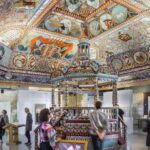
Then you head to Koneser Warsaw Vodka Factory. Again, it is about 20 minutes and admission is free. This is not a deep tasting tour, it is a district story stop. The guide explains how vodka production and its physical footprint connected to life in the area, and you get a feel for why factories mattered for Praga’s identity.
This stop connects well with the rest of the tour because it links industry to neighborhood transformation. Praga is known today for hip cafes and bars, but you learn that this vibe did not come from nowhere. It grew out of workdays, production, and the way the district adapted after disruption.
If you are the type of traveler who likes seeing how a place’s past shows up in today’s architecture, this is one of your strongest stops.
Brzeska and Stalowa murals, Różycki’s Bazaar, and the forgery underworld
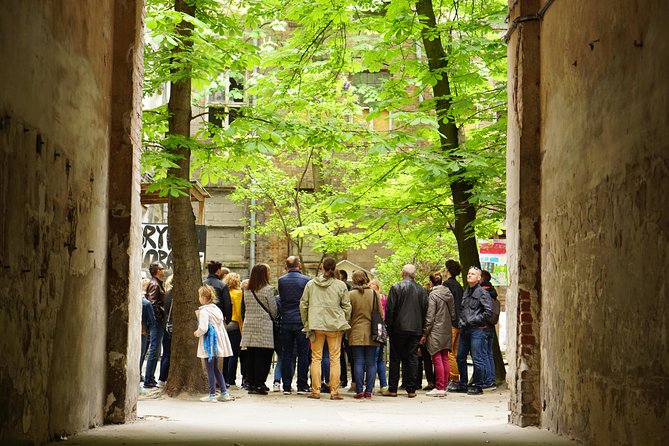
Now the tour turns darker in a very specific way. You visit the streets of Brzeska and Stalowa, where colorful murals depict Poland’s history and political climate. It is history on walls, not behind glass. The guide helps you read what you are seeing, including themes that link to WWII and later political pressures.
From there, you encounter stories tied to the former black market of Różycki’s Bazaar. This is one of the tour’s “edge of the story” moments, because the point is not just that illegal commerce existed. It is what people tried to buy, like forged documents, and what that says about survival under occupation and control.
You also stop near a former vodka factory context again, but the bigger value is how the guide stitches the narrative together: industry, underground economies, and then the later redevelopment that turns parts of Praga into the trendy places people photograph today.
If you like tours that explain the logic behind a neighborhood reputation, this section gives you the reasons, not just the label.
Praga Polnoc and the Praga Bermuda Triangle: courtyards and pre-war architecture
The center of the whole experience is Praga Polnoc, with about an hour dedicated to this area. This is where the name Dark Side of Warsaw makes sense, but it is not just gloom. The guide frames it around the “Praga Bermuda Triangle,” an area described as full of scenic courtyards and pre-war architecture.
This is the kind of segment where the walking and visuals do a lot of work for you. Courtyards are one of the best ways to see the district’s texture, because you get a glimpse of how buildings relate to each other, how people live around shared spaces, and how the district’s form survives even when the outside world changes.
The tour also uses this area to explain why Praga feels slightly confusing in the best way, like you could get turned around but would still end up discovering something. It is less about getting lost and more about noticing the hidden connections.
A street used for The Pianist and other pop-culture wayfinding
Praga also shows up in film. The tour includes a picturesque street that became a movie set for Roman Polański’s The Pianist. Even if you have not seen the film, the guide’s storytelling turns this into more than a trivia stop. You start noticing how architecture and streets can be preserved, reused, or altered, and why that matters for understanding Warsaw’s layers.
Later, there is also a stop tied to Warsaw Zoo, prompted by the movie The Zookeeper’s Wife. The tour does not sell zoo-time as the main goal, but it helps you connect the route to something familiar.
For me, this is where the tour becomes playful without forgetting the serious parts. You get the dark narrative, but you also get a feeling that Praga is part of contemporary culture, not only a graveyard of the past.
New Praga and the inner courtyard house feel
The final Praga-focused segment is New Praga, with about 15 minutes. This is a shorter story stop, but it is useful because it narrows from “big district history” into how people planned and lived at the block level.
You hear about the founder of the Nowa Praga district and see the inner courtyard of a pre-war residential house. Courtyards again. That repeat is on purpose. It teaches you how Praga’s character is built into the spatial details, not only the headline events.
This is also a good moment to slow down, even if only briefly. Use the 15 minutes to look carefully at the building edges, the stairways, and the relationship between street and interior space. That is the kind of detail that makes Praga feel like a real neighborhood rather than a tour stop.
Retro bus comfort, timing, and group size reality
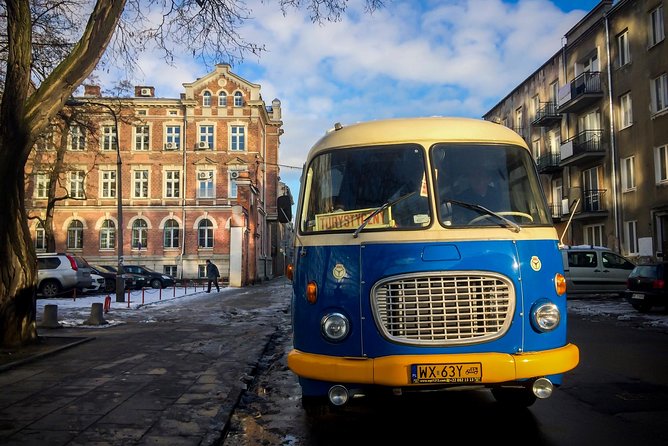
The transportation is by a 1980s-style coach, which makes the ride part of the fun. You are not stuck in a bland shuttle feel. And the onboard commentary is live, in English, so you are hearing it as a story rather than reading captions.
Group size can reach up to 40 people. Many people love that this tour still feels organized, but you should still assume that time at stops can get compressed. There can also be awkward energy if a section of the group is louder than others, which can affect how much you hear during the ride and how relaxed the photo stops feel.
If you want the quietest experience, plan to sit closer to the front of the bus where you can hear the guide clearly. And if you are traveling in warmer weather, dress for a ride that can get warm, since there is no promise of modern climate control.
One more practical tip: wear shoes you can walk in for short bursts. This is not a long hike tour, but it does include enough stepping out to make comfy footwear worth it.
Price and value: what $42.34 buys you in practice
At about $42.34 per person for roughly 2 hours 30 minutes, this is one of the more cost-effective ways to get Praga’s backstory without chaining together multiple tickets and separate guide services.
Here is what you get for that price:
- Live English guide and onboard commentary
- Retro coach transport
- A cup of hot chocolate at E.Wedel
- Several stops where admission is listed as free
That is the key value point. You are paying mainly for the interpretation and the access to a route that stays outside the typical center-only track. You are also getting a guide who can explain why Praga developed the way it did, including WWII and Communism still visible in rebuilding.
If you usually pay extra for guided neighborhoods, this feels like a straight deal. If you are expecting huge, long museum visits or lots of time at each location, adjust your expectations. This is a guided sampler with enough stops to build a clear picture, not a full-day immersion.
Should you book the Retro Bus Dark Side of Warsaw tour?
Book it if you want a guided “Praga story in motion.” The mix of hot chocolate at E.Wedel, street murals on Brzeska and Stalowa, WWII and post-war context, and a street connection to The Pianist gives you more than simple sightseeing. You also get a nice balance of darker themes with concrete, beautiful details like courtyards and pre-war architecture.
Skip it or go only if you can handle crowds if you are a slow traveler who likes long time at each spot. With a group up to 40 and short stops, you may feel rushed. Also, bring your own water snacks plan since food and drinks are not included unless specified.
If your goal is to understand why Praga earned its reputation and how that identity shows up in streets, factories, and courtyards today, this is a strong use of a half-day in Warsaw.
FAQ
Where does the tour start and end?
It starts at Warsaw Tourist Information by the Palace of Culture and Science, pl. Defilad 1, 00-901 Warszawa, Poland. It ends back at the same meeting point.
How long is the tour?
The tour lasts about 2 hours 30 minutes (approx.).
What time does the tour begin?
Start times shown are around 10:30am and 11:00am. Check your booking confirmation for the exact time.
Is the tour offered in English?
Yes, the tour is offered in English, and you will use a mobile ticket.
What is included in the price?
Included are a professional guide, live commentary on board, transport by a 1980s coach, and a cup of hot chocolate.
Are there any stop admissions you need to pay?
Many listed stops include free admission tickets, including E.Wedel, the Basilica of the Sacred Heart of Jesus, and Koneser Vodka Factory.
Does the tour include food or drinks?
Food and drinks are not included unless specified.
Will the tour run in bad weather?
Yes, it operates in all weather conditions. Dress appropriately.
How big are the groups?
The tour has a maximum of 40 travelers.
Can I cancel and get a refund?
Yes, cancellation is free up to 24 hours before the start time for a full refund.
Freshly posted from Warsaw
- Warsaw Private Transfer from Warsaw Chopin Airport (WAW) to City centre★ 4.0 · 7 reviews
- Krakow Small Group Tour from Warsaw with Lunch, Schindler’s Factory included★ 5.0 · 7 reviews
- Wolfs Lair – Hitlers hideout★ 4.5 · 7 reviews
- 3-hour tour at Warsaw Uprising 1944 Museum /inc. Pick-up/★ 4.9 · 7 reviews
- Warsaw: Evening History and Pubs Tour by Retro Minibus★ 5.0 · 7 reviews
- Warsaw: Private Vodka Tasting Night with Snacks and Pickup★ 5.0 · 7 reviews
- Warsaw Old Town with Royal Castle + Royal Route: SMALL GROUP /inc. Pick-up/★ 5.0 · 7 reviews
Warsaw Tours & Activities, compared.
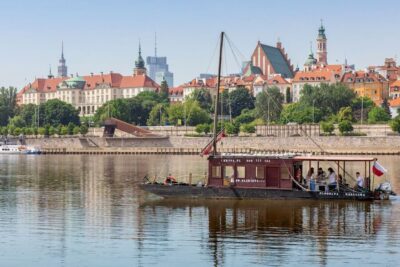
Traditional Galar Cruise on The Vistula River
Read our review →
Warsaw Concert: Chopin – Painted by Candlelights with Wine
Read our review →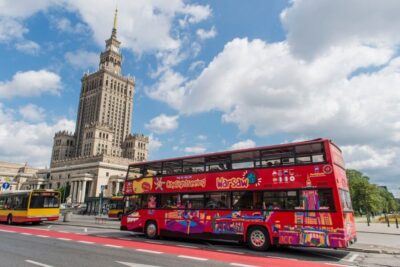

Highline Warsaw Entry With 360° Views & Rooftop Bar
Read our review →
POLIN Museum of the History of Polish Jews Ticket
Read our review →
Browse the lists this tour appears in