Reviewed · KRAKOW TOURS & ACTIVITIES
WOMAI Cracow – Into the darkness experience
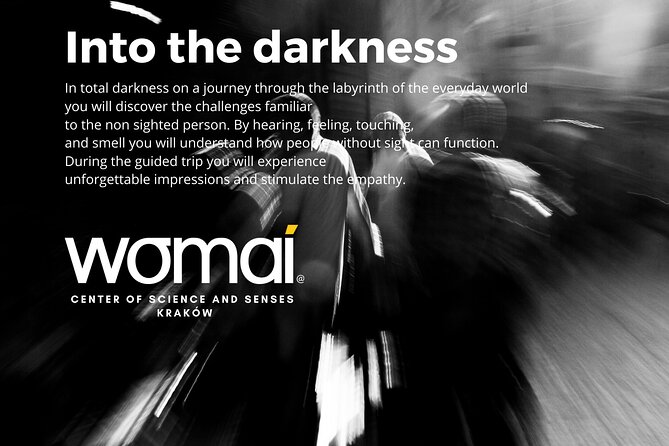
Turn off one sense, and everything changes. WOMAI Cracow’s Into the Darkness experience lets you do exactly that, guided by a blind guide through total darkness for about an hour. It is a hands-on way to understand what daily life can feel like without sight, without turning it into a lecture.
I love how practical it feels: you do everyday activities in the dark, so you notice how your balance, hearing, and touch start doing more work. I also like that the experience ends with a Q-and-A and a short lesson on braille, so you leave with something you can actually use and share.
One clear consideration: this tour is not recommended if you have hearing problems or if you have severe claustrophobia, since the environment is dark and communication matters. It is also not a good fit for people with significant mobility disabilities, and it calls for moderate physical fitness.
In This Review
- Key highlights you should know
- WOMAI Cracow, in one hour you can feel how sight changes everything
- Entering the Darkness Experience at Womai, what the flow feels like
- The blind guide dynamic, and why it matters
- Your senses in action, what you will actually notice
- Price and value in Krakow, is it worth $17.33?
- Timing and getting there near public transport
- Who should book this tour, and who should skip it
- Comfort tips for your hour in total darkness
- Should you book WOMAI Into the Darkness in Krakow?
- FAQ
- Where does the Into the Darkness experience run in Krakow?
- How long is the experience?
- What does it cost?
- Is the tour offered in English?
- Will I receive a mobile ticket?
- Is it recommended if I have hearing problems?
- Is it recommended if I have severe claustrophobia?
- Is it recommended if I have significant mobility disabilities?
- What physical fitness level do I need?
- What happens at the end?
- Is there free cancellation?
Key highlights you should know
- Blind-guided total darkness in Krakow for about one hour
- Everyday tasks in the dark that make your other senses work harder
- Q-and-A and braille teaching at the end
- English offered, with a clear focus on explanation and safety
- Near public transportation, easy to slot into a day in town
WOMAI Cracow, in one hour you can feel how sight changes everything
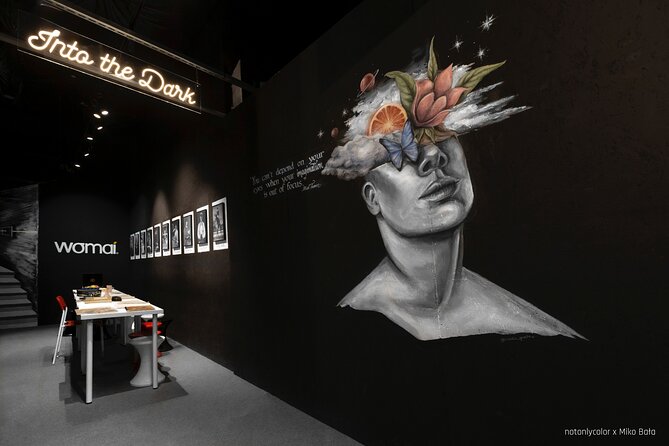
This is one of those rare Krakow activities where the main attraction is not a building or a landmark. It is your own perception. The idea is simple, then surprisingly emotional: what happens if you suddenly can’t rely on one of your senses?
At WOMAI, you step into a guided experience built around total darkness. You are not expected to “perform.” You are expected to cope with a new situation using hearing, touch, and careful movement. That is where the value is. Even if you never thought about disability before, you start to grasp the daily problem blind and partially sighted people can face: navigation, orientation, and knowing what is around you.
The setting also keeps things honest. Without visual cues, you cannot fake confidence. You learn fast. In a way, that is the point. I like that the tour does not try to be dramatic or theatrical. It stays grounded in real, everyday skills, and it gives you a window into what support and guidance can look like.
Still tacked up around Krakow
- From Krakow: Auschwitz-Birkenau Guided Tour & Hotel Pickup
★ 4.5 · 33,358 reviews - From Krakow: Auschwitz-Birkenau Guided Tour & Hotel Pickup
★ 4.5 · 29,340 reviews - Krakow: Auschwitz Guided Tour with Optional Hotel Pickup
★ 4.5 · 15,280 reviews
Entering the Darkness Experience at Womai, what the flow feels like
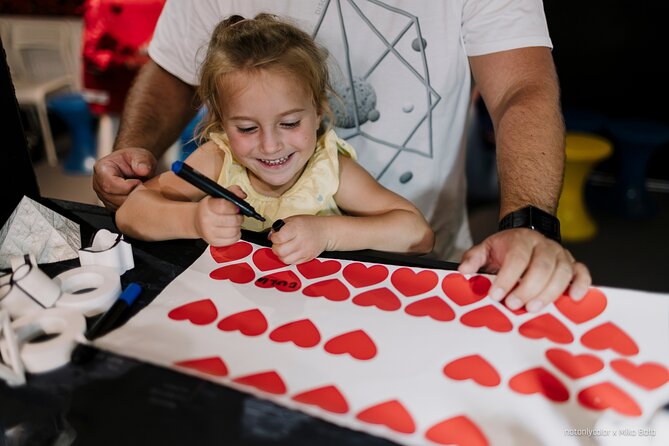
WOMAI’s Into the Darkness experience is centered on one main stop: the Womai site in Krakow. The whole visit runs about 1 hour, which is long enough for your senses to adjust, but short enough that it does not drag.
Here is the practical flow you can expect:
First, you will go through an introduction and instructions from your guide. You are being set up for something different, so pay attention early. In darkness, details you might normally ignore become important, like how to move, how to ask for help, and what to do if you feel disoriented.
Next, you enter the dark and the guide takes you into an environment where you cannot see. This is the core of the experience: you explore from a previously unknown perspective while your other senses sharpen. That “sharpening” is not magic. It is what happens when your brain has to work with less information. Hearing becomes more useful. Touch becomes more precise. Your sense of distance changes.
Then comes the hands-on part. You will navigate and handle everyday tasks in complete darkness. The exact activities are not the main point, and you do not need to be good at anything special. The value comes from doing normal motions without your usual visual safety net. This is where people often feel a bit alone, especially when you cannot feel the person or object directly in front of you. That feeling can be uncomfortable, but it also creates real understanding.
Finally, you reach the end of the experience with time to ask questions. One of the strongest parts is that you are also taught how braille works. Even a short explanation can change how you think about literacy and accessibility, and it gives the tour a clear payoff beyond the hour in the dark.
The blind guide dynamic, and why it matters
A lot of tours use guides for facts. This one uses a guide for real-world experience. Your blind guide is not only there to talk. They lead you through the environment and help you adapt to a new way of moving and listening.
That changes the tone. When you are guided by someone who lives with sight differences every day, you tend to ask better questions. You stop focusing on what the spectacle is supposed to be and start focusing on what the situation actually requires.
It also helps that the experience is designed for communication, not silence. The guide gives direction, and you get chances to ask questions during the wrap-up. In the Q-and-A, people value the chance to get personal insight and practical answers, not vague motivational messages.
I also like that this tour invites curiosity. You leave with a better sense of how tactile reading works through braille. You also walk away with a clearer idea of what “support” can mean in real daily life, from navigation to simple tasks.
Your senses in action, what you will actually notice
The Into the Darkness experience is basically a workout for attention. When you lose sight, your brain reorganizes itself quickly. You start to rely on cues you might not normally notice.
Here is what you will likely notice during the hour:
- Hearing takes the lead. Small sounds become navigation cues.
- Touch becomes information. Edges, textures, and spacing matter more.
- Movement becomes slower and more intentional. Your body wants certainty, so you pay attention.
- Your sense of time can feel different. When you cannot see, the mind fills in gaps, which is exactly why it is meaningful.
That is the emotional side. The practical side is that you also learn something about problem-solving. In the dark, you cannot just look around. You have to figure out what you need step by step, often with the guidance of your guide.
And because it is built around everyday tasks, it avoids the “only for special occasions” feeling. You are not learning a brand-new skill unrelated to life. You are learning how ordinary routines shift when sight is not available.
Beneath the newer pins on the Krakow board:


Price and value in Krakow, is it worth $17.33?
The price listed is about $17.33 per person, and the tour runs about 1 hour. That might sound small for such a unique concept, but in my view, the value is in what you get for that time.
What makes it good value:
- You get guided access to a controlled, safe environment of total darkness.
- You get a blind guide who leads you through real navigation and daily-life activities.
- You get a braille teaching moment plus time for questions.
- You can do it without needing special training or a long day.
So yes, it is one of those experiences where the “cost per hour” is not the main story. It is the “cost per understanding” that feels fair. You pay for a designed setting and expert guidance, then you leave with a deeper perspective than you could get from a standard museum stop.
Also, it is booked fairly often, with an average booking window of about 18 days in advance. If you are traveling in peak season or on a tight schedule, it is smart to book earlier rather than waiting for walk-up availability.
Timing and getting there near public transport
This experience is near public transportation, which matters because an activity like this is easiest when it fits smoothly into your day. You do not want to rush across town right before you lose visual cues. Plan for a calm arrival.
Duration is listed as about 1 hour, so it can work well as:
- a stand-alone activity in the middle of your day
- an evening plan if you want something different from sightseeing
- a way to break up heavier walking days
Because the experience relies on communication and clear instructions, I suggest showing up with a little buffer time. Even a few minutes of stress can make the first moments in darkness feel harder than they need to.
Who should book this tour, and who should skip it
This is not for everyone, and that is okay. The tour sets clear expectations with its suitability notes.
Best fit if you:
- want a unique, hands-on experience focused on real daily-life understanding
- are comfortable being guided and following instructions
- can handle an hour where you cannot see at all
- are curious about accessibility and braille
Use extra caution or skip it if you:
- have hearing problems (it is not recommended)
- have severe claustrophobia (it is not recommended)
- have significant mobility disabilities (it is not recommended)
The tour also says it is appropriate for people with moderate physical fitness. That means you do not need to be an athlete, but you should expect to move and participate in a way that is not totally sedentary.
One more practical idea: if you are someone who gets overwhelmed in sensory-restricted settings, treat this like a “bring patience” activity. The first few minutes can feel strange. Give yourself time to adjust, and lean into the guide’s direction.
Comfort tips for your hour in total darkness
Even with guidance, darkness can feel intense at first. Here are practical tips that keep the experience smoother, without ruining the point of it.
- Wear something comfortable and simple. You will be moving and focusing on tactile cues.
- Think calm thoughts. The goal is to cope, not to rush.
- Stay close to the guide when instructed. This reduces confusion and helps you feel oriented.
- If you need reassurance, ask during the Q-and-A time at the end, or follow whatever check-in system the guide uses.
Because the tour includes braille teaching afterward, you can also approach the experience with curiosity. You are not only surviving an hour. You are building a new understanding you can carry home.
And if you tend to be the “I must know everything” type, don’t worry. The tour is designed to explain what is happening and give you time to ask questions.
Should you book WOMAI Into the Darkness in Krakow?
If you want a Krakow experience that changes how you see the world, I think this is a strong choice. At $17.33 for about one hour, with English support, guided total darkness, and a braille lesson at the end, you are getting a lot of human perspective per unit of time.
I would book it if you are curious, open-minded, and okay with sensory restriction. I would skip it if you have severe claustrophobia, hearing issues, or significant mobility limitations, since the experience is specifically not recommended for those cases.
One last decision helper: if you’re looking for another photo stop, this is not that. If you’re looking for a guided hour that teaches empathy through lived-sense navigation, then this tour belongs on your list.
FAQ
Where does the Into the Darkness experience run in Krakow?
It runs with WOMAI in Krakow. The meeting area is near public transportation.
How long is the experience?
The duration is approximately 1 hour.
What does it cost?
The price is listed as $17.33 per person.
Is the tour offered in English?
Yes, the experience is offered in English.
Will I receive a mobile ticket?
Yes, the tour uses a mobile ticket.
Is it recommended if I have hearing problems?
No, it is not recommended for people with hearing problems.
Is it recommended if I have severe claustrophobia?
No, it is not recommended for people with severe claustrophobia.
Is it recommended if I have significant mobility disabilities?
No, it is not recommended for people with significant mobility disabilities.
What physical fitness level do I need?
You should have a moderate physical fitness level.
What happens at the end?
You have time to ask questions and you will be taught how braille works at the end of the experience.
Is there free cancellation?
Yes. You can cancel for a full refund up to 24 hours in advance of the experience start time. If you cancel less than 24 hours before, the amount paid is not refunded.
Freshly posted from Krakow
- ZALIPIE – painted village, unique small group tour from Krakow★ 5.0 · 7 reviews
- “John Paul II Route” PRIVATE -Wadowice, Kalwaria Z.-Łagiewniki★ 5.0 · 7 reviews
- Krakow: Craft Beer Tasting City Walking Tour★ 4.4 · 7 reviews
- Magic of Krakow: Guided Tour of the Old Town★ 5.0 · 7 reviews
- Krakow : Zakopane Tour + Thermal Pools with Hotel Pickup★ 4.8 · 7 reviews
- Krakow in One Day: City Tour by Electric Car★ 5.0 · 7 reviews
- Cracow: Wawel Castle and Cathedral Guided Tour★ 5.0 · 7 reviews
Krakow Tours & Activities, compared.

Auschwitz-Birkenau Guided Tour & Hotel Pickup
Read our review →Auschwitz-Birkenau Guided Tour & Hotel Pickup
Read our review →
Auschwitz Guided Tour with Optional Hotel Pickup
Read our review →

Cable Car, Chocholow Baths, Cheese & Vodka
Read our review →
Auschwitz-Birkenau Guided Tour with Pickup & Lunch
Read our review →