
Reviewed · WALKING TOURS
Poznan Old Town and Top Attractions Private Walking Tour
Noon goats make Poznań feel alive. A private 5-star guide turns the Old Town into a clear, walkable story, starting at the Basilica of Our Lady and moving through the city’s key squares and buildings.
What I really like is the way the tour mixes big sights with specific local details you would likely miss on your own, like how the noontime goat legend ties into everyday life.
I especially love the focus on Market Square, Rynek, and the famous Poznań Goats that appear at noon. You also get a steady hand at picking up context, from Renaissance and Baroque buildings to the human stories behind fountains and monuments.
One thing to keep in mind: the pace can feel fast in busy areas, and the walk may end around the castle area depending on your option, so plan an easy next step for getting back when you are done.
In This Review
- Key highlights at a glance
- Why Poznań Old Town is ideal for a private walk
- Basilica of Our Lady of Perpetual Help, Baroque as a starting line
- Jesuits Collegium and Chopin Park, the calm moments you will appreciate later
- Market Square, Rynek, Old Town Hall, and the Poznań Goats at noon
- Bamberka Fountain and the story behind the German-Polish mix
- Adding the Polish Theater and Imperial Castle on the 3-hour option
- Adam Mickiewicz University area, where art and education shape the view
- Citadel Park and the Museum of Armored Weapons in the 5-hour option
- Pacing, shoes, and how to handle the private-guide rhythm
- Price and value: is $107 per person a good deal?
- Should you book this Poznań Old Town private walking tour?
- FAQ
- How long is the Poznań Old Town and Top Attractions private walking tour?
- Where does the tour start?
- What is included in the 2-hour option?
- What extra sights do you get with the 3-hour option?
- What extra sights do you get with the 5-hour option?
- Are admission tickets included?
- Is the tour difficult to walk?
- What languages are the guides available in?
Key highlights at a glance
- Basilica of Our Lady of Perpetual Help as the Baroque starting point, with stucco and grand frescoes
- Market Square, Rynek, plus the Poznań Goats show at noon
- Bamberka Fountain and the cultural story behind its German settler tribute
- Polish Theater and Grand Theatre on the 3-hour route, linked to cultural life since 1875
- Imperial Castle architecture built for German Emperor Wilhelm II, now tied to arts at Zamek Culture Centre
- Skip-the-line Museum of Armored Weapons in Citadel Park in the 5-hour option (security queue still applies)
Why Poznań Old Town is ideal for a private walk
Poznań’s Old Town is compact enough that you can actually see it without racing. The best part of a private format is control. You get a licensed guide who adjusts pacing to your group, and you can ask the little questions that make history click, like why certain buildings look the way they do or how legends grew around everyday places.
This tour also works because it is built around visual anchors. You start with a heavyweight church, then you move to the city’s social center (Rynek). After that, the longer options add institutions and power buildings, then finish with an arms museum setting in Citadel Park. You end with a satisfying arc, from faith and civic life to culture and military memory.
Also, it is a moderate walk. Expect about 2.5 to 5 km, with some uneven surfaces and steps. It runs in rain or shine, so comfortable shoes matter.
More Polish squares crossed on foot:
- Poznań Experience 2-Hours Guided Walking Tour
★ 5.0 · 155 reviews - Old Town Poznan: Guided Walking Tour in English
★ 4.6 · 78 reviews - Poznan: Spy-Themed Walk & Game with Host
★ 4.8 · 37 reviews
Basilica of Our Lady of Perpetual Help, Baroque as a starting line
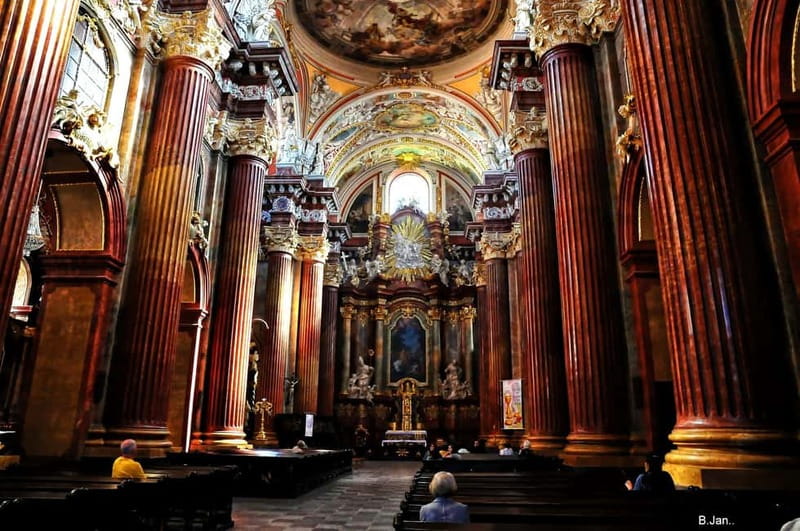
The tour begins at the Basilica of Our Lady of Perpetual Help, and that is smart. This is not a quick photo-stop. It is the kind of church where Baroque details pull you inward, especially the stucco decoration and grand frescoes.
What you get from having a guide here is not just describing what you are seeing. You get the “how to look” part. A good guide points out where your eye should land first, and why the design choices were meant to do more than impress. Even if you are not a museum person, churches like this make the surrounding Old Town feel more meaningful because they set the tone of power, devotion, and wealth.
If you like architecture, this is a great first hour. If you are short on time, it still helps because it gives you an immediate sense of scale and style before the tour drops into street-level stories.
Jesuits Collegium and Chopin Park, the calm moments you will appreciate later
After the Basilica, the walk slows down in a good way at the Jesuits Collegium. The key detail here is its connection to the city’s educational tradition. Instead of treating it as just another historic building, the guide helps you understand why it matters in a place like Poznań, where institutions shaped daily life, not only elite history.
Then you hit Frédéric Chopin Park, a green pocket dedicated to Poland’s beloved composer. This is a breather, but it also works as a reset for your attention. When you come out of a church and into a park, the city stops feeling like a list of landmarks and starts feeling like a real place where people live, study, and gather.
For readers who get tired of nonstop walking commentary, these stops are the kind that make the tour feel balanced.
Market Square, Rynek, Old Town Hall, and the Poznań Goats at noon
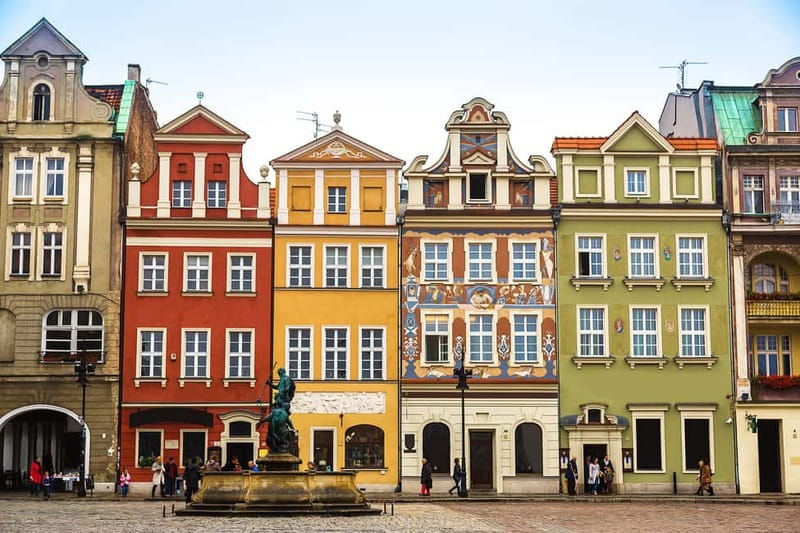
The highlight most people remember is Rynek, Market Square, because it is where Poznań’s public life shows up. The tour focuses on the Old Town Hall in a Renaissance style, but the real magic is timing.
You get the chance to see the Poznań Goats legend at noon. That show is one of those local moments that feels both playful and deeply rooted. If you are traveling with kids, it tends to land well. If you are traveling as adults, it still works because it makes the square feel lived-in, not frozen in time.
A guide also helps you understand what makes the square more than pretty architecture. Rynek is where stories pile up. When you learn the backstory to a fountain or the reason for a building’s look, your photos get better because you know what you are photographing.
Practical note: noon is popular. If you have mobility limits or you hate crowds, plan your expectations. The guide adapts the pace to the group, but Market Square can be busy.
Still tacked up around Poznan


Bamberka Fountain and the story behind the German-Polish mix
One of the most interesting details in the tour is the Bamberka Fountain. It is a tribute linked to German settlers who shaped parts of the region’s culture. That matters, because Poznań is not a one-note city. Its identity was formed through shifting political control and real cultural mixing.
When you see something like this fountain explained with care, you stop thinking of Central Europe as a blur of borders. You start noticing how ordinary objects and public art can carry big, long memories.
If you love “small detail, big meaning” travel, this stop is worth leaning into. You get a cultural explanation tied directly to what is in front of you.
Adding the Polish Theater and Imperial Castle on the 3-hour option
Choose the 3-hour route if you want Poznań to feel more modern and institutional, not only medieval and civic.
You add the Polish Theater, noted as a cultural beacon since 1875. Nearby, the itinerary also points you toward the Grand Theatre. Even if you do not go inside, the architecture gives you a sense of how the city presented itself in the period when public culture was becoming a major statement.
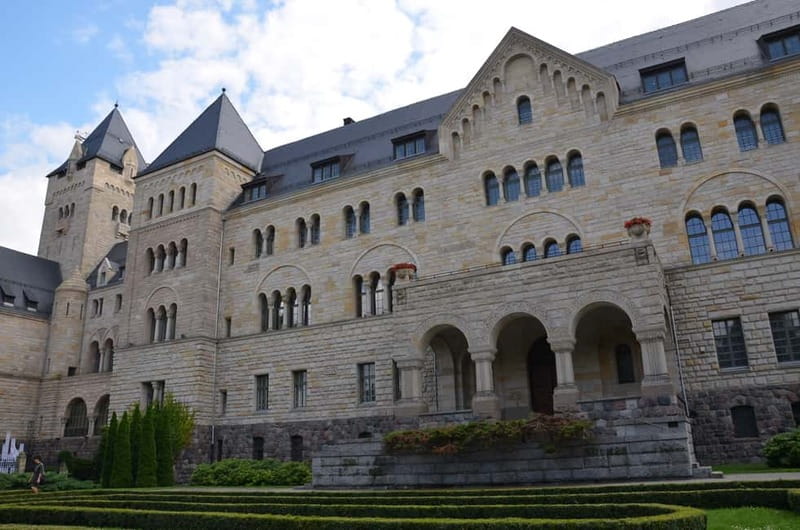
Then you move toward the Imperial Castle, built for German Emperor Wilhelm II. This is one of those buildings where history is physical. You are not just reading facts. You see a structure tied to an era of imperial power and political tension.
The tour also connects the castle to its present life. The castle is now tied to Zamek Culture Centre, which supports artists. That bridge from past to present is what makes this portion satisfying. It is not history as a closed chapter. It is history still shaping a working cultural hub.
Adam Mickiewicz University area, where art and education shape the view
On the longer options, the walk includes the area around Adam Mickiewicz University. The university is named after one of Poland’s greatest artistic icons, and that naming matters. You are seeing how national identity gets built into institutions.
The guide’s value here is simple. Without context, universities can look like “just another cluster of buildings.” With context, you notice how architecture, location, and naming combine to keep culture and education tied to the city’s self-image.
If you want your trip to feel grounded in real Polish life, not only monuments, this stop helps. It shifts the tour from only “who ruled” to “who learned and created.”
Citadel Park and the Museum of Armored Weapons in the 5-hour option
If you pick the 5-hour tour, you get the payoff of seeing Poznań’s military memory in a very physical setting. You visit Citadel Park, where you can spot remnants of Prussian fortifications. It is a different kind of “old town” experience. Instead of tight streets and façades, you get open space, views, and the feeling of history layered into terrain.
Then comes the Museum of Armored Weapons. You get skip-the-line tickets for the permanent collection. Important detail: skip-the-line helps with the ticket office, but you still deal with security and entry queue. So you are not saving time in a magical way, but you are usually saving hassle.
Inside, you see tanks and military artifacts, with some weapons displayed outside and smaller samples and photos inside. If you are a history fan, this adds a strong contrast to the cultural stops earlier in the day. You finish with the “how the city defended itself and remembered war” side of the story.
And if you are not a military buff, it can still work because you are looking at technology and design as history. The setting in Citadel Park makes it feel less like a warehouse and more like part of how the city survived.
Pacing, shoes, and how to handle the private-guide rhythm
The tour is designed for a private group, so the guide should feel like your personal translator and coordinator, not a broadcaster. That said, the experience depends on how well your guide manages flow in busy areas.
A downside that can happen in Old Town crowds is that a guide may move quicker than you expect, and you can get separated if the group has trouble keeping up. If that is your concern, tell the guide at the start that you prefer a slower pace and clearer regrouping points.
Shoes matter. Expect uneven ground and steps. Comfortable footwear is not optional here. Also dress for weather, since the tour runs rain or shine.
One more practical point: hotel pickup is available within 1.5 km of the designated meeting point, and the route can adjust. That is useful if you are staying near the Old Town core.
And about language: guides are available in English, German, and Polish. If you want a smoother experience, choose the language you speak best.
Price and value: is $107 per person a good deal?
At $107 per person for a private walking tour lasting 2 to 5 hours, value depends on two things: what option you choose and who is in your group.
- If you go for the 2-hour option, you are mainly paying for a highly efficient, curated look at the Old Town center: Basilica, Jesuits Collegium, Chopin Park, Rynek, Old Town Hall, Poznań Goats at noon, and Bamberka Fountain. That can be a strong deal if you like “see the key stuff fast with explanations.”
- If you go for the 3-hour option, you are adding the Polish Theater area and Imperial Castle architecture, which turns the tour into a better all-around city introduction.
- If you go for the 5-hour option, you add Citadel Park and the Museum of Armored Weapons with skip-the-line tickets. That can be the best value if you want both culture and a very different kind of history, plus a museum finish rather than only street stops.
Private tours can feel pricey when you travel solo. They often feel more reasonable when you are splitting costs with a couple or small group. Either way, think about what you would otherwise pay for guide time plus ticket lines plus the time you would spend figuring out what to prioritize.
Should you book this Poznań Old Town private walking tour?
Yes, if you want a guided Old Town that mixes major sights with specific local stories. The big reasons to book are the Basilica of Our Lady, the Market Square, Rynek focus, and the chance to time your walk for the Poznań Goats at noon. If you are choosing between options, pick based on your curiosity:
- Go 2 hours if you want the core Old Town hits without committing to longer walking.
- Go 3 hours if you want cultural landmarks like the Polish Theater and the Imperial Castle included.
- Go 5 hours if you want Citadel Park and the Museum of Armored Weapons, plus the added time to see Poznań from a wider historical angle.
Skip the booking if you hate crowds, are very sensitive to pace, or only want museum interiors without walking. Then you might prefer a different format with less time in open squares.
If you do book, come with comfortable shoes, a flexible attitude about crowds near noon, and a willingness to ask questions. The best moments happen when you let the guide connect what you see to why it matters.
FAQ
How long is the Poznań Old Town and Top Attractions private walking tour?
The tour runs for 2 to 5 hours, depending on the option you choose. Availability and starting times depend on the selected duration.
Where does the tour start?
The meeting point may vary depending on the option booked. If you are staying within 1.5 km of the meeting point, pickup is available and the itinerary can adjust.
What is included in the 2-hour option?
The 2-hour route includes starting at the Basilica of Our Lady of Perpetual Help, plus stops at the historic Jesuits Collegium, Frédéric Chopin Park, and Market Square (Rynek), including the Poznań Goats at noon and the Bamberka Fountain.
What extra sights do you get with the 3-hour option?
The 3-hour option adds the Polish Theater, the Imperial Castle’s architecture, and sights around Adam Mickiewicz University. The tour also references the Grand Theatre as part of the architectural experience.
What extra sights do you get with the 5-hour option?
The 5-hour option includes the 3-hour route and adds Citadel Park plus a visit to the Museum of Armored Weapons in Citadel Park, with skip-the-line tickets to the permanent collection.
Are admission tickets included?
Tickets to attractions are not included in the price. The 5-hour option includes skip-the-line tickets for the Museum of Armored Weapons, but the tour still requires security and entry processing.
Is the tour difficult to walk?
It is a moderate walking tour (about 2.5 to 5 km), with uneven surfaces or steps. The guide will adapt the pace to your group, and it runs rain or shine.
What languages are the guides available in?
Guides are available in English, German, and Polish.
Freshly posted from Poznan
- The Best of Poznan 4 Hour Guided Private Walking Tour★ 5.0 · 7 reviews
- Private walking city tour in Poznan★ 4.0 · 9 reviews
- Poznan: Private Traditional Polish Food Tour★ 5.0 · 9 reviews
- Poznań Half-day Tour★ 4.9 · 10 reviews
- Poznan: Old Town, Srodka District, & Cathedral Private Tour★ 5.0 · 10 reviews
- 2 Hour Poznan Highlights Tour★ 5.0 · 12 reviews
- Poznan: Pub Crawl with Free Club Entry★ 4.1 · 12 reviews
Walking Tours, compared.
Old Town Krakow & Wawel Castle Walking Tour
Read our review →
Gdańsk City Sights & History Guided Walking Tour in English
Read our review →
Browse the lists this tour appears in