
Reviewed · WALKING TOURS
Krakow Walking Tour with Audioguide on Your Smartphone
Krakow gets easier when your guide is on your phone. This self-guided audioguide tour strings together the city’s big landmarks, from the Barbican to Wawel Hill and into Kazimierz, with 26 narrated stops by a professional historian. I like the freedom to pause, rewind, and move at your own pace without waiting for a group. I also love that you get an offline map and simple landmark illustrations so you spend less time fumbling and more time looking up.
My one watch-out is that it is still a 100 percent walking day. If you travel in winter, bring real cold-weather gear, since one account noted temperatures around -14 C, and you will be outside most of the time.
In This Review
- Key points before you go
- How the smartphone audioguide works in Krakow
- Barbican to St. Florian’s Gate, a strong start at the city’s defenses
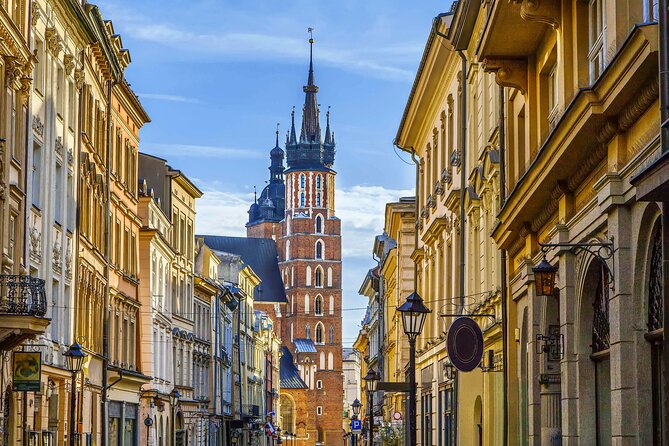
- Florianska Street and St. Mary’s Basilica, the Main Market area energy
- Market Square and the Town Hall Tower, views and civic pride
- Collegium Maius and Collegium Iuridicum, Jagiellonian University in your footsteps
- Bishop Erasmus Ciolek Palace and Kanonicza Street, elegant Old Town by clergy
- Wawel Cathedral and Wawel Castle, Poland’s royal hill
- Kazimierz begins at the Tempel Synagogue and keeps going
- Ghetto Heroes Square and Jan Karski’s monument, remembrance with a human scale
- Okrąglak and the Kazimierz street-food pause
- Price and value: $8.27 for expert audio across major landmarks
- Timing, weather, and gear for a mostly outdoor walk
- Who this smartphone audioguide tour is for
- Should you book this Krakow walking tour with audioguide?
- FAQ
- Is there a human guide during the tour?
- What do I need to bring?
- Where does the tour start and end?
- How long is the walking route?
- Is the audio guide available in English?
- Do I need to pay for entry tickets during the route?
Key points before you go
- 26 audio recordings by a professional historian in your chosen language, available with 1 year access
- Offline map with GPS route so you can follow along without signal stress
- No human guide at the start, so you rely on the app and your own timing
- Main sights plus Kazimierz memorials, including Ghetto Heroes Square and Jan Karski’s monument
- Designed for street walking with no entry fee required for the route itself
- Bring headphones because they are not included, and the phone needs battery
How the smartphone audioguide works in Krakow
This tour is self-guided, meaning no guide meets you at the Barbican. The experience starts at Kraków Barbican, Basztowa, 30-547 Kraków, Poland, and it ends back at the same meeting point.
Your job is simple: download the app, activate your purchase, then follow the route on the map. You will get an offline map and illustrations that help you spot the landmarks quickly. Because it is GPS-based, you are not just reading, you are walking through a sequence with audio cues.
The content is built around 26 separate audio recordings. Most people like this format because you can match the audio to what you see instead of listening to a fast group speech. If you want a longer look at a doorway detail or a chapel interior, you can pause and restart. One reviewer also mentioned the app can create framed, souvenir-style photos, which is a fun extra if you like photo keepsakes.
One practical point: charge your phone fully before you leave. You are using screen brightness, GPS, and audio at the same time. And yes, you will need your own headphones, since the tour does not include them.
More Walking Tours in Krakow
- Old Town Krakow & Wawel Castle Walking Tour
★ 5.0 · 1,508 reviews - Creepy Krakow: 2-Hour City Walking Tour
★ 4.7 · 1,131 reviews - Krakow: The Old Town Walking Tour
★ 4.8 · 794 reviews
Barbican to St. Florian’s Gate, a strong start at the city’s defenses
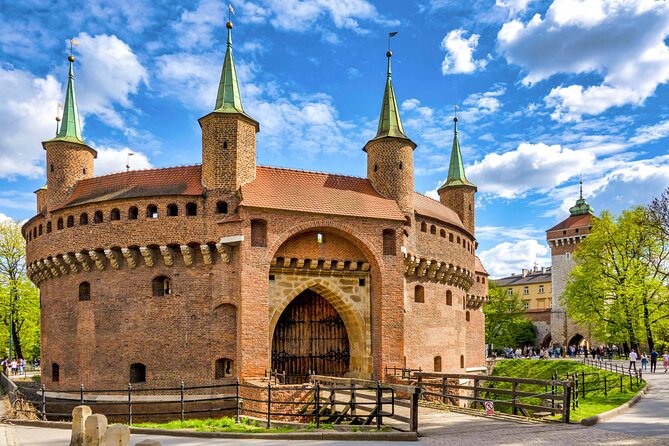
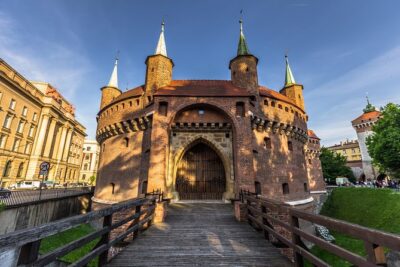
The route kicks off at the Barbican, a late 15th-century medieval fortress designed to protect Kraków. It is circular, with thick brick walls and seven turrets around a courtyard. Even if you only see it from the outside and at the courtyard edge, it gives you instant context: Kraków was built to be defended, not just admired.
From there, you move toward St. Florian’s Gate. This is one of the most recognizable medieval towers in the city, built in the 14th century and topped with a Baroque roof. At 33.5 meters tall, it is tall enough that it frames the next part of your walk like a historical threshold. Walk through it and you feel the shift from fortress edge to the Royal Route world of processions and public life.
What I like about starting here is the timeline. The audio helps you connect architecture to purpose. If you are the type who usually skips descriptions, this is the kind of start that makes you look longer, because the buildings explain why the city grew where it did.
Florianska Street and St. Mary’s Basilica, the Main Market area energy
Next comes Ulica Florianska (Florianska Street), the classic connector between St. Florian’s Gate and the Main Market Square. Florianska Street is where Kraków mixes old facades with everyday street life. It is ideal for stretching your legs while still staying in the historical flow. You can stop for coffee or a snack and still feel like you are on the tour, not wandering away.
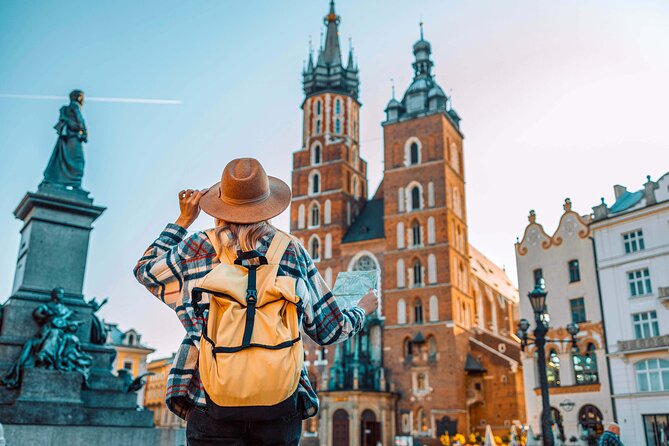
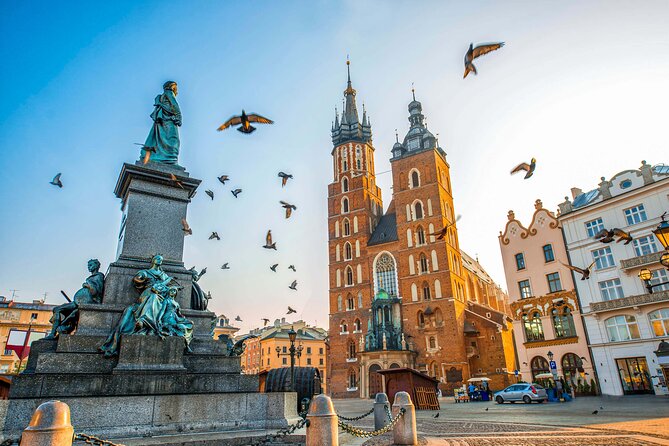
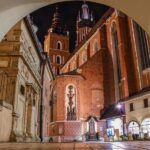
Then the audio leads you to St. Mary’s Basilica in the Main Market Square. This is a Gothic church with twin towers, and it is especially famous for its wooden altarpiece by Veit Stoss. The basilica area is also where you get the tower rhythm: the Bugle Tower has an hourly trumpet call, which turns the square into a kind of living clock.
A balanced note: you might want to time your visit so you are not rushing right past the interior. The route is built so you keep moving, but if you want the full church experience, plan extra minutes on your own. The route itself does not force paid entry, but the inside of major sites can involve separate tickets.
Market Square and the Town Hall Tower, views and civic pride
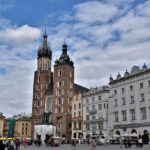
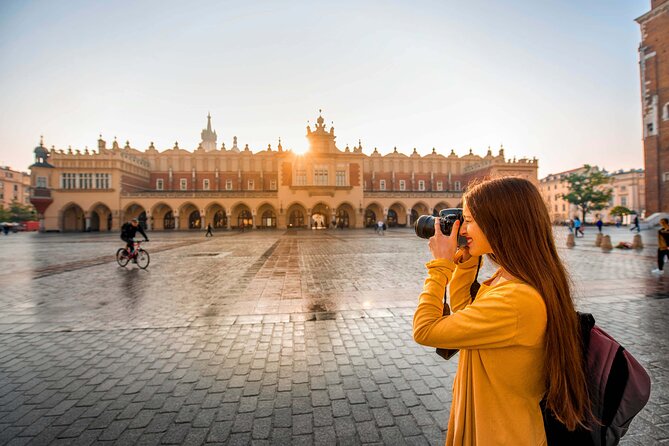
Once you are in Market Square, the scale hits you. It is one of Europe’s largest medieval town squares, surrounded by historic townhouse fronts. This is the heart of Kraków for a reason. It is not just pretty. It is functional, social, and layered with landmarks.
Two highlights you will likely pause at are the Cloth Hall and the Town Hall Tower. The tower is 70 meters tall and is the last vestige of the original 14th-century town hall. The audio sets you up for the tower’s purpose, not just its height, which helps you understand why civic buildings were symbols of power and order.
If you go up the tower, you get panoramic views that help you read the city from above. And even if you skip climbing, standing in the square and looking outward is useful. You can line up what you saw in Kazimierz later, and you will understand where the river and main districts sit in relation to the Old Town core.
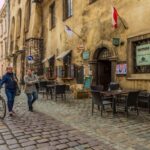
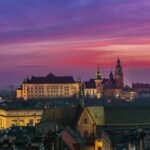
More Polish squares crossed on foot:
Collegium Maius and Collegium Iuridicum, Jagiellonian University in your footsteps
After the old town landmarks, the route shifts into academic Kraków. You will pass Collegium Maius, the oldest building of Jagiellonian University, founded in the 14th century. This stop is more than a photo op. The audio talks about medieval arcades, courtyards, lecture halls, and historical collections, including ancient scientific instruments and artifacts.
Why this matters for you: universities are often treated like background detail. Here, it becomes a core storyline. Jagiellonian University educated major figures, and the tour highlights that Nicolaus Copernicus studied there. So as you listen, you start seeing Kraków not just as royal and religious, but also as a place of learning and science.
The next university-related stop is Jagiellonian University Collegium Iuridicum. This is another historic building tied to the broader university legacy. The audio emphasizes the mix of Gothic and Renaissance architecture and the institutional weight of one of Europe’s oldest centers of higher education. Again, it is easy to breeze past if you are in hurry mode, but the pacing of a self-guided walk lets you slow down.
Bishop Erasmus Ciolek Palace and Kanonicza Street, elegant Old Town by clergy
Now the tour turns to palaces and old streets. You will reach the Palace of Bishop Erasmus Ciolek, an early 16th-century Renaissance palace. Today it houses a branch of the National Museum, and the audio points you toward what kind of collections you can expect, including Polish art such as medieval sculptures, religious icons, and early modern paintings.
Right after that, walk Ulica Kanonicza (Kanonicza Street). This cobblestone lane is one of the prettier, quieter stretches in the Old Town area. It is lined with preserved Renaissance and Baroque townhouses, many connected to clergy and scholars. The vibe here is not party-on-the-square. It is old-world calm, and it makes a good reset after the busier central landmarks.
If you like architecture, these two stops are a nice pairing. The palace gives you the grand building story, while Kanonicza gives you the street-level feel of who lived nearby and what the area was for.
Wawel Cathedral and Wawel Castle, Poland’s royal hill
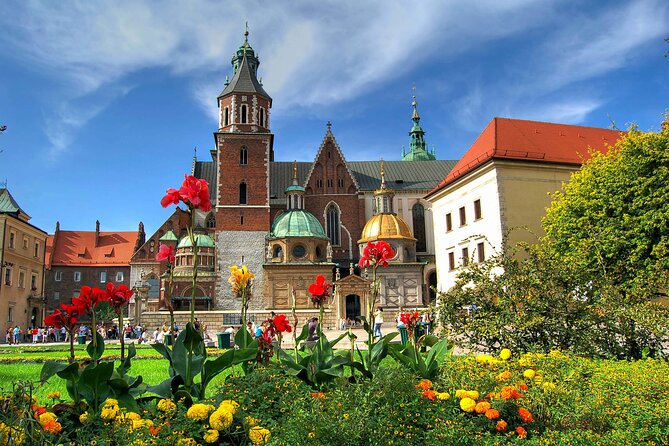
Eventually you climb into the big one: Wawel Hill. The tour includes both Wawel Cathedral and Wawel Castle, and the audio framing makes them feel linked rather than duplicated.
At Wawel Cathedral, you are in the Gothic heart of coronations, weddings, and funerals of Polish kings and queens. The tour calls out the Sigismund Bell and the Royal Tombs, plus the cathedral museum and the kind of sacred artifacts and regalia you can see. If you care about art and ritual space, this is where the details matter most, like the chapels, stained glass, and decorated interiors.
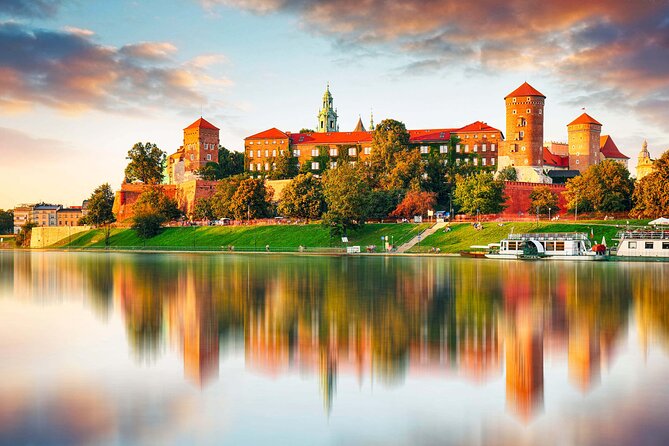
Then comes the Wawel Castle portion. This UNESCO World Heritage site is built on centuries of changes, starting in the 14th century and expanding into later styles. The audio points you toward opulent state rooms, Renaissance courtyards, Royal Apartments, and collections such as tapestries and art. You also get the Crown Treasury and Armory mention, which tells you the castle is not only about royal living, it is also about power shown through objects and craft.
Practical tip: Wawel is a spot where you might want to stand and look out. Even if you skip some interior time, the views over the Vistula and the river angle help you orient the whole city.
Kazimierz begins at the Tempel Synagogue and keeps going
When the route enters Kazimierz, it changes tone. You go from royal and civic symbols to Jewish cultural memory and everyday community life.
First is the Tempel Synagogue, built in 1862 in the Moorish Revival style. Inside, you are meant to notice the richly decorated interiors, including gilded stuccoes, intricate woodwork, and stained glass. The audio notes that the building once served progressive Judaism and now hosts concerts, cultural events, and religious services.
Next you reach Szeroka Street, the cultural and historical heart of Kazimierz. The audio highlights Old Synagogue and Remuh Synagogue and the adjacent cemetery, plus the fact that the street is known for cafes, restaurants, and Judaica shops. Even if you are just walking through, this is the kind of street where the names on buildings matter, because Kazimierz is a neighborhood with layered identity.
Szeroka Street also links naturally to another big stop: the Old Synagogue. The tour positions it as one of the oldest surviving synagogues in Poland, dating back to the 15th century. Here the audio shifts toward museum-style viewing, with artifacts and exhibitions related to Jewish traditions and community life.
If you only want the highlights, this is still enough. But if you pay attention, you will come away with a clearer sense of what community institutions looked like in daily life, not just as static monuments.
Ghetto Heroes Square and Jan Karski’s monument, remembrance with a human scale
This part of the route is heavier. You will visit Square of Ghettos Heroes in the Podgórze district, the memorial site marking the heart of the Kraków Ghetto during World War II. The audio describes 70 empty metal chairs representing the absence of thousands of Jews who lived there, plus a plaque and small exhibits.
Then, near the Old Town in Planty Park, the tour includes the Jan Karski Monument. The statue shows Jan Karski seated with a book, and the audio emphasizes his role as a Polish World War II resistance fighter and diplomat. It also highlights his efforts to report the Holocaust horrors to the Allies.
Why these two stops work together for you: one is a place designed to hold collective grief, the other is a person-focused reminder of courage and testimony. Together, they prevent the history from feeling abstract.
A small pacing note: do not rush through this area just to finish the route. Let your brain catch up. The self-guided format makes that possible.
Okrąglak and the Kazimierz street-food pause
Halfway through the Kazimierz segment, the tour brings you to Okrąglak, a circular market hall from the early 20th century that still carries a market atmosphere. The audio points out today’s food stalls and the local favorite zapiekanki, open-faced sandwiches.
This is not just a snack stop. It is a way to ground the history in regular life. After memorials and museums, eating something simple helps the day feel real again. And if you are traveling on a schedule, Okrąglak is a practical place to take 20 minutes and regroup.
Price and value: $8.27 for expert audio across major landmarks
At $8.27 per person for roughly 2 hours 30 minutes, this tour is best valued for two reasons.
First, you are paying for structure. The route stitches together a lot of top Kraków sights that are otherwise scattered across districts. For that price, you get 26 historian narrated recordings plus an offline route, which can save time and reduce guesswork.
Second, you are paying for flexibility. With a self-guided plan, you can match your pace to the weather, your interests, and your energy level. One review also pointed out convenience features like pause and restart, and even photo framing. Those small design choices can make the experience feel smoother than a basic text guide.
What you should know about costs: entrance fees and tickets are not included, and you should bring your own headphones and smartphone. The route is built to be walkable without mandatory entry fees, but if you want to go inside museums, towers, or cathedrals, expect extra charges at those sites.
Timing, weather, and gear for a mostly outdoor walk
This is a walking route with stops spread through the Old Town and into Kazimierz, plus a royal hill area at Wawel. That means weather matters.
If you travel in colder months, dress like you plan to stand outside for long stretches. The route is designed for walking, not for constant indoor breaks. I would also bring a power bank if you have one. Using GPS plus audio can drain battery faster than you expect.
And do not forget headphones. Even if the tour is cheap, sound matters. You want both your ears free for audio without blasting it around the street.
Finally, plan your start time with common sense. The route includes landmarks where viewing conditions depend on daylight and open hours. Since the audio guide works any time and you can access it during your subscription window, you can adjust your day if the city schedule shifts.
Who this smartphone audioguide tour is for
This tour is a great match if you:
- want a low-cost way to connect Kraków’s biggest landmarks
- prefer walking at your own pace instead of joining a group
- like having a professional historian explain what you are seeing
- can handle a day that is mostly outdoors, with occasional stops near major sites
It may not be ideal if you want a full-service experience with a human guide answering questions on the spot. Because there is no guide meeting you, your experience depends on the app and your comfort with self-guided navigation.
Should you book this Krakow walking tour with audioguide?
I think it is worth booking if your main goal is to get oriented and cover Old Town plus Kazimierz in one smart route. For $8.27, the combination of offline GPS, 26 historian tracks, and a tight sequence of major landmarks is strong value, especially if you like pausing to look closely.
Skip the booking if you hate using apps on your phone while walking, or if you want a guided Q and A and timed museum entry support. In those cases, a guided group tour could fit better.
If you do book, my best advice is straightforward: download the app and offline map before you step out, bring headphones, and dress for the weather. Then walk with your eyes up. Kraków rewards attention, and this route is built to help you notice it.
FAQ
Is there a human guide during the tour?
No. This is a self-guided experience. The app provides the route and audio, and there is no guide at the meeting point.
What do I need to bring?
Bring your own smartphone and headphones. Smartphones and headphones are not included. Also, charge your phone since you will use GPS and audio.
Where does the tour start and end?
It starts at Kraków Barbican (Basztowa, 30-547 Kraków, Poland) and ends back at the same meeting point.
How long is the walking route?
The duration is about 2 hours 30 minutes.
Is the audio guide available in English?
Yes, the tour is offered in English. You also get access in your preferred language for 1 year, chosen during checkout.
Do I need to pay for entry tickets during the route?
Entrance fees and tickets are not included. The route is designed so you do not need an entry fee to follow the walking stages, but if you choose to enter specific sites, extra tickets may be needed.
More Self-Guided Tours in Krakow
- Krakow: Auschwitz-Birkenau Guided Tour or Self-Guided Tour
★ 4.1 · 5,852 reviews - Krakow: Day or Night Vistula River Cruise with Audio Guide
★ 4.5 · 1,303 reviews - Krakow: Hop-On Hop-Off Bus Tour with Audio Guide
★ 3.6 · 703 reviews - From Krakow: Auschwitz-Birkenau and Self-Guided Day Tour
★ 4.1 · 576 reviews
Freshly posted from Krakow
- Krakow: Audio-Guided City Experience by Golf Cart★ 5.0 · 1 review
- Krakow: Zakopane and Thermal Springs Tour with Hotel Pickup★ 5.0 · 1 review
- Half-day In the footsteps of John Paul II Tour from Krakow★ 5.0 · 1 review
- Tour to Wadowice: Hometown of Pope Saint John Paul II★ 5.0 · 1 review
- Krakow: Wawel & Salt Mine Experience with Lunch★ 5.0 · 1 review
- Krakow: Nowa Huta Communist District Walking Tour★ 5.0 · 1 review
- Krakow: Outdoor Paintball with Hotel Transfers★ 5.0 · 1 review
Walking Tours, compared.
Old Town Krakow & Wawel Castle Walking Tour
Read our review →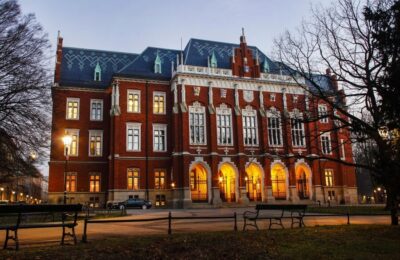
Gdańsk City Sights & History Guided Walking Tour in English
Read our review →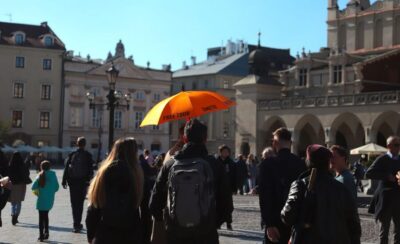
Browse the lists this tour appears in