
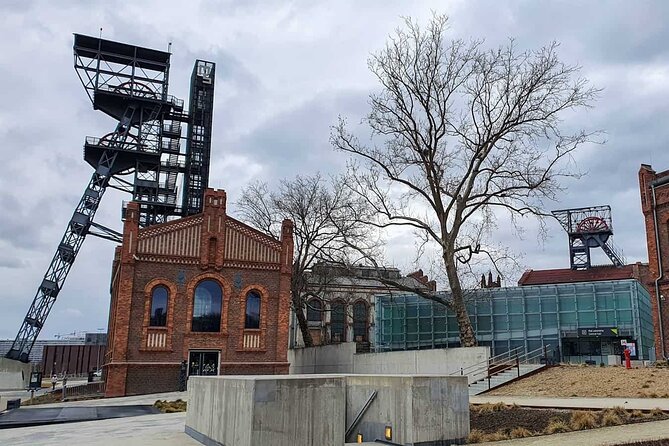
Reviewed · WALKING TOURS
Katowice Old Town Walking Tour
Katowice history is on foot. This Katowice Old Town Walking Tour strings together Market Square landmarks, church architecture, and the city’s best-known symbol, Spodek, with an English-speaking guide who keeps the story moving. I especially like how the route pairs big civic sights with everyday street life, so you get context, not just photos. I also like the practical setup, many stops are free to enter, which makes it easier to spend on food and time instead of ticket lines.
One consideration: you’ll cover about 6.5 km over roughly 3 hours, so comfy shoes matter. Also, the tour requires good weather, so if skies turn gray, you’ll need a plan B date or a refund.
In This Review
- Quick hits before you go
- Where the tour begins: Silesian Theatre and Market Square basics
- Step into Kosciol Mariacki: church architecture you can actually read
- Academy of Music in Katowice: prestige with a human scale
- Silesian Parliament and the nearby theater vibe
- Cathedral of Christ the King: the architecture tells a mixed story
- Miarka Square to Stawowa: the longer street walk that pays off
- The Silesian Insurgents’ Monument: why three uprisings matter
- Spodek: the city’s symbol with a futuristic presence
- Price and value check for a 3-hour walking tour
- The guide experience: what you should listen for
- Who this tour suits best (and who should choose something else)
- Should you book the Katowice Old Town Walking Tour?
- FAQ
- How long is the Katowice Old Town Walking Tour?
- About how far do you walk during the tour?
- Is the tour private and in English?
- Where does the tour start?
- Do you pay admission fees at the stops?
- What if the weather is bad or you need to cancel?
Quick hits before you go
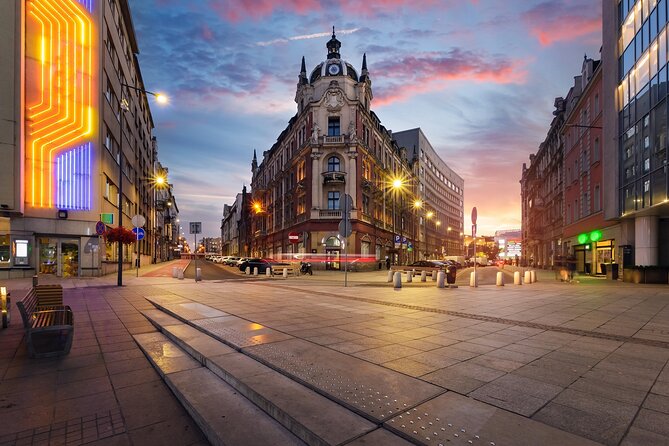
- Market Square as your storyline starting point: You begin right where the city’s layers show up, from old buildings to Soviet-era shopping vibes.
- Free-entry stops that still feel worth your time: Churches, music institutions, and monuments are on the list with no admission fees.
- Silesian identity explained through architecture and culture: Expect clear connections between borders, faith influences, and regional pride.
- A guided mix of quick looks and one longer stroll: Most stops are brief, then Stawowa gives you time for streets and buildings.
- Spodek finishes the walk with futuristic drama: It’s an easy way to tie the whole tour together visually.
- Private by design, your group gets the attention: If you’re coming with friends, the pace stays flexible and questions land faster.
Where the tour begins: Silesian Theatre and Market Square basics
The tour kicks off at the Silesian Theatre on Rynek 10. From the start, you’re in the city’s public living room, not some far-off landmark with a parking-lot vibe. Market Square is the right opener because it lets your guide set the theme quickly: Katowice and the broader Silesia region have been shaped by changing cultures, shifting borders, and very human local life.
This first stretch also gives you a fun mix of old and newer layers. You’ll see the theater area and then move through Market Square highlights, including what’s described as shopping “dream places” from communistic Poland, with Skarbek and Zenit called out by name. That’s a useful detail because it pushes beyond architecture into the lived experience of the 20th century.
You also get that Market Square feeling that it’s both historical and social. The area is treated like a gathering zone, with places for eating and drinking nearby. Translation for your trip: I’d budget a little time after the tour to stay in the area for a meal, because the neighborhood is meant for lingering, not rushing through.
More Walking Tours in Krakow
- Old Town Krakow & Wawel Castle Walking Tour
★ 5.0 · 1,508 reviews - Creepy Krakow: 2-Hour City Walking Tour
★ 4.7 · 1,131 reviews - Krakow: The Old Town Walking Tour
★ 4.8 · 794 reviews
Step into Kosciol Mariacki: church architecture you can actually read
Next comes Immaculate Conception Catholic Church (Kosciol Mariacki). The time here is short, about 10 minutes, so you’re not being asked to treat it like a half-day museum. Instead, it’s set up for quick visual understanding, which is exactly how church architecture works best when someone explains what to notice.
Outside, the focus is on breathtaking architecture. Inside, the emphasis shifts to artworks by top Polish artists. For you, this means the stop is a chance to train your eye. You’ll likely come away with a practical sense of how the building’s design supports its role in community life.
A small drawback to plan for: because the stop is brief, if you love slow looking, you might want to return later on your own. This is more about orientation and appreciation than deep study.
Academy of Music in Katowice: prestige with a human scale
Then you move to the Academy of Music in Katowice, described as the most prestigious music academy in Poland. You spend about 7 minutes here, so think of it as a focused pause that signals what kind of cultural engine the city runs on.
Even without going inside for a long visit, a music academy spot works well in a walking tour because it offers a different “type” of landmark. Many cities sell you castles and squares. Katowice adds an institutional landmark that says, people here still invest in arts and training.
If your group includes music fans, this stop is an easy win. If your group is more into architecture, it’s still worth it because it broadens the story beyond politics and religion, which makes the later stops feel more coherent.
Silesian Parliament and the nearby theater vibe
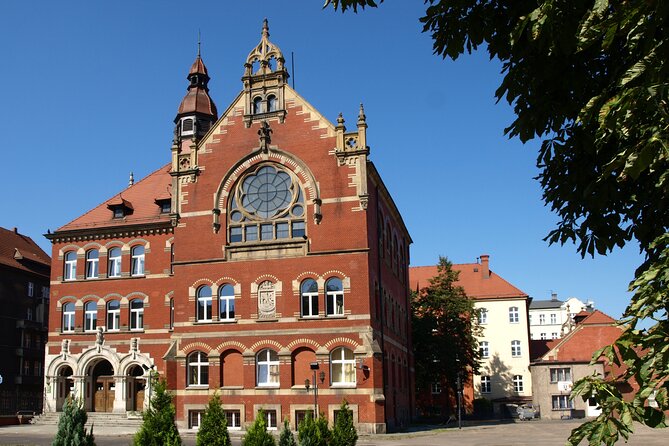
The route then turns to the Silesian Parliament, the former seat of parliament for the Autonomous Silesia Region. You have around 10 minutes here, enough time to understand the building’s role without turning the walk into a lecture.
Why this matters for your trip: civic buildings like this are where you see the regional identity in an official form. It ties directly to the rest of the tour’s theme, a place that has repeatedly negotiated who it is and what influences it accepts.
Right around this section, there’s also a stop for a local’s favourite theater with an informal vibe. Even though it’s not framed as a museum stop, that contrast is useful. It shows that the city’s cultural life is not only formal and historical, it’s also everyday and slightly relaxed.
If you like tours where the guide notices social texture, you’ll probably enjoy this part.
More Polish squares crossed on foot:

Cathedral of Christ the King: the architecture tells a mixed story
One of the most interesting stops on the whole walk is the Cathedral of Christ the King. The description sets up an immediate visual comparison: from the outside it reads Catholic-like, while inside it feels more Protestant-like.
That mix is not a throwaway detail. It’s the kind of clue that helps you understand Silesia as a region with layered spirituality. You’re not just seeing two styles for decoration. You’re seeing how history can shape worship spaces, even when communities share geographic space and time.
You also get about 10 minutes here, so it’s again a quick hit. But the tour’s structure makes it work. Earlier stops give you the civic and cultural context. This stop then wraps those ideas into a single building, where the “why” is built into the architecture.
Tip for you: when you’re inside, slow down for a moment and look for the features that support that Catholic-like vs Protestant-like contrast. Your guide will help you place what you’re seeing, and it’s one of those experiences that clicks faster when you actively look.
Miarka Square to Stawowa: the longer street walk that pays off
Stawowa is where the tour gives you its most time, about 30 minutes. Before you arrive there, you pass through Miarka Square, Dworcowa street, and 3 maja street. That transit matters because it lets you read the city’s fabric, not just point at isolated landmarks.
This is also the part where the tour emphasizes 19th-century tenements and mentions you can see the oldest high-school in Katowice. That’s a great combination for travelers who like city texture. Tenements teach you how people lived. An older school teaches you how long institutions lasted, even when political eras changed.
Two more details are tied into this area. First, there’s a monument commemorating Silesian scouts opposing Nazis in 1939. Second, Stawowa is described as a venue for art exhibitions, international meetups, and other events.
So for you, this section works on multiple levels:
- You get street architecture and scale.
- You meet a WWII-era memory marker.
- You also see that the area has a present-day cultural role, not only a past one.
A drawback worth noting: because it’s a street-and-building focus, you will feel the walking. If you’re tired, this is the part where a break helps. If you love wandering, you’ll appreciate how much more time you’re given here compared with other stops.
The Silesian Insurgents’ Monument: why three uprisings matter
After Stawowa, the route moves to the Silesian Insurgents’ Monument (Pomnik Powstancow Slaskich). You’ll spend about 10 minutes here.
The key detail is right in the name and explanation: it commemorates 3 Silesian uprisings. Monuments like this can feel abstract if you don’t have context. On this tour, the placement after the civic and faith stops helps. You’re building a timeline of what shaped the region, from institutions and belief spaces to the political moments that demanded action.
If you like history made understandable, this is a good stop because you’re not just told a fact and moved on. You’re given a reason to connect the uprisings to what came before and after in daily life.
Spodek: the city’s symbol with a futuristic presence
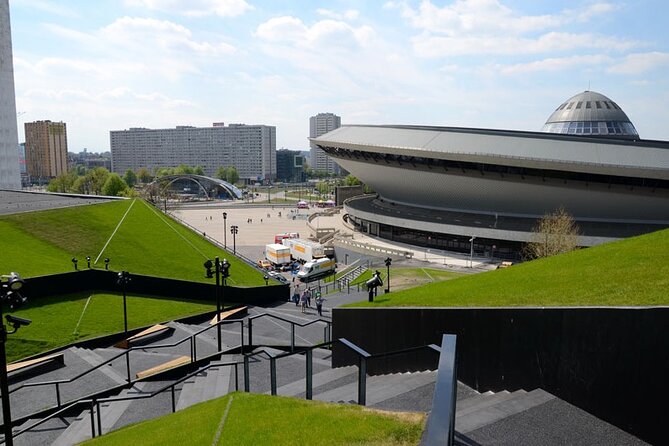
Finally, you reach Spodek, described as the symbol of the city. It’s a 10-minute stop, and that timing fits well. Spodek is the kind of landmark that usually needs only one pass to register visually, then you’re ready to think about why it represents the city.
The building feels distinctly modern compared with the older streets and church architecture you’ve been seeing. That contrast is useful. It helps you sense that Katowice is not stuck in one era. The region keeps reinventing itself, while still honoring its older layers.
For your trip strategy: if you’re planning photos, Spodek is a good end point. You’re also likely back near the start area right after, so it’s easy to extend your evening with dinner around the center.
Price and value check for a 3-hour walking tour
The price is listed at $81.62 per person for about 3 hours and roughly 6.5 km of walking. On paper, that can sound pricey for a walking tour. Here’s where the value argument gets real.
First, many of the stops are admission ticket free. That means the money is mostly paying for interpretation and routing, not covering entry fees. Second, the tour is offered in English, and the experience is positioned as a private activity where only your group participates. That matters because you’re not fighting the logistics of a giant crowd trying to hear over everyone.
Third, the tour is set up with short segments and one longer one, so you get variety without turning it into an all-day commitment. If you’re in Katowice for a limited window, this pacing is practical.
Where the price might feel less worth it: if you want very long museum time, or if you prefer deep, slow interior visits. The tour is designed for street-level understanding and guided orientation. It’s not a full-day deep dive kind of day. But for most people trying to get grounded fast, it’s a solid way to spend a half-morning or afternoon.
The guide experience: what you should listen for
This tour lives and dies by how the guide frames the connections. The strongest praise is consistent: guides are described as responsive, and the tour is treated like a learning session rather than a quick sightseeing loop.
One of the specific themes that comes up is how Silesia kept changing hands between Slavs and Germans. Even if you arrive knowing only basics, that kind of explanation gives you a lens. It helps you understand why the region’s identity can feel mixed and why architecture and culture blend rather than separate cleanly.
Another repeated highlight is the impact of the church buildings. The way the tour handles Kosciol Mariacki and Cathedral of Christ the King makes sense: you’re asked to look, then told what your eyes are likely seeing, and then you leave with a sharper sense of meaning.
Also, there’s at least one guide name that comes through in praise: Malwina. So if you get a guide like that, you can expect a guide who shares lots of interesting facts and keeps the flow engaging.
Who this tour suits best (and who should choose something else)
This is a good fit if you:
- Want a fast overview of Katowice and Silesian culture without bouncing between unrelated neighborhoods.
- Enjoy a guide who explains how history shows up in buildings and street life.
- Prefer walking tours with a mix of monuments, churches, and city institutions.
It might not be the best fit if you:
- Struggle with moderate walking and time on your feet. The 6.5 km is real.
- Need long indoor stays. Most stops are 7 to 10 minutes, with Stawowa at about 30.
- Have very limited mobility needs, since the tour assumes a moderate physical fitness level.
Should you book the Katowice Old Town Walking Tour?
If you’re the type of traveler who likes your sightseeing tied to meaning, I’d book it. The route covers the kind of landmarks that help you understand a place in one sitting: civic history at Silesian Parliament, culture at the music academy, faith and architectural mixing at the Cathedral of Christ the King, and the city’s modern identity at Spodek.
You should consider passing or choosing another option if your ideal day is mostly indoor time or if the idea of walking 6.5 km sounds stressful. This is a “get your bearings fast” tour, not a slow wandering day.
My practical advice: if you’re coming at a time when the weather usually holds, book it. Then plan a post-walk meal in the Market Square area, because that’s where the tour starts and where it feels most natural to keep the day going.
FAQ
How long is the Katowice Old Town Walking Tour?
It lasts about 3 hours.
About how far do you walk during the tour?
You walk about 6.5 km.
Is the tour private and in English?
Yes, it is private, and it is offered in English.
Where does the tour start?
The tour starts at Silesian Theatre, Rynek 10, 40-003 Katowice, Poland, and it ends back at the meeting point.
Do you pay admission fees at the stops?
The stops listed are marked as free for admission ticket purposes.
What if the weather is bad or you need to cancel?
The tour requires good weather. If it is canceled due to poor weather, you will be offered a different date or a full refund. Cancellation is free up to 24 hours in advance for a full refund.
Freshly posted from Krakow
- Krakow: Audio-Guided City Experience by Golf Cart★ 5.0 · 1 review
- Krakow: Zakopane and Thermal Springs Tour with Hotel Pickup★ 5.0 · 1 review
- Half-day In the footsteps of John Paul II Tour from Krakow★ 5.0 · 1 review
- Tour to Wadowice: Hometown of Pope Saint John Paul II★ 5.0 · 1 review
- Krakow: Wawel & Salt Mine Experience with Lunch★ 5.0 · 1 review
- Krakow: Nowa Huta Communist District Walking Tour★ 5.0 · 1 review
- Krakow: Outdoor Paintball with Hotel Transfers★ 5.0 · 1 review
Walking Tours, compared.
Old Town Krakow & Wawel Castle Walking Tour
Read our review →
Gdańsk City Sights & History Guided Walking Tour in English
Read our review →
Browse the lists this tour appears in