Reviewed · GUIDED
Guided Tour in Kraków-Płaszów Former Concentration Camp
Krakow has its own concentration camp site. This guided walk takes you to the Płaszów grounds in Podgórze, then connects it to Krakow’s Holocaust-era places, including the memorial at Ghetto Heroes Square. Even if you know Krakow only as a stop on the way to Auschwitz, this tour shows a darker chapter right inside the city limits.
Two things I like a lot: first, you get clear, human explanations from the guide, not a cold list of facts. In at least one small group experience, the guide Olga was praised for being very prepared and gentle, and even helped with figuring out tram tickets. Second, the visit is well paced for a short trip, with about one hour at the camp site plus time to orient yourself around the related memorial landmarks.
One consideration: this is heavy subject matter, and the camp area is described as a wild, uneven space of land. So go in expecting emotions, not a casual sightseeing stroll, and wear shoes that can handle uneven ground.
In This Review
- Key things to know before you go
- Why the Płaszów Camp Visit Changes How You See Kraków
- Ghetto Heroes Square and the 70-Chair Memorial
- Stepping Into the Płaszów Camp Grounds in Podgórze
- The Ghetto Wall Fragment, With a Plaque in Hebrew and Polish
- What the Guides Do Well, and How to Get More From the Walk
- Price and Value: $30.01 for a Focused, Krakow-Local Story
- Timing, Group Size, and How You’ll Move Through the Day
- Getting There: Start at Plac Bohaterów Getta, End Near Kamienskiego
- Who Should Book This Kraków-Płaszów Tour
- Should You Book This Tour?
- FAQ
- How long is the guided tour?
- What is the price per person?
- Is the tour offered in English?
- Where does the tour start and end?
- What will I visit during the tour?
- Is there an admission ticket for the camp stop?
- How big are the groups?
- Will I get a ticket on my phone?
- What is the cancellation policy?
Key things to know before you go
- Krakow-specific Holocaust sites: Płaszów camp, Ghetto Heroes Square, and the ghetto wall fragment
- A guided 2 hour format that links the places into one story
- Small group feel (up to 25), which tends to make questions easier
- Admission ticket free for the camp stop, so your money goes to the guide and time
- A real memorial landscape: 70 metal chairs at the square and a plaque on the wall fragment
- English language tour with a mobile ticket for less hassle
Why the Płaszów Camp Visit Changes How You See Kraków
Most people plan Krakow as a pregame for Auschwitz. This tour flips that idea. You spend your time inside Krakow’s own Holocaust geography, at the former German Nazi concentration camp in Płaszów, known as Konzentrationslager Plaszow bei Krakau. That matters because it shows how the Nazi system used areas close to everyday city life, not only far-off “big name” sites.
What I like is the way the tour connects locations across the river. You start at a memorial square in Podgórze, move into the camp grounds, and then finish by passing the fragment of the ghetto wall. That order gives you a sense of place, not just a sequence of stops.
You also get a guide who contextualizes the events. In the reviews, the tone is described as detailed and careful, with guides praised for being prepared. That’s the kind of guidance you want here, because you are walking through space that can feel confusing on its own.
Still tacked up around Krakow
- From Krakow: Auschwitz-Birkenau Guided Tour & Hotel Pickup
★ 4.5 · 33,358 reviews - From Krakow: Auschwitz-Birkenau Guided Tour & Hotel Pickup
★ 4.5 · 29,340 reviews - Krakow: Auschwitz Guided Tour with Optional Hotel Pickup
★ 4.5 · 15,280 reviews
Ghetto Heroes Square and the 70-Chair Memorial
Before you reach the camp grounds, you walk by the Ghetto Heroes Square, across the river in the Podgórze suburb. This is not only a memorial location, it is also a story about how public spaces get used, ignored, and then reinterpreted.
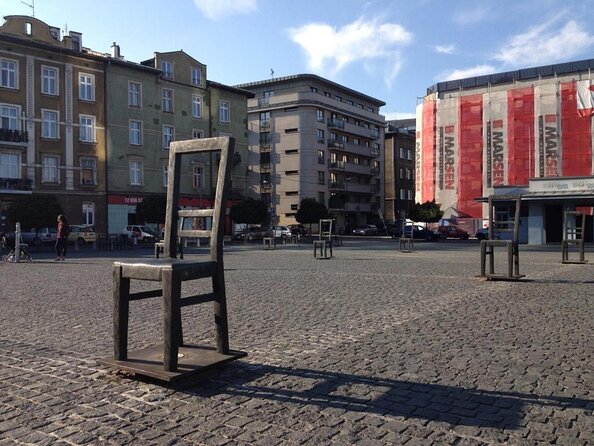
Here’s what makes the square worth your attention. After the war, Plac Zgody was renamed to Plac Bohaterów Getta (Ghetto Heroes Square), and a small monument was added. But for decades, the space was essentially used as a public toilet or parking lot, which is the kind of detail that can feel hard to absorb.
In 2005 the square was renovated, and the design sparked controversy. The layout includes 70 large, well-spaced metal chairs meant to symbolize departure and subsequent absence. When you stand among them, the memorial concept becomes physical and personal, even though it might look unusual at first glance. It is one of those places where you will probably feel your brain trying to categorize it like art or architecture, until the Holocaust connection pulls you back to the purpose.
Stepping Into the Płaszów Camp Grounds in Podgórze
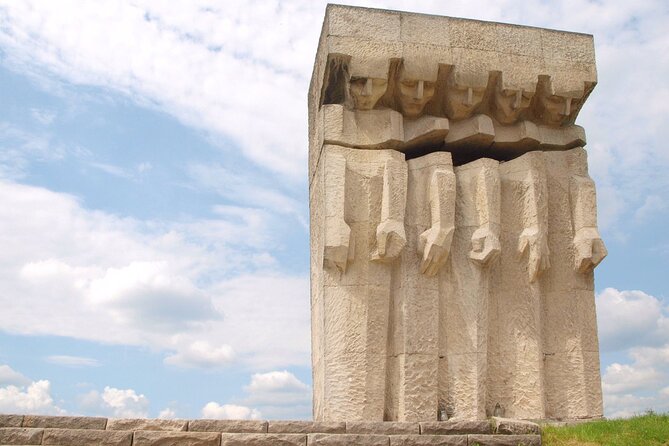
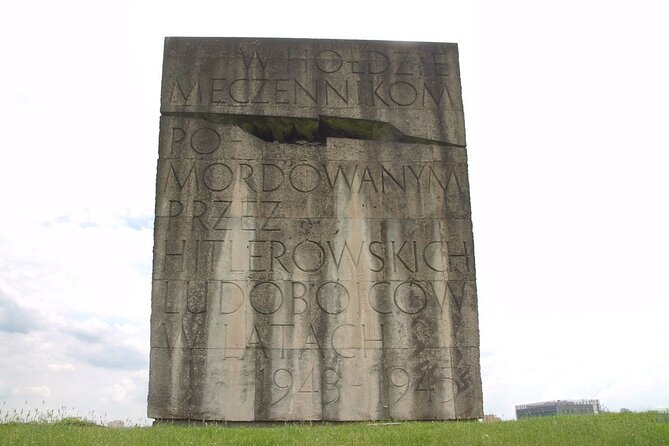
Your guided visit begins in the camp area, roughly an hour of focused time. The space today is described as a wild, uneven area of land that does not immediately scream its wartime role. That contrast is exactly why a guide is so important. Without context, you can easily miss what you are looking at.
You are also in an urban location that surprises people. The former camp site is on the main communication artery (Wielicka Street), opposite a large shopping center (Bonarka), and not far from another tourist landmark, Krakus Mound. In other words, you are near everyday city destinations, which makes the history feel even closer.
The tour gives you information you need to understand the area, and the guides are praised for being both prepared and gentle. In one review, a guide even supported the group with practical transit help like tram tickets. That’s a small thing, but it adds up on a day when your head is already full.
Practical note: the tour is described as start-to-finish about two hours, and Stop 1 is about an hour with admission ticket free. That is a good use of time if you want the Krakow-only Holocaust story without losing half a day. Just remember that this is outside walking on uneven land, so plan for comfort first.
The Ghetto Wall Fragment, With a Plaque in Hebrew and Polish
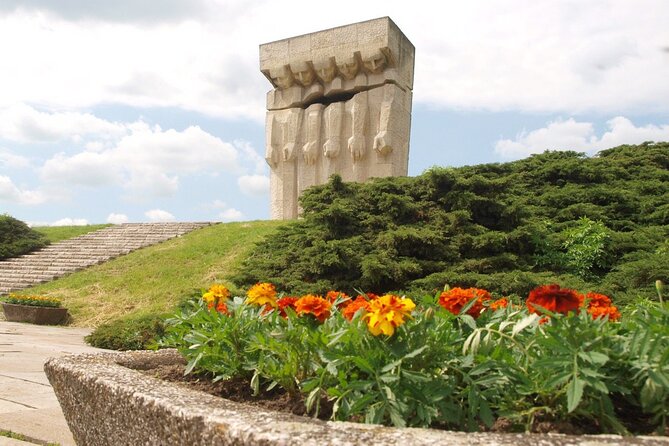
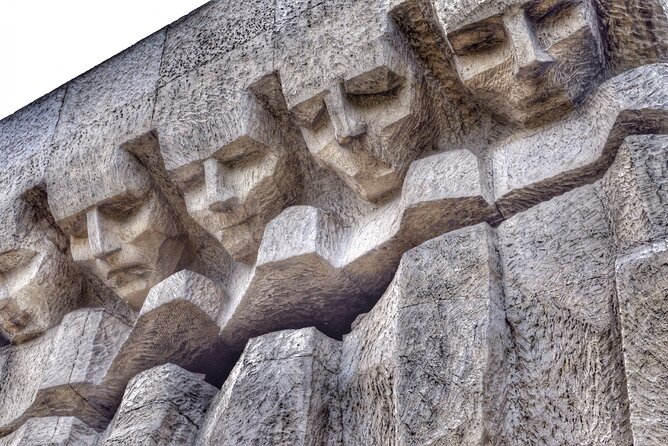
After your camp visit, you pass one of Krakow’s most prominent ghetto landmarks: the fragment of the ghetto wall. This is a 12-metre stretch of original ghetto wall, which means you are not looking at a reproduction or a vague marker. It’s a physical remnant.
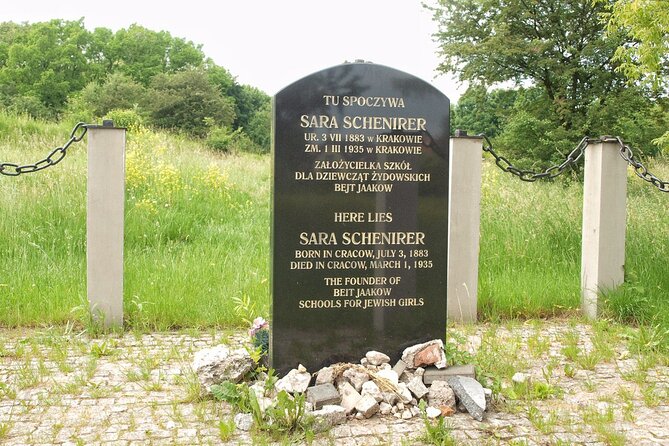
In 1983, a commemorative plaque was raised with text in Hebrew and Polish. The message, in plain terms, explains that people lived, suffered, and died from the German torturers, and that from this place they began their final journey to the death camps.
This part of the tour is valuable because it ties the camp story back to Krakow’s ghetto reality. When you see the wall fragment after learning about the concentration camp grounds, you start to understand the system as connected steps, not separate topics.
It also helps you end with something you can picture later. A wall fragment is hard to forget. Even the measurement, 12 metres, gives your brain a concrete anchor.
Beneath the newer pins on the Krakow board:

What the Guides Do Well, and How to Get More From the Walk
The reviews point to a clear pattern: the guides are attentive, prepared, and able to explain events from beginning to end. One praised guide was named Olga, and the feedback mentions both her knowledge and her kindness, plus her help with tram tickets. Another review describes a young guide who explained the field in detail from start to finish.
You can lean into this by coming with a couple of questions. For example, ask how each place fits into Krakow’s Holocaust story. Or ask what you should notice in the camp area given that it does not look “obviously historic” today. Guides like this can turn a confusing space into a coherent one.
Also, expect the tone to be respectful. This is not a showy photo-op tour. You are walking through sites tied to suffering and loss, and the memorial elements reinforce that.
If you want to make your experience even smoother, plan to take your time at the key moments: the chairs at Ghetto Heroes Square, the camp orientation, and the wall fragment plaque.
Price and Value: $30.01 for a Focused, Krakow-Local Story
At $30.01 per person for about two hours, this is priced like a straightforward guided experience, not a premium day trip. The value improves because admission for the camp stop is listed as free for the 1 hour segment. So you are not paying extra entry fees on top.
You are also buying something harder to quantify: context. The tour is offered in English, uses a mobile ticket, and keeps the group size to a maximum of 25. Smaller groups are often easier to manage, and in at least one review the experience was described as especially good when the group was only three people, which suggests the guide could really tailor attention.
Compared with longer, busier alternatives, this is a smart option if you want Holocaust history that stays inside Krakow. You get a full story arc in a short block of time, which helps if your schedule is tight.
Is it “enough” if you are comparing it to massive sites? That depends on what you want. This tour gives a Krakow in-your-backyard perspective, not the scale of a larger international destination. If you want scale, you might still consider other trips. If you want local context, this one is a strong pick.
Timing, Group Size, and How You’ll Move Through the Day
The tour runs about two hours. That’s long enough to start with a memorial orientation, spend meaningful time at the camp grounds, and still pass the ghetto wall fragment at the end.
Group size matters here. With a maximum of 25, you should feel like you are part of a guided walk, not lost in a crowd. It also gives the guide room to explain without rushing everyone through.
The tour is offered in English and you’ll get confirmation at booking. It uses a mobile ticket, so you are not hunting for paper tickets at your start point.
Getting There: Start at Plac Bohaterów Getta, End Near Kamienskiego
The tour starts at Apteka pod Orłem, Plac Bohaterów Getta 18, Kraków. It ends at Henryka Kamieńskiego 57, Kraków, with a note that the end is tied to a bus stop at 57, Kamienskiego street.
It’s also described as near public transportation. That’s a big deal for a two hour experience, because you don’t want your day to wobble around transit logistics.
If you like having a clean plan, treat the end point as a “reload” moment, like a place to grab a tram or bus back into central Krakow. In one review, transit help like tram ticket guidance was specifically mentioned, which suggests the guides are comfortable supporting practical questions if you ask.
Who Should Book This Kraków-Płaszów Tour
This tour is a good fit if:
- you want Holocaust sites that are directly tied to Krakow, not only a transfer point
- you prefer guided context to help interpret spaces that feel ambiguous today
- you like a short, structured walking experience around meaningful memorials
- you care about respectful storytelling, not just “what to see”
It might not be your best choice if you want something light and casual. The topic is tragic by definition, and the setting includes uneven outdoor ground. Go anyway if you can handle serious history, but don’t treat it like a quick photo loop.
Should You Book This Tour?
I think it’s worth booking if you want Krakow’s own Holocaust geography explained clearly and respectfully. The strongest reasons are practical and emotional at the same time: you get a guided walkthrough that connects the camp site with the Ghetto Heroes Square memorial and the 12-metre ghetto wall fragment. You also pay a straightforward rate for an about-two-hour experience, with admission free for the camp stop.
Book it if your priority is understanding what happened in Krakow itself. Skip it only if you strongly prefer very large, long format sites, or if you know you need a gentler day than a concentration camp and memorial walk.
If you do book, come ready to walk, and give the guide your attention at the moments that feel confusing. That’s when the guidance matters most.
FAQ
How long is the guided tour?
The tour is about 2 hours.
What is the price per person?
The price is $30.01 per person.
Is the tour offered in English?
Yes, it is offered in English.
Where does the tour start and end?
It starts at Apteka pod Orłem, Plac Bohaterów Getta 18, 33-332 Kraków, Poland. It ends at Henryka Kamieńskiego 57, 30-644 Kraków, Poland.
What will I visit during the tour?
You’ll walk by Ghetto Heroes Square, visit the Płaszów concentration camp grounds with a guide, and pass by the fragment of the ghetto wall afterward.
Is there an admission ticket for the camp stop?
For the camp stop (about 1 hour), admission ticket is listed as free.
How big are the groups?
The tour has a maximum of 25 travelers.
Will I get a ticket on my phone?
Yes, it uses a mobile ticket.
What is the cancellation policy?
You can cancel for a full refund up to 24 hours before the experience’s start time.
Freshly posted from Krakow
- ZALIPIE – painted village, unique small group tour from Krakow★ 5.0 · 7 reviews
- “John Paul II Route” PRIVATE -Wadowice, Kalwaria Z.-Łagiewniki★ 5.0 · 7 reviews
- Krakow: Craft Beer Tasting City Walking Tour★ 4.4 · 7 reviews
- Magic of Krakow: Guided Tour of the Old Town★ 5.0 · 7 reviews
- Krakow : Zakopane Tour + Thermal Pools with Hotel Pickup★ 4.8 · 7 reviews
- Krakow in One Day: City Tour by Electric Car★ 5.0 · 7 reviews
- Cracow: Wawel Castle and Cathedral Guided Tour★ 5.0 · 7 reviews
Guided, compared.
Auschwitz-Birkenau Guided Tour & Hotel Pickup
Read our review →Auschwitz-Birkenau Guided Tour & Hotel Pickup
Read our review →
Auschwitz Guided Tour with Optional Hotel Pickup
Read our review →
Auschwitz-Birkenau Guided Tour with Pickup & Lunch
Read our review →
Krakow to Auschwitz Birkenau Guided Tour with Transfer and Ticket
Read our review →
Wieliczka Salt Mine Fast-Track Ticket & Guided Tour
Read our review →