
Reviewed · CANOES & KAYAKS
Guided Sightseeing Kayak Tour at Gdansk
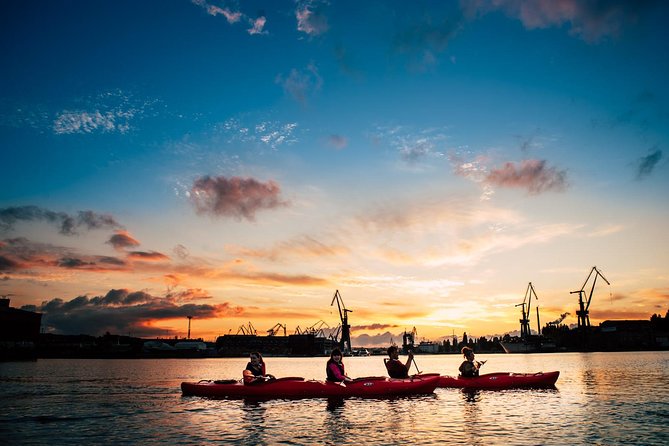
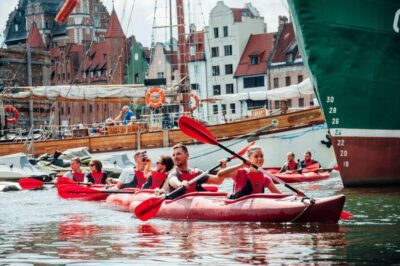
Kayaking makes Gdańsk feel brand-new. From the water, this guided paddle shows you real waterfront life, with The Crane as the big visual anchor and the Motława canals doing the rest. You get a guide who handles the route, so your only job is staying steady and enjoying the views.
I love two things most. First, the history is tied to what you can actually see, like medieval cargo work at The Crane and nearby industrial relics. Second, it’s built for comfort, with small-group energy and double kayaks available, so couples can paddle together without the awkward logistics of sharing gear.
One consideration: you need to be able to swim, and the tour runs in all weather. So dress for the conditions and take the safety briefing seriously, because you start on time and late arrivals are not admitted.
In This Review
- Key highlights at a glance
- Gdańsk from the water: why a kayak tour hits differently
- Price and value: what you’re really paying for at $48.85
- Kayak prep: safety briefing, start time, and how hard it feels
- Stop by stop: what you see at The Crane and why it matters
- SS Sołdek and the shipyard world: industry up close
- Motława River around Granary Island and Olowianka Island
- Main City views: canals give you access streets can’t
- Guides and group size: why it feels personal
- What to know before you go: swimmers only, English basics, couples welcome
- Should you book this Gdańsk kayak tour?
- FAQ
- How long is the guided kayak sightseeing tour in Gdańsk?
- Is the tour offered in English?
- Do I need to know how to kayak before I go?
- Is there a weight limit?
- Do I need to be able to swim?
- Are double kayaks available for couples?
- Can I cancel for a full refund?
Key highlights at a glance
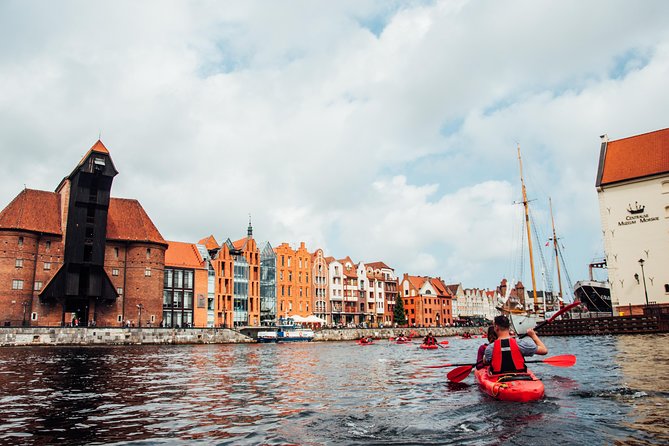
- Paddle past The Crane, a medieval hoisting machine that shaped Gdańsk’s trading power
- Working-shipyard views at Remontowa, including ferries and repair activity from close range
- Motława River route around Granary Island and Olowianka Island, with canal access ferries can’t reach
- No navigation stress, because your guide plans the route and keeps you moving safely
- Couples welcome with double kayaks, plus instruction that helps first-timers get comfortable
Gdańsk from the water: why a kayak tour hits differently
Gdańsk is a water city. Not in a poetic way, but in a practical one. The rivers, the canals, and the Baltic connections shaped where people built, traded, and worked. On land, you can take photos and admire the skyline. On a kayak, you feel the city’s shape through the water routes themselves.
This is exactly why the kayaking format works so well here. You slide along the Motława waterways and into canals where big boats do not go. That changes your mental map fast. Instead of seeing Old Town as a list of monuments, you start seeing it as a waterfront network that once mattered for movement and cargo.
And the tour is guided, which matters more than you might think. Gdańsk’s waterways can look simple from a distance, but up close there are turns, bridges, and busy areas where attention is required. When someone else manages that, you can focus on technique, sights, and staying comfortable.
Still tacked up around Gdansk
- Gdansk: Sunset Kayak Tour
★ 4.9 · 199 reviews - Gdansk: Guided Kayak Tour
★ 4.9 · 105 reviews - Gdansk: Winter Kayaking Tour
★ 5.0 · 66 reviews
Price and value: what you’re really paying for at $48.85
$48.85 is not just for sitting in a boat and hearing a few facts. You’re paying for three things that add real value in Gdańsk:
Time on the water. The tour runs about 2 hours 30 minutes. That’s long enough to feel like a genuine activity, not a quick sightseeing detour.
Guided navigation and pacing. You don’t have to figure anything out. You also get a structured experience, including a safety briefing before you go in.
Quality of sights. The route targets meaningful stops: a medieval crane, an industrial freighter, a working shipyard, and canal viewpoints that most visitors never reach. You’re getting history tied to the actual setting, not just landmarks seen from a sidewalk.
If you’re trying to choose between a standard walking tour and a water tour, this is where the value comes in. The price is similar to many guided experiences, but kayaking gives you a different viewpoint and a bit of activity baked in.
Kayak prep: safety briefing, start time, and how hard it feels
Plan to arrive a few minutes early. There’s a mandatory safety briefing at the start, and late arrivals will not be admitted. That’s a good sign, by the way. It means they take operating on water seriously.
Most travelers can participate, and the experience is designed so you’re not dropped into chaos. You get clear instruction before you paddle, and the guides help with kayak handling so you can get your confidence level up quickly. In past groups, people have noted that it was not too strenuous, including visitors in their late 50s.
Still, treat it as real paddling. You’ll want to pace yourself. One practical tip: save some energy for the way back, because the return leg can feel longer once you’ve already spent time sightseeing.
What to wear matters. The tour operates in all weather, so you should dress appropriately for wind, rain, or cool temperatures. If it’s sunny, bring sunscreen and sunglasses. If you’re prone to sunburn, pack protection like it’s a full outdoor afternoon, because you will be exposed.
Also, follow the rules: no alcohol before or during the tour, and no smoking or vaping while using the equipment.
Stop by stop: what you see at The Crane and why it matters
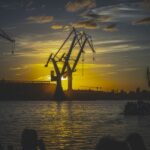
Your first big landmark moment is The Crane. It’s one of Gdańsk’s defining symbols, and it represents what’s left from the city’s great trading age.
From the water, you’re not just looking at a building. You’re seeing the physical context of how cargo moved. The crane was built in the mid-15th century as part of a major double-towered gate on the shoreline. It wasn’t decorative. It helped install and remove ships’ masts, and it loaded and unloaded heavy cargo right at the quay.
Here’s the kind of detail that makes this stop worth doing by kayak: this human-powered machine could hoist loads up to 2000 kg, and it was the largest crane in medieval Europe. When you paddle near it, the story becomes concrete. You can almost imagine the weight, the work, and the rhythm of a port day.
One practical drawback to note: you’ll want your eyes working in two directions, up for the structure and around for your paddle line. If you’re the type who likes to stare at one object for photos, you may need to remind yourself to focus on basic technique first.
Beneath the newer pins on the Gdansk board:

SS Sołdek and the shipyard world: industry up close
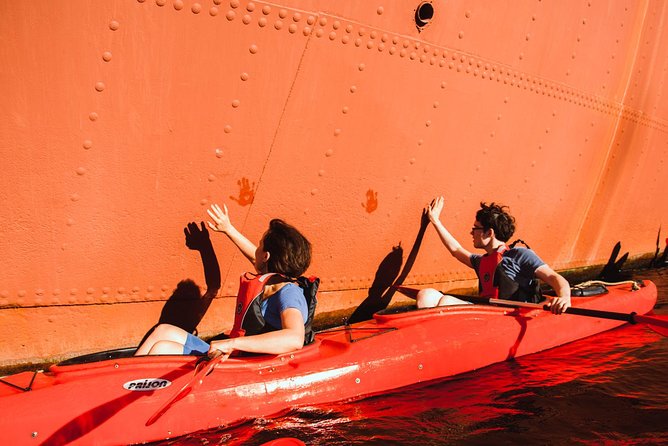
Next up, you encounter SS Sołdek, a Polish coal and ore freighter. Even though you might not think about it at first, this kind of industrial vessel helps you understand what the waterways carried every day. It’s a reminder that “history” here is not only architecture, it’s also the work that kept the city running.
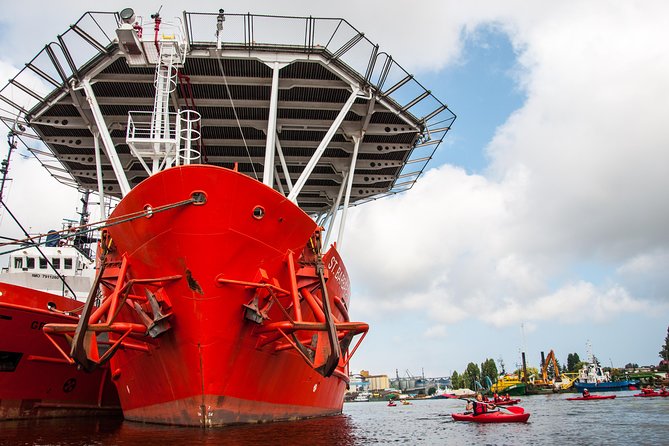
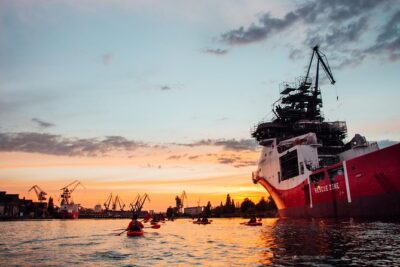
Then the tour shifts into one of the most exciting parts for many visitors: the Gdańsk Remontowa Shipyard. This is still a working yard. That means you see ships at different stages of repair or construction, and you can spot people working on ferries.
From a kayak, the perspective changes in a subtle but powerful way. You’re not photographing from far away like a visitor behind a fence. You’re on the same water channel that supports the yard’s operations. The sounds, the scale, and the real-life activity give you a sense of how maritime industry connects directly to the city.
Possible consideration: because it’s an active worksite, the area can feel busy and industrial. That’s not a downside if you like real-world scenes, but it won’t feel like a quiet, postcard-only stretch of water.
Motława River around Granary Island and Olowianka Island
After the industrial highlights, you settle into what many people came for: paddling through the Motława River and canal areas around Granary Island and Olowianka Island.
These islands matter because they sit in the middle of the water routes that define how Gdańsk developed. The city sits at crossroads of sea and river traffic, with connections that link the Vistula river at the Baltic estuary and additional river systems feeding into the Motława. That mix shaped daily life.
On the water, you see why water is not a background here. It’s the main stage. The tour uses these sections to show Gdańsk through its relationship to water, which is the kind of explanation that sticks because you’re moving through it at the same time.
What’s enjoyable about this section: the route gives you an “in motion” feeling. You get time to look, not just stop and start like a checklist. And in past tours, people have described the water conditions as flat, which helps reduce stress for first-time paddlers.
What to watch for: islands and canal turns can demand quick attention. Keep your focus on what your guide is doing and where the kayak is headed, especially when the water narrows or when you’re near structures.
Main City views: canals give you access streets can’t
One of the biggest promises of this tour is also one of the most practical benefits: you get a different perspective on the historical value of the Main City.
Paddling through canals gives you freedom that ferries do not have. Big sightseeing boats follow routes and clearances. Kayaks go where the water and narrow passages allow. That is what creates the feeling of discovering a side of Gdańsk that land-based sightseeing doesn’t show.
It’s also where you start to understand Gdańsk as a system. Streets tell one story. Canals tell another, older and more functional one. You’ll see places that feel tucked in and close, and you’ll likely notice how bridges, waterfront edges, and turning spaces control the city’s movement.
A small trade-off: canal viewpoints can be more partial than wide-open skyline views. If you’re craving huge panoramic photos at every stop, this may not be your fastest path. But you’ll gain something better: a sense of scale and purpose that’s hard to get any other way.
Guides and group size: why it feels personal
This experience caps at 20 travelers, and you feel it. A smaller group means you get more direct attention during instruction and during paddling. When conditions change, you’re not lost in a crowd.
The guides also bring the city alive. Names you might encounter include Nick, Szymon, Eric, and Eryk. Across these guides, the consistent theme is friendly, clear teaching and a focus on keeping everyone safe while also answering questions. Some guides even adjust pace based on the group’s paddling ability, which is a big deal for first-timers who want to avoid falling behind.
If you’re visiting with someone who worries about keeping up physically, this tour tends to feel manageable. People have noted that instructions are detailed and that guides help with kayak control until you’re comfortable.
What to know before you go: swimmers only, English basics, couples welcome
Here’s the practical checklist so you can decide with confidence.
- You need to be able to swim. This is non-negotiable.
- Basic English is required. Your guide offers the tour in English, but everyone needs to understand basic phrases and explanations.
- Weight limit is 110 kg. Plan within that range so you fit the equipment safely.
- Couples: double kayaks are available, which is great for paddling side by side.
- Minors: any minor must be accompanied by an adult in the kayak.
- No alcohol, no smoking, no vaping before or during the tour, and no alcohol even before you arrive on the water.
If you fit these points, you’re set up for an experience that feels active without being punishing.
Should you book this Gdańsk kayak tour?
I’d book it if you want Gdańsk from the best angle possible: the waterfront. You’ll get meaningful stops like The Crane, SS Sołdek, and the working Remontowa Shipyard, then you’ll spend real time on the Motława canals where the city’s layout makes sense.
Skip it or think twice if you don’t meet the swimming requirement, you hate outdoor activity, or you’re very sensitive about being on the water in changing weather. Also, if your idea of sightseeing is mostly low effort and minimal movement, kayaking will ask more of you than a bench-and-museum plan.
If you want a few hours that mix history, working maritime scenes, and a different viewpoint from normal Gdańsk tours, this one is a strong call.
FAQ
How long is the guided kayak sightseeing tour in Gdańsk?
The tour lasts about 2 hours 30 minutes.
Is the tour offered in English?
Yes. The tour is offered in English, and everyone needs to understand basic English.
Do I need to know how to kayak before I go?
Most travelers can participate. You’ll start with a safety briefing before you paddle, and the guide provides instructions.
Is there a weight limit?
Yes. The weight limit is 110 kg.
Do I need to be able to swim?
Yes. You need to be able to swim to join the tour.
Are double kayaks available for couples?
Yes. Double kayaks are available, and it’s a good fit for couples.
Can I cancel for a full refund?
Free cancellation is available up to 24 hours in advance for a full refund. If you cancel less than 24 hours before the start time, the amount paid is not refunded.
Freshly posted from Gdansk
- Private Walking Tour of Old Gdańsk with an architect-guide★ 5.0 · 7 reviews
- GDANSK City Tour by Golf Cart Live Guide & Sightseeing 90min★ 4.7 · 7 reviews
- Stutthof Concentration Camp private tour★ 5.0 · 7 reviews
- Private Roundtrip Transfer to Stutthof Concentration Camp 4h★ 5.0 · 7 reviews
- Gdansk: Polish Craft Beer Tasting Session★ 4.5 · 7 reviews
- Gdansk, Sopot & Gdynia – Private 3 City Tour★ 5.0 · 7 reviews
- Gdansk: PRIVATE Alcotour City Tour Sightseeing Golf Cart★ 5.0 · 7 reviews
Canoes & Kayaks, compared.
Guided Winter Kayak Tour in Gdańsk & Hot Chocolate Treat
Read our review →
Packrafting kayaking guided tour Vistula river Warsaw Poland
Read our review →
Browse the lists this tour appears in